• TalkBass has been independent since 1998. Add your voice.
    Create a free account to reply to discussions, view embedded media, and browse with fewer display ads.
    Join freeLog in
    Want zero display ads or expanded classifieds tools? Compare plans.

Learning to read...

Hi all,
I've finally made the decision to take the plunge into learning to read standard notation :nailbiting: I've been a tab guy up to this point.
I've only just got the very basics now, ie: notes in spaces, notes on the lines, the location of middle C
What I'm looking for is a place that I can find songs (ideally songs I might know) written out in bass clef so that I can practice reading on the go.
Your suggestions are appreciated.
Thanks in advance!
Cheers!
 
  • Like
Reactions: Mushroo
Lots of good song transcriptions here, to get you started: Bass Transcriptions

Another great resource is your friendly neighborhood public library! Their music section might have some famous classical pieces, like Beethoven's 5th Symphony. These are great for practicing reading: Listen along to the CD while you follow along on the sheet music.

Number one best advice I can give you about learning to read and write, from my own personal experience: Make sure at least half your reading/writing practice is without your bass in your hands. Being able to read directly from the sheet music to my brain (without using my bass as a middleman) is when reading/writing really started to "click" for me. In my opinion, this is the HUGE advantage standard music notation has over TAB: We can use it to communicate with any instrumentalist, or singers who don't play any instrument at all. Unlike TAB, which is measured in terms of strings and frets, and is specific to the bass, standard notation is measured in pitch and rhythm, and is universal to all music.

Again, the shortcut for me to build this skill was to follow along visually in the sheet music, while my ears listened to the recording, no bass in my hands. You can do this with classical music, your favorite pop songs, bass transcriptions, movie/TV theme songs, or whatever. The exercise works best with songs you know very well, like the Beatles' greatest hits, for example. It's the same way my parents taught me to read English: we would look at a famous book, like Dr. Seuss, and they would say the words out loud, while I followed along with my eyes. Eventually, the patterns just "clicked" and I was able to sound the words out loud myself, and then eventually read to myself silently in my head.
 
Big band bass charts have lines that are very good for learning to read.
More challenging parts when you get comfortable and want to extend your sight reading ability are available via trombone method books and scores. Why trombone? they write their parts in the bass clef, lowest note is an E first ledger line below the stave same as bass.
Their low E is actually the same as the low E of a guitar, Bass is a transposing instrument but just ignore that and play as written.
 
As soon as you can (and that means now, not when you think you're ready) get with real musicians reading real music for a real reason. Church groups (although a lot of them use chord charts) community groups, big bands. Whatever you can find.
And what you'll find is; there is major shortage of bass players that read. You get this skill together, you'll work as much as you want.
 
Consider writing on your sheet music and learning how to note which finger one each hand you are using.

I found it beneficial to ditch tab altogether. As you learn the fingerboard it starts to make more sense to say, "the A note on the B string" than "the tenth fret." Reading music and practicing scales really changed my ability to know what notes were on the fingerboard.
 
I am still a work in progress on this very front my damn self.

but when I get the itch to start back again and again here is my formula.


Get a metronome! my pedals have them and a tuner built into them:D

and real quick FWIW, the Library is a HUGE resource in my area. lots of stuff for free!
I would start with the nursery rhyme type of songs. Happy Birthday, Twinkle Twinkle type stuff..you should 'know' them so it will be easier to digest from the jump..

First I bought some bass books.

Complete Jazz Bass Book (Mel Bay) https://www.amazon.com/Complete-Jaz...eywords=Jazz+bass+book&qid=1582649914&sr=8-30
and
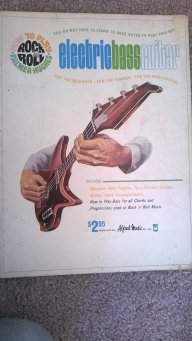
Electric Bass Method https://www.amazon.com/Electric-Bas...9778&sprefix=bass+guitar+boo,aps,169&sr=8-126 (this is the first book I ever bought way back in like 1994:bag:)

and more recently Ed (Bad Mutha) Fuqua's Walking bassics https://www.amazon.com/Walking-Bass...d+Fuqua+walking+bassics&qid=1582650060&sr=8-1

and I also have an app called 'Music Tutor' (apple store, has a big G clef icon) that is free. you can set Alto, G or F clef (or both/all). you can set accidentals, and a range of notes from A1 to A4 for bass anyhow (if you get the app this bit it will be more explanatory) you can set a timer for 1,5,10 min or infinite.. great app! in a nut shell its like flash cards for music notes. it also will chime the tone for the note which is helpful after a while because you start to get aurally trained too. I use the Music tutor app in line at the store/fast food joint, on a commute (passenger type).

Now for the work.

I suggest EVERY DAY 15-30 mins hit the shed (BEST CASE SCENARIO). If you cant do every day then try for 5, or at least 3 days a week.. IME it is better than just 1 or 2 days. the Mel Bay books take a positional approach which I like.

*NOTE*
Once your 'cup is full', take a break so your brain can process what it is trying to 'digest' and empty out for another refill later on. you know that saying about Rome right???

Work away from your bass when and as often as you can, and with it once you get more familiar with the dots. The books and the app are good for this. as is knowing your bass's notes! (cant stress this enough, know your bass fretboard)

take it slow. *what is the rush?*

oh and finally (at least for this post) buy/download a manuscript book with blank staff lines on it. you can copy some things and eventually create your own ideas. I suggest starting with the Major scale in every key, then the Minors (think circle of fifths/fourths) these two scales are pretty much bread and butter for western music.

Eventually you get enough base to start transcribing lines if you are serious about pursuing reading regularly.. its a step in the process.

I am sure this is far to much for one post, but you get the gist hopefully.

The main things are 1) to start. and 2) to do it daily until you have a good foundation. and 3) repeat to keep you axe sharp.

again work with a metronome/drum machine and start slow.

Good Luck soldier!:bassist:
 
As an Amazon Associate, TalkBass may receive commissions from qualifying purchases made via links on this site.
  • Like
Reactions: herbygardener
The most useful advice I got about sight reading.

1) Always feel the pulse
2 ) Always see the pulse in a measure. Be able to sort out poorly written notation, by practicing the exceptions.
3 ) Read a measure ahead.
4) Read everything you can get your hands on. Sax stuff is the bomb.

Edit 5) Know all the rhythmic rudiments
 
Last edited:
The most useful advice I got about sight reading.

1) Always feel the pulse
2 ) Always see the pulse in a measure. Be able to sort out poorly written notation, by practicing the exceptions.
3 ) Read a measure ahead.
4) Read everything you can get your hands on. Sax stuff is the bomb.

Edit 5) Know all the rhythmic rudiments

If I might add a #6, since you mentioned sight-reading, which is to also use music you don't know. Sight-reading unknown music, at tempo (however slow), even one or two measures at a time, forces you to actually read, rather than play what you you know - or think you know - whilst 'following along', which is what can happen if you are familiar with, or can already play, the music.
 
If I might add a #6, since you mentioned sight-reading, which is to also use music you don't know. Sight-reading unknown music, at tempo (however slow), even one or two measures at a time, forces you to actually read, rather than play what you you know - or think you know - whilst 'following along', which is what can happen if you are familiar with, or can already play, the music.
Just took the bass chair for a big band with weekly rehearsals. Maybe 12" of sheetmusic from Glenn Miller to Sammy Nestico and you cant take the music home, so getting your sight reading in shape is key.
 
  • Like
Reactions: SteveCS
In Big Band, the biggest challenges are:
1) The measures with just one or two syncopated hits,
2) syncopated lines duplicated by the piano left hand.
3. Reading the scribbled corrections for repeats, dal segno, coda, etc
 
  • Like
Reactions: David Jayne
It took me a little bit to smooth out as I have been playing treble clef exclusively for the last 8 months.

Interesting. Presumably with bass you play an octave down from what is written, as if on a grand stave? When I write stuff out for myself in that register I use tenor clef at pitch. So on a 24-fret 4 string it runs up to first ledger line above. The first space below the tenor stave takes over from bass clef 8vb at the first ledger above the stave (middle C, 8vb), so covers the range of bass guitar perfectly.