• TalkBass has been independent since 1998. Add your voice.
    Create a free account to reply to discussions, view embedded media, and browse with fewer display ads.
    Join freeLog in
    Want zero display ads or expanded classifieds tools? Compare plans.

Leave her Stock?...no fun zone

Depends on the bass, Rickenbackers, for instance, leave the factory with ZERO shielding, what’s up with that? I’d call even basic shielding mandatory for any single coil bass, instant huge hum improvement, unless you actually like 60 cycle hum! By contrast my G&L L2000 was nearly perfect when I bought it in 1983, still is. The only mod I did was to add a pickguard , which I kinda regret now.
 
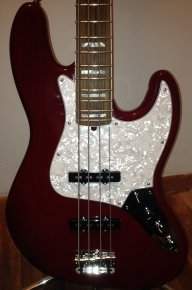
Hey guys, I just ordered this bass (photos)
It arrives next week, what pickups should I buy for it?
In my case that can be a valid question. i tend to stick to used MIM J basses so i know the stock pickups are not my cuppa and will be on the lookout for something else, so asking for current info can be helpful in that situation. I’ve got a couple sets ready to be tried, a set of overwound single coils with alnico 5 magnets and a no name set of humbucker blades
 
In my old age I have grown increasingly picky about my basses. There are no affordable production basses that meet my requirements. Rather than buying the one that is the closest and modifying it into what I want, I chosen the 100% mod approach.

Buy Warmoth parts, pick the (tuners / pickups / electronics / bridge / hardware / woods) I want and assemble something for about $1000 that I can't buy pre-made.

The closest to meeting my list of must-haves would be a USA G&L with empress body but that misses the mark on cost.
 
  • Like
Reactions: screefer
It depends on the axe. When I had the Alembics, really, there was sure nothing I needed to change, it was all there, and there's lots of basses that hit a lot of us that they're fine 'as delivered'.


On the other hand, since the Fender aftermarket is SO deep, I bought a Squier James Johnston Jazz and a VM P-Bass Five strictly as hop-up projects (though I must admit they are more than useable as-is). The JJJ will grow EMG's and maybe replacement keys, and the VMP5 is headed for a P/J conversion with Seymour QP's and the Squier-pattern Omega bridge. I've always wanted to do some hot-rodding and Squiers or maybe used Fenders bought right are just like doing something with a small-block Chevy: EVERYBODY makes parts for them. On the other hand, if I had top-line MIA Fenders or Sadowslys, I really doubt I'd do anything to them.
 
As a Telecaster tinkerer and recent convert to bass, I've been reading all I can about basses.I just read this article on Premier Guitar...On Bass: Leaving Well Enough Alone | Premier Guitar... and reluctantly have to agree with him although I LOVE to tinker. All instruments can't be expected to be stock keepers but when you find one it's maybe best to "step away" from the soldering iron....regardless of what the headstock reads.
What say y'all?

I used to screwdriver and soldering iron parts for a living 20 years ago.
It's about as hard as replacing leaking cam timing feed lines from a modern engine when you've done it 1000x.
Hard parts are as interesting as tire rotations and alignment jobs after a while.

__________
Common build patterns
--------------

1) Customers that want their bass to sound like totally unlike XXXXXX bass.
That rarely works bc I found that a player is more a part of the equation than the gear.
In cases of cloning a build that did work, the targeted tone was so utterly overboard that nuance doesn't tend to come through.
I'll cite Warwick, MM, Spector (real ones with a Haz + EMGs), Epiphone hollowbody, Rick, and Wal as particular sounds that are difficult for a lot of players to make not sound like that instrument but pointless to clone something else to sound like one.

At that point just go buy XXXXX bass, it's easier to get an "SVT sound" out of "not an SVT" than it is to make your MIM Jazz 5 sound like a Modulus.

2) Like to like mods.
It's a piece of cake job to throw in boutique or "real" pickups to do a like for like mod.
OLP rays, Fender anything, Warwick crapstar to German, korean Spector to Haz'd out EMG NS whatever.
I used to live on jobs like these bc they are totally satisfactory, fast to turn around, and the customer already has this sound in their head they are 100% sold on.

3) Ground up mutants.
These are time consuming and cause the most issues.
Wood recipe cloning into a different scale, body/neck, or trying to multiply one build into a Wal-Stingray-P.
These are fun, but that customer generally has needs that are only addressed after the build has walked out the door.
It comes back, over and over again.
There is rarely remediation, it's a one shot or tantrum per usual interaction.
There's never a resolution, what they're trying to get isn't attainable bc it's not a gear issue.

4) Race car jobs.
These are ever evolving mods like #3, but the customer is totally different in that every build close has some satisfactory outcome.
Unlike #3 a negative or meh result is a "learning experience" welcomed by the customer.
They could be a player working, a hobbyist bouncing around genres, someone just there for the ride to see what the instrument can do.
There's rarely a resolution unless they stop playing.

--------------

So there you have it, my instant gut PTSD experiences wrenching on gear in my 20's.
I tend to collect parts from #3 and #4 types of customer.

I've worked on enough gear than subconsciously when I leave a bass on the wall I know I hit either it's current limit of exploration based on available parts.....or it's taken apart in a gig bag bc it's just a test bench.

These are cattle to me, not pets.
I won't put my tools down unless people stop making parts with new ideas.

What fun is there in that?
 
I've been playing for 40 years and have only modified two basses. The first was a 2011 MIA Jazz Deluxe. It came stock with N3 Noiseless pickups and active circuit with a switch to go from active to passive. I noticed that when I switched to passive, the volume level dropped significantly. Even with the volume pots turned all the way up, it still had less output than my passive basses. I installed Lindy Fralin pickups over wound 8% to get more mids and more lows and set it up passive. I also changed the stock black pickguard to pearl white.

The second was a MIA Precision. I replaced the stock pickup with a Nordstrand NP4V Vintage pickup.
 
Last edited:
As a Telecaster tinkerer and recent convert to bass, I've been reading all I can about basses.I just read this article on Premier Guitar...On Bass: Leaving Well Enough Alone | Premier Guitar... and reluctantly have to agree with him although I LOVE to tinker. All instruments can't be expected to be stock keepers but when you find one it's maybe best to "step away" from the soldering iron....regardless of what the headstock reads.
What say y'all?

I’ve only modified two instruments in my life. A MIM Jazz, replacing the pickups with JB 62s, a rousing success, and the pickups on my AM Deluxe Strat, SRVs, a major disappontment. Other than those, I pretty much buy what will work as is.
Not exactly being a dedicated follower of fashion, I would never alter the appearance intentionally.
 
I agree to a point. Replacing pickups is a thousand dollar exercise in utter futility. If the tone isn't there, it will never be there.
I don't agree with that at all. There was a time I did, but that all changed a few years back when a pickup change made this dogass Steinberger copy I had into a respectable sounding bass. Since then, I also made my 95 P Lyte and 09 AmStd P into wonderful sounding basses by changing out the crap pickups they had. So I changed my mind completely on that.
 
I have no problem modding things if I think they'd be significantly improved. This has almost always been the minority of my instruments - I modded my '62 Fender Jaguar to add a humbucker in the bridge; I have a telecaster that I cut open to add a humbucker at the neck and added a B-Bender; and most recently, I modded my old Warwick to swap the stock pickups to first Nordstrands, and then Delanos. This last one I regret a bit, only because when I listen to old recordings of the bass before I took the original pickups out, I actually prefer the tone to both the Nordys and the Delanos (although the Delanos are really spectacular pickups).

Cosmetic "mods" don't really count in my book. Adding a pickup cover or straplocks, or even new drop-in replacement tuners aren't mods, except in the most literal sense of the word, becuase they're 100% reversible. Just my $0.05.
 
...Replacing pickups is a thousand dollar exercise in utter futility. If the tone isn't there, it will never be there.

That being said, I always replace certain things: I replace the nut with bone or MOP - always. If it's a Fender style bass, I replace the bridge as well with a "high mass" unit. And on every single one of them I replace/rewire all the pots. I know if I do them they will not fail....

Correct me if I'm wrong, but your last statement is implying that you replace these parts as a precaution for physical or electrical failure, right?

YMMV, but I've had DiMarzio pickups save quite a few basses from the scrap heap. I'll be playing one tonight at rehearsal :thumbsup:
 
Definitely a tinkerer. I've always changed pups in my guitars, added treble bleeds, switches, etc.

Now on bass I'm the same. Putting Bart Mk1s in all my basses, made a fretless out of an SR300M, always trying new strings.
 
  • Like
Reactions: screefer