
Enjoy the benefits of a premium membership!
Upgrade Account
-
TalkBass has been independent since 1998. Add your voice.
Create a free account to reply to discussions, view embedded media, and browse with fewer display ads.
Join free Log in
Want zero display ads or expanded classifieds tools? Compare plans.
You are using an out of date browser. It may not display this or other websites correctly.
You should upgrade or use an alternative browser.
You should upgrade or use an alternative browser.
linear pots are the answer
- Thread starter heavyfunkmachin
- Start date
More options
Who Replied?

sorry, but i hate linear volumes on guitars! with any kind of gain on the amp, linear volumes jump from "0" to "3", and have little useful control from "6" to "10". if you work the distortion from the guitar like i do, you need audio volume controls.
again, i find linears useless for passive tone pots in any case, as nothing happens until the pot is almost all the way off.
100% sure. remember, the jump that audio pots themselves have is at the top, from like "8" to "10". linear tones in a passive guitar circuit do nothing until they're almost all the way off.Wait, are you sure you're talking about linears? Audio pots are the ones that have a big "jump" in signal/tone in a very small turn range, like what you describe in the second paragraph.
think about it; a linear 250k tone turned halfway down would still be at 125k resistance, which (trust me) is barely darker than the full 250k. hell, a 500k tone pot would have to be 3/4ths of the way off to even get to that 125k point, which again is an almost indiscernable difference in a tone circuit.
and to reiterate, it's all about the amp in determining which works better for volume. distorted/compressed guitar amps work better with audio volumes, clean bass rigs like linear volumes.
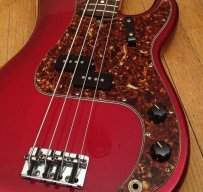
Ok... so why does my new, stock 2009 Fender Jazz have the pots that give me all of my volume and tone control in the "8 to 10" range? Why didn't Fender put the other pots in... regardless what they are called, so we can have an even increase in volume or tone from 1 to 10 ?  Hmmmmmm???
Hmmmmmm???Ok... so why does my new, stock 2009 Fender Jazz have the pots that give me all of my volume and tone control in the "8 to 10" range? Why didn't Fender put the other pots in... regardless what they are called, so we can have an even increase in volume or tone from 1 to 10 ?
Simple economics. You go with the lowest cost per unit widget and standardize it across all makes. Like Henry Ford said, "You can have any color you want as long as it is black." You want something non-standard, it'll cost you.

Rick Auricchio
Registered Bass Offender
Nah... they both cost exactly the same. Check the net.
You aren't including the cost of (possible) multiple suppliers, two separate product numbers, stocking them, incoming QA on two parts, and the factory QC to ensure you haven't built an instrument with the wrong pots. And if you run out of one type of pot but have the other, production stops.
The whole reason for audio-taper pots in volume controls is because of the human ear's response to loudness. As the overall loudness goes up, you need more change to perceive a change in volume.
As to whether they're the best choice for bass guitars, that's open to discussion. Guitarists who want to overdrive the amplifier probably want audio-taper pots to get a larger voltage change, especially if they're always working with the instrument controls above the halfway point.
I understand about the distortion issue, but we are focusing on basses here right? So... if Fender wanted to have just one pot in stock to save money... why aren't they just stocking the "other" pot? You know... the one that has a nice even volume sweep with no "bumps" or "jumps" or "8 to 10" issues?? 
Nah... they both cost exactly the same. Check the net.
If you think Fender is buying parts off the 'net and paying what we do, I got a bridge you may be interested in.

Interesting. I've tried both and went back to audio taper. I actually like the bump at near max, because I run the volumes usually at around 60%-70% of max, to get a smoother tone(remember that to a large degree the volumes act as tone controls on a Jazz). If I want to go full bore aggressive, it's a small movement to get there instantly, and a small movement to get back. Plus you have smoother volume reduction near zero than you will with linear's, useful for fades. Whatever works for you.
Now that makes more sense. I think you are on the right track. I think it's intentional for function and playability and not economics or just a shortcut for Fender production.
If you think Fender is buying parts off the 'net and paying what we do, I got a bridge you may be interested in.
I don't think that Fender buys them from the net...

I think Fender buys them by the truckload from CTS.. but the point was... they cost Fender the same amount for either type.
Wow... you own a bridge??


Interesting points here, especially about trying to get a less claustrophobic blend zone for the pickups on a J bass. (I wouldn't mind having a little more than the typical 3/32".  )
)
OTOH I just wired up a single coil with audio taper for the tone control. The pickup manufacturer was advising linear - apparently audio taper is "incorrect". But my local source didn't have that handy so I just went for it and it turned out fine.
Whatever you're plugging in to definitely makes a big difference! I was using a Roland keyboard amp at a rehearsal space and my volume & tone controls felt way out of whack. But with my G/K bass amp (higher input impedance more suitable for a passive BG) the controls feel perfectly normal.
)OTOH I just wired up a single coil with audio taper for the tone control. The pickup manufacturer was advising linear - apparently audio taper is "incorrect". But my local source didn't have that handy so I just went for it and it turned out fine.
Whatever you're plugging in to definitely makes a big difference! I was using a Roland keyboard amp at a rehearsal space and my volume & tone controls felt way out of whack. But with my G/K bass amp (higher input impedance more suitable for a passive BG) the controls feel perfectly normal.
Rick Auricchio
Registered Bass Offender
...we are focusing on basses here right? So... if Fender wanted to have just one pot in stock to save money... why aren't they just stocking the "other" pot?
They also make guitars, so if they can use the same pots...
They also make guitars, so if they can use the same pots...
So you really believe that Fender won't stock two kinds of pots to make a superior instrument because of the "cost" of ordering and storing one additional part so they shove in a guitar pot ??
I surrender...

- Aug 21, 2008
- 10,386
- 252
- 68
- Disclosures
- Owner, SGD Music Products
So you really believe that Fender won't stock two kinds of pots to make a superior instrument because of the "cost" of ordering and storing one additional part so they shove in a guitar pot ??
I surrender...
Some of it is marketing, and some is about not messing with tradition. Some of the large guitar companies keep using archaic parts because that's what people expect to see, and ask for. It's the whole vintage is better thing. Using the same parts wont make the instrument as good as one from 40 years ago, and using modern parts will improve upon the bass from 40 years ago in many ways, and not in others.
When you buy a Fender, or a Ric, or a Gibson, that's what you get... what they have always done. If you want something different, you go with a more "modern" builder.
When audio tapers aren't done completely wrong, they'll seem a lot more natural in a lot of applications. Unfortunately, it's cheaper to modify linear pots slightly to give something that sounds vaguely like an audio taper (if you happen to be deaf and surrounded by construction workers), rather than make a proper linear taper - because of the way we hear 'loudness', the audio taper makes sense as a volume control, but these ersatz 'audio' pots are really just 'kinked' linear pots that have one rate of change in the lower end and a steeper rate of change in the higher end.
Jeff
Jeff


