You know you can get the Alphabass preamp right?
I guy I know around here has one available, I think, if they're rare...
Hi there!
Yes, I know there is a separate Alpha preamp. I have one...it can get a SIMILAR tone, but there is a design flaw in the Alphabass head that works particularly well for distortion. The Alpha preamp doesn't have this flaw.
The flaw is that the "post" volume control on the Alphabass head isn't at the end of the signal chain. On the Alpha preamp, it IS. Now you're wondering...what the hell difference does it make?
Typical of alot of Peavey tube heads (guitar and bass), there tends to be a little bit of preamp gain "leaked signal" sizzle or fuzziness at any post volume settings under around 2 on the post control. Now, usually this is a BAD thing (for instance, 5150 heads and Classic 100 heads only sound good for guitar once at a substantial volume and the post volume is above 2 as the preamp sizzle/fuzz is tuned out). However, the way I run my preamp distortion of the Alphabass head, and with my overall volume controlled by the channel 2 of the Alesis compressor's output, the post control on the Alphabass head actually works as a "tunable high end fuzziness" to fine tailor the distortion. The higher the settings of the post control, the woolier it gets. Anything under 1.5 and it gets kind of thin and raspy. The trick is to find that sweet spot (and it is VERY touchy)...it combines just the right end of high end cutting sizzle with the thick fat low mids. The Alpha preamp doesn't have this ability because it doesn't have the design flaw...the post volume control is an actual post volume control at the end of the signal chain.
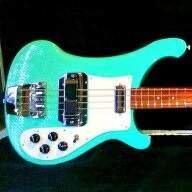
Actually, I stumbled across how great the Alphabass head works for smooth bass distortion by accident. I was using a loud clanky distorted Rick tone through an ADA MB-1 and purchased the Alphabass to use mainly as a power amp with the ADA. It didn't really work as planned. There is another design flaw of the Alphabass regarding the graphic eq section so that when you overboost mids something in the circuit starts to clip as you turn up the post control...way before the output tubes start to clip, and before you get any real volume out of the amp. There was no way to boost the mids like I like AND use the post control as an output volume knob due the graphic EQ section being overloaded and clipped. I even sent it back to Peavey...they said there was nothing wrong, and to just "not boost the mids as much." So, I figured, "Let's put one channel of my dual channel eq in the preamp out/power amp in loop just to use as a volume control." So, I did that, and I found that I could really tweak the post distortion eq to where all the sizzle and shrillness was gone, and could still control the volume using the outboard eq's gain control without the Alphabass' graphic EQ being clipped. This is also where I noticed the "tunable" nature of the post control. After experimenting for a few hours, I noticed that even with the Alphabass' pre-gain control all the way up, I wasn't getting the distortion I wanted...so I thought, "Hey, my eq is dual channel, let me use the other channel of my outboard eq to run the bass into this eq FIRST before the distortion and 'tune' the frequencies that I want to distort BEFORE it actually gets distorted." I also could use this channel of the outboard eq as a gain boost to overdrive the Alphabass preamp tubes. MAN did it work. I could get this super controlled easily thick and SMOOTH usable distortion through the preamp tubes, tailor this with the post gain control for just the right amount of sizzle, send it to the Alphabass' graphic eq without overloading it, then go out of the preamp output into the other side of the outboard dual channel eq (described above for volume control) and tune out all the harsh buzz and "rip your head off" noise of the distortion, while using (as stated above) this one channel of the outboard eq's output to control the overall volume going into the power tube section of the Alphabass. Later I added the compression before the first pre-distortion outboard eq just to smooth it out even more, and added an ADA Ampulator after the post distortion outboard eq channel as a direct signal/cabinet simulator for recording but to also again smooth out the distortion even more, then through a Rocktron hush, then to the other channel of the Alesis compressor to just put the finishing smoothness on the overall tone. In using the compressor as the final signal before boing back into the power section of the Alphabass, the compressor's output volume ended up being the overall "volume" control. Since I added the Ampulator, Hush, and compression after the 2nd channel of the outboard eq described above, I could now set the output control of that channel of the eq to drive the input of the Ampulator how I wanted it and leave it set (same goes for the signal going into the Hush and compressor). So, now I have an easy REAL output volume control that doesn't change the tone no matter how low or high you set it.
But again...initially, the way I stumbled across the Alphabass as a great sounding distortion preamp tone for bass was by accident trying to overcome 2 design flaws of the amp itself.
That was in 1992. I've been using the same essential tone ever since.




 hopefully adding some Aguilar soon...