Specs for the TX300 say 300W at 4 ohms and 200W at 8 ohms.
The specs I found for the Mag 210T are:
Power Handling: 250W
Impedance: 8 ohms.
Sensitivity: 98dB 1W/1m
I don't know if these specs are correct for your era of cab.
Calculated SPL at 250W: [Log(250) x 10] + 98 = ~122dB
122dB should be able to keep up with drummer who is not bashing the set. However I would not find it surprising if an aggro guitarist with a 75W combo amp can bury you. IMHO, the solution is for the guitarist to turn down, or for you to find better musicians to play with (YMMV).
For context, I feel I can make a rig rated for 118dB work, but I may have to modify the way I play to limit dynamic range. Also, I probably won't be able to hear as well as I want, so the experience will not be enjoyable.
I usually find a rig rated for at least 124dB to be loud enough for most situations, but I don't generally play in super loud settings.
My last touring rig was rated for 127dB. There were gigs where it was not loud enough, but I am only willing to turn up so much. I don't remember ever pushing this rig to clipping, but sometimes I decided to smile and nod when I could not hear as well as I wanted.
Why a 75W guitar amp can bury a 250W bass amp.
First you need to understand that volume comes from a combination of usable power and the sensitivity rating of your speaker. Guitar speakers are often a bit more efficient than bass speakers. The 98dB 1W/1m sensitivity rating of the Mag 210T is decent, but I would call it medium. I used to run an Eden D210XLT with about 250W. The D210XLT has a sensitivity rating of 103dB 1W/1m, and with 250W the calculated SPL is almost 127dB.
For the record the sensitivity rating of a single Celestion Vintage 30 is 100dB 1W/1m. With 75W the calculated SPL is ~119dB. So technically your rig should actually play louder at ~122dB. However, the frequency response of our ears is not flat, so it won't sound louder.
So our second problem is bass must actually be louder than guitar for equal perceived loudness.
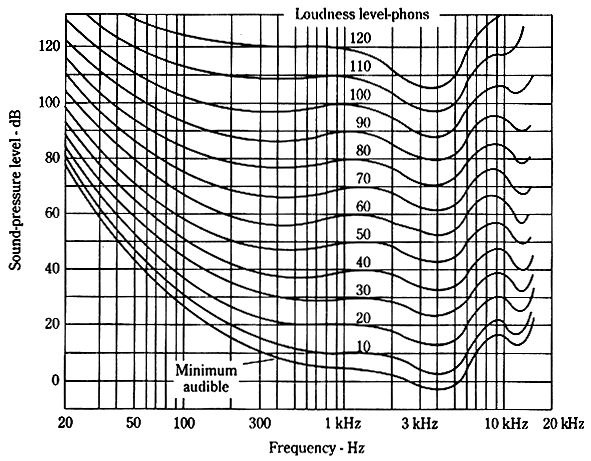
The Fletcher Munson curves explain:
A decibel is a measure of actual loudness. The vertical axis of this chart is calibrated to decibels.
A phon is a measure of perceived loudness. The squiggly lines show the decibel level required to produce a certain perceived phon level by frequency. These are labeled to the right of the vertical line that designates 1kHz.
Let's look at the 100 phon line. For 100 phon you need 100dB at 1kHz, but at 50Hz you need about 110dB. At 4kHz you get 100 phon with only 88dB.
So essentially 50hz must be 10dB louder than 1khz for equal perceived loudness:
- 100 phon = 110dB at 50hz and 100 phon at 1kHz.
Also 50hz must be 22dB louder than 4khz for equal perceived loudness:
- 100 phon = 110dB at 50hz and 88dB at 4khz.





 .
.
