• TalkBass has been independent since 1998. Add your voice.
    Create a free account to reply to discussions, view embedded media, and browse with fewer display ads.
    Join freeLog in
    Want zero display ads or expanded classifieds tools? Compare plans.

Double Bass Low G Extensions on a Five String Bass - Because why not??

People make C extensions for a four string bass. Why not just throw one of those on a bass with a low B string to make it a low D? That's the type of subsonic range that I am surprised nobody has tried yet (at least to my knowledge).

Discuss...

EDIT: I meant low G.
 
Last edited:
That won't give you a low D.
It might give you a low G, maybe a low F#, because the pegbox is longer for a 5-string. Not that useful, I think.
But for a high C 5-string you can also get down to the low C or probably even low B with an extension.
Dennis says he really likes having the A. I've tuned the B to A on a Pöllmann on occasion, and found the A and Bb to be really nice. The problem with trying for G or F# would naturally be where to get the string, but on the right bass I bet those notes would also be quite thrilling.
 
The low A would vibrate at 27.5 times per second, barely above the 25 frames per second of movie projectors that give continuous movement, not flickering. You should see individual vibrations for a low D and probably could not tell whether you were sharp, flat or indifferent IMO. The only piece I can recall with a low B is Respighi's Pines of Rome, majestic sounding but slow to speak.
 
The low A would vibrate at 27.5 times per second, barely above the 25 frames per second of movie projectors that give continuous movement, not flickering. You should see individual vibrations for a low D and probably could not tell whether you were sharp, flat or indifferent IMO. The only piece I can recall with a low B is Respighi's Pines of Rome, majestic sounding but slow to speak.

Do you mean low A? I would just say that it maybe depends on the bass, but I think the lowest notes need to be just as in tune as any other notes. We did a Shostakovitch piece a few years back which had a bass soli section mostly on the fifth string. It was actually quite difficult to get it in tune, and man did it sound horrible when it wasn't!
 
Last edited:
Good luck finding a B string that will hold tension going that low...
Lot's of people play with their E tuned down a step, so why would tuning the B down be any different? I once tuned the Pöllmann AEADG (Flexocores) for a modern work which had a Bb. It worked well enough that I left it that way for the whole program, and even found a place in a Schumann symphony where I thought a Bb would sound pretty cool. The other guys in the section kind of rolled their eyes when they heard it, but no one asked me to stop:D
 
I have a 5-string portable bass and I have had those moments I wish I could go to a low A... so I do understand.. ha..


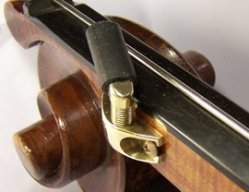
image.jpg
 
Please don't all rush out and convert your basses. Instead buy your dear old mother a good box of chocolates or give a cow to some needy community via Oxfam. The end results would give far more lasting pleasure IMO.

Going back to the original post a low G would vibrate at about 25 times a second? OK, we are low note specialists but that would be ridiculous, wouldn't it?
 
Last edited:
The contrabassoon goes down to subcontra-Bb.

The organ can even go lower to about 16 Hz which is a subcontra-C. But these notes are usually used in a mix of registers, not on their own.
Don't forget that each note has higher harmonics often with a higher amplitude than the fundamental, but seriously this mostly makes sense on an instrument with a really large body that can transmit the low frequency stuff well.

You better might get an Octobass and a second player if you want to go that low. :D
 
Last edited:
  • Like
Reactions: Zane DeBord

Latest posts