Hi again. Now that the ÜG6 Oblivion thread is finished I want to stick to my commitment of being more active on TB and what better way that committing to another thread?
With the ÜG Oblivion I discovered that, for a bass that has already been built, it seems more interesting to reverse engineer the process and start with a picture of the finished bass. Then take it from the beginning and see how we got to that. I liked this perhaps unorthodox approach and hope you'll like it to.
So here's the finished bass:

The first thing those of you know know me will notice is that, this bass sports traditional tuners. All my threads have so far have on my Headless Hybrid system. But I do build classic basses too. Just to keep what I do fresh and up to date
The main reason for traditional tuners in this case was the need for a drop-D machine head.
The bass was built in 2016 for Neil Bertrand, a Dallas area bassist, member of When Angels Die and Flamenco guitarist David Gallegos group. He has provided clinic support for Lynch Mob/Dokken guitarist George Lynch and played live for Grammy award winner Steven Archer. He sure can play and you should check him out @
neilbertrandbass.com and Link Removed
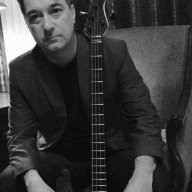
Here's Neil with his MüB.

Specs are:
34" scale, 24 frets, Gotoh hardware and Res-o-lite tuners at headstock. Chambered African mahogany body, camphor burl top with matching headstock plate and block inlays. Ebony H/S back plate. Maple/Padauk neck with two carbon fiber reinforcement spars; ebony board with camphor burl block inlays. Bartolini p-ups and 3 band pre amp. Gloss finish. Target weight 7.7lbs or 3.5kg.
On to the build now.
The theme chosen by Neil is best described by the Greek word Meraki.
meraki [may-rah-kee] (adjective) This is a word that modern Greeks often use to describe doing something with soul, creativity, or love — when you put “something of yourself” into what you're doing, whatever it may be.
Well, lets look for something with soul, shall we?

I had this African mahogany billet for sometime, waiting for the right build. As you can see the crack starts with a void and then gets narrower and narrower until it fades out. We'll get back to it later on.
Neil calls himself a 'Mahogany guy' and I must say I am partial to mahogany as well. We are now building a Ü-G fretless together and, well, we did start off with an ash body. Guess how it ended.
The first thing I did was obviously to have fun with my Constellation Chambers. In the true spirit of custom, no two CC are the same.
Next to the body is the first top we selected: a very old Lychee set which I acquired (4 of them) a few years back.
Lychee is a fairly hard wood and, with a great tap tone, it should make a good acoustic. These sets are very old and a bit of a pain to work with because they were not properly stored and required a lot of care and time to be brought back to a usable condition. But they're beautiful and unique. So it's worth it.

As you know the Lychee was eventually put aside in favor of a pretty stunning camphor burl. There's a little story behind this change of plan. But it's quite late at night and I have run out of beer.
Thanks for reading this far.
Maurizio
With the ÜG Oblivion I discovered that, for a bass that has already been built, it seems more interesting to reverse engineer the process and start with a picture of the finished bass. Then take it from the beginning and see how we got to that. I liked this perhaps unorthodox approach and hope you'll like it to.
So here's the finished bass:
The first thing those of you know know me will notice is that, this bass sports traditional tuners. All my threads have so far have on my Headless Hybrid system. But I do build classic basses too. Just to keep what I do fresh and up to date
The main reason for traditional tuners in this case was the need for a drop-D machine head.
The bass was built in 2016 for Neil Bertrand, a Dallas area bassist, member of When Angels Die and Flamenco guitarist David Gallegos group. He has provided clinic support for Lynch Mob/Dokken guitarist George Lynch and played live for Grammy award winner Steven Archer. He sure can play and you should check him out @
neilbertrandbass.com and Link Removed
Here's Neil with his MüB.
Specs are:
34" scale, 24 frets, Gotoh hardware and Res-o-lite tuners at headstock. Chambered African mahogany body, camphor burl top with matching headstock plate and block inlays. Ebony H/S back plate. Maple/Padauk neck with two carbon fiber reinforcement spars; ebony board with camphor burl block inlays. Bartolini p-ups and 3 band pre amp. Gloss finish. Target weight 7.7lbs or 3.5kg.
On to the build now.
The theme chosen by Neil is best described by the Greek word Meraki.
meraki [may-rah-kee] (adjective) This is a word that modern Greeks often use to describe doing something with soul, creativity, or love — when you put “something of yourself” into what you're doing, whatever it may be.
Well, lets look for something with soul, shall we?
I had this African mahogany billet for sometime, waiting for the right build. As you can see the crack starts with a void and then gets narrower and narrower until it fades out. We'll get back to it later on.
Neil calls himself a 'Mahogany guy' and I must say I am partial to mahogany as well. We are now building a Ü-G fretless together and, well, we did start off with an ash body. Guess how it ended.
The first thing I did was obviously to have fun with my Constellation Chambers. In the true spirit of custom, no two CC are the same.
Next to the body is the first top we selected: a very old Lychee set which I acquired (4 of them) a few years back.
Lychee is a fairly hard wood and, with a great tap tone, it should make a good acoustic. These sets are very old and a bit of a pain to work with because they were not properly stored and required a lot of care and time to be brought back to a usable condition. But they're beautiful and unique. So it's worth it.
As you know the Lychee was eventually put aside in favor of a pretty stunning camphor burl. There's a little story behind this change of plan. But it's quite late at night and I have run out of beer.
Thanks for reading this far.
Maurizio
Last edited: