• TalkBass has been independent since 1998. Add your voice.
    Create a free account to reply to discussions, view embedded media, and browse with fewer display ads.
    Join freeLog in
    Want zero display ads or expanded classifieds tools? Compare plans.

Magnets & Copper Wire: A Pickup Building Thread


Those names and people describing instrument tone always make me think of the ads many years ago in Bass Player with Jeff Berlin and someone else, I can’t remember who at the moment, making humorous descriptions of bass tone. The one that I recall was something along the lines of “It sounds like a glass tank firing crystal bowling balls at a waterfall.” :laugh: :smug:
 
I'm about ready to take over the pickup-making world with this new line...

black_lumps v1.png
 
Velvet Hammer. In cursive. That's priceless. Seriously. Never let go of that pickup!

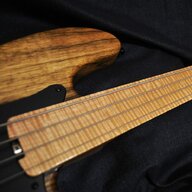
Looks like a pretty special piece of wood in that body too. The grain pattern is just perfect and it looks authentic.
 
  • Like
Reactions: wraub
They need to be more lumpy. They're too perfect looking.

Maybe get a 2nd grader to do the writing on top, instead of a computer?

Actually, just get the 2nd grader to do the whole shell. You could make it an art project. "Okay kids today we're going to use clay to made something useful - molds for bass pickups, instead of lopsided pencil holders or mugs your parents will put on a shelf and forget about!"
 
The pickup was made in the Seventies and is rare and rather pricey, but I got very lucky on CL. :D Made by a guy who ran an amp repair shop in Los Angeles, he made guitar pickups that are much better known and also pricey- users included Clarence White and Joan Jett. He was also a former oil worker and boxer, as well as a well-regarded pedal steel player who played with Mike Nesmith for years, and even won an Oscar for soundtrack work. A real character, and something of a design whiz, he also designed the electronics for the Peavey T-60 guitar. Red Rhodes was his name.

On topic, they are taller than normal P Bass pickups, and low resistance. Clarity almost like an active pickup, but gets right down to old-skool thump when needed. The sound is complex, with a seemingly compressed quality great for recording.
I have no intention of parting with them. ;)


The bass is from '83 I think, and the body is reportedly Sen.
The whole bass has wear and battle scars all over, weighs 8lbs 9ozs, and is magic. :)


Velvet Hammer? :laugh:

love it! :thumbsup:

Velvet Hammer. In cursive. That's priceless. Seriously. Never let go of that pickup!

Looks like a pretty special piece of wood in that body too. The grain pattern is just perfect and it looks authentic.
 
The pickup was made in the Seventies and is rare and rather pricey, but I got very lucky on CL. :D Made by a guy who ran an amp repair shop in Los Angeles, he made guitar pickups that are much better known and also pricey- users included Clarence White and Joan Jett. He was also a former oil worker and boxer, as well as a well-regarded pedal steel player who played with Mike Nesmith for years, and even won an Oscar for soundtrack work. A real character, and something of a design whiz, he also designed the electronics for the Peavey T-60 guitar. Red Rhodes was his name.

On topic, they are taller than normal P Bass pickups, and low resistance. Clarity almost like an active pickup, but gets right down to old-skool thump when needed. The sound is complex, with a seemingly compressed quality great for recording.
I have no intention of parting with them. ;)


The bass is from '83 I think, and the body is reportedly Sen.
The whole bass has wear and battle scars all over, weighs 8lbs 9ozs, and is magic. :)

Any idea of what the 4 filled holes on the arm bevel were for?

Velvet Hammers pop up on Reverb occasionally, There's a bucker on there presently.
 
Last edited:
  • Like
Reactions: wraub
On topic, they are taller than normal P Bass pickups, and low resistance. Clarity almost like an active pickup, but gets right down to old-skool thump when needed. The sound is complex, with a seemingly compressed quality great for recording.
I have no intention of parting with them.

In the spirit of this being a pickup making thread, do you have any idea what's inside them? Do the covers pop off or are they potted in place? I'm curious to know if the magnets are marked at all and if they're normal pole style p bass bobbins or blades. What's the resistance?
 
  • Like
Reactions: wraub
rb-com-2fimage-2fupload-2fs-7huo7n20-2ff_auto-2ct_large-2fv1579458873-2fdyo7czr8hwwge0iimhxy-jpg.jpg


rb-com-2fimage-2fupload-2fs-emgffvk2-2ff_auto-2ct_large-2fv1579458871-2furymlqfeijtiiye3yclz-jpg.jpg


The company literature states the following, fwiw:
"...made with four 1/4 inch Alnico magnets instead of the normal eight smaller magnets, Red's specially designed isolating bobbins are wound in the same direction like a typical humbucking pickup, then wired in series and out of phase to improve hum rejection."

IIRC, resistance is 8.16K. Very balanced string to string, and note to note. Clarity and precision, and when recording it's the perfect base for mixing and processing. Honestly shocked at their sound quality. Underwound is my jam. :D

Worldwide, there may be 50-100 sets, total, possibly more but I'd say not many.


In the spirit of this being a pickup making thread, do you have any idea what's inside them? Do the covers pop off or are they potted in place? I'm curious to know if the magnets are marked at all and if they're normal pole style p bass bobbins or blades. What's the resistance?
 
Last edited:
  • Like
Reactions: Freekmagnet
Reportedly, oddly placed DIY thumb rests which were removed, filled, then sanded, which dished the wood in that spot. In playing, it's become more worn and a little dirty- I am okay with this. :)

Any idea of what the 4 filled holes on the arm bevel were for?

Velvet Hammers pop up on Reverb occasionally, There's a bucker on there presently.
 
I built a jig to cut slots in flatwork for the p-ish soapbar I'm working on, from that drawing I posted a few days ago. There's a bottom platform with thin walnut scraps positioned to hold a strip of flatwork:

IMG_20210201_194639.jpg


Then a top that sits over it with slots cut in it to allow a router bit and collar down through:

IMG_20210202_074115.jpg


Slap a collar and 1/8" bit on the router and have at it!

Well, except there's a problem. My 1/8" straight router bit - which I'd bought years ago but never actually used - appears to not actually be 1/8" in diameter. I cut the slots in a test piece and they were a very loose fit on the 1/8" steel bar I'm using. So I measured the router bit. It's 5/32" in diameter. The slots it cut are also exactly 5/32" so at least it's accurate...

IMG_20210202_073513.jpg


Right there on the package it claims it's 1/8"! Not so.

At any rate, after this test run, I'm feeling like I don't want to deal with router bushings to cut these slots, so once I get my hands on an actual 1/8" router bit I'm going to re-do the top plate in the jig so it has a fence to slide the edge of the router along, with stops for the ends of the slot, and just do it that way instead of using the bushings in the slots.

I didn't want the morning to be a total waste so I finish sanded the two sets of shells I'm going to use for this experiment.

IMG_20210202_080955.jpg


Maple sides and bubinga tops. I'll slice each pair in half later.
 
Sidewinder experts, I have a question:

I've wound a few in the past, and I know I made some notes on the wiring, but have since lost them. But, I figure if I can get a definitive consensus here, I can make a bookmark out of it for future reference. Soooo....

Wiring: IIRC, the way to do these is to wind both coils the same direction, and connect the end of "Coil 1" to the start of "Coil 2". Then, of, course, the same polarity for each coil's magnets are pointed inward toward the blade/pole pieces, etc. This "seems" wrong, since it seems opposite of RWRP, but I think this worked for me to buck the hum.

Am I remembering correctly?
 
Correction- resistance is 9.16K.

View attachment 4150020

View attachment 4150021

The company literature states the following, fwiw:
"...made with four 1/4 inch Alnico magnets instead of the normal eight smaller magnets, Red's specially designed isolating bobbins are wound in the same direction like a typical humbucking pickup, then wired in series and out of phase to improve hum rejection."

IIRC, resistance is 8.16K. Very balanced string to string, and note to note. Clarity and precision, and when recording it's the perfect base for mixing and processing. Honestly shocked at their sound quality. Underwound is my jam. :D

Worldwide, there may be 50-100 sets, total, possibly more but I'd say not many.
 
  • Like
Reactions: dwizum
Sidewinder experts, I have a question:

I've wound a few in the past, and I know I made some notes on the wiring, but have since lost them. But, I figure if I can get a definitive consensus here, I can make a bookmark out of it for future reference. Soooo....

Wiring: IIRC, the way to do these is to wind both coils the same direction, and connect the end of "Coil 1" to the start of "Coil 2". Then, of, course, the same polarity for each coil's magnets are pointed inward toward the blade/pole pieces, etc. This "seems" wrong, since it seems opposite of RWRP, but I think this worked for me to buck the hum.

Am I remembering correctly?

Dang, it’s been a while for me, too.

I think it’s RWRP. Wind the coils in the same direction and wire both ends together like on a normal pickup.

I’m not 100% on that. I haven’t built a sidewinder for a while.
 
Dang, it’s been a while for me, too.

I think it’s RWRP. Wind the coils in the same direction and wire both ends together like on a normal pickup.

I’m not 100% on that. I haven’t built a sidewinder for a while.

Thanks! Yeah, I can't remember either! lol

See, that's the thing, though... how can you really do RWRP on a sidewinder, given that the same polarity faces the strings?
 
Thanks! Yeah, I can't remember either! lol

See, that's the thing, though... how can you really do RWRP on a sidewinder, given that the same polarity faces the strings?

It’s not a question of magnetic polarity - it’s the direction of the electrical flow. If the electricity flows in the same direction, there’s no cancellation.

But, I might be wrong - I’m pretty sure that’s right, though.
 
Sidewinder experts, I have a question:

I've wound a few in the past, and I know I made some notes on the wiring, but have since lost them. But, I figure if I can get a definitive consensus here, I can make a bookmark out of it for future reference. Soooo....

Wiring: IIRC, the way to do these is to wind both coils the same direction, and connect the end of "Coil 1" to the start of "Coil 2". Then, of, course, the same polarity for each coil's magnets are pointed inward toward the blade/pole pieces, etc. This "seems" wrong, since it seems opposite of RWRP, but I think this worked for me to buck the hum.

Am I remembering correctly?

OK, full disclosure, I have never wound one of these so I can only speak theoretically, but here goes:

The humbucking part comes from the induced voltage in the two coils being in opposite phase from each other (that's the RW part). You can accomplish this either through winding the coil in the reverse direction, or by wiring the coil in the reverse direction. So if you wind both coils the same direction then the ends of the two coils go together (start-finish-finish-start) and the two starts make the positive and negative. If you put them in-phase (start-finish-start-finish) you will end up with no humbucking and, in the worst case if you also reverse the magnet polarity, then also an out of phase signal. It's basically the opposite of what you want a humbucker to do!

The first step is to reverse the windings, either by winding in the reverse direction, or by wiring both starts (or finishes) together.

Then, to make sure the signal isn't also cancelled with the hum, the polarity of the magnets needs to be reversed by putting the magnets as S-N-N-S or N-S-S-N. I you were to put the magnets N-S-N-S then you will get humbucking, but your signal will also be out of phase.

EDIT: I should point out, if you mount the coils in the opposite direction it has the same effect as winding in the opposite direction, so in that case it would be start-finish-start-finish.

EDIT2:
Thanks! Yeah, I can't remember either! lol

See, that's the thing, though... how can you really do RWRP on a sidewinder, given that the same polarity faces the strings?

It all comes down to the magnetic field around the coils, and those are reversed, so yes, you still get RP
 
Last edited:
  • Like
Reactions: Freekmagnet
Dang... I think I'm making this harder than it needs to be.


So, are we saying that you essentially wind the 2 coils like you would with any "standard" humbucker, meaning for instance:

Coil 1, North Up, wound CW
Coil 2, South Up, wound CCW

And then, for a sidewinder with coils in series, put the "top" (north side) of Coil1 and the "bottom" (north side) of Coil 2 facing inward, and then hook up the End of Coil 1 to the Start of Coil 2?
 
Last edited:

Latest posts