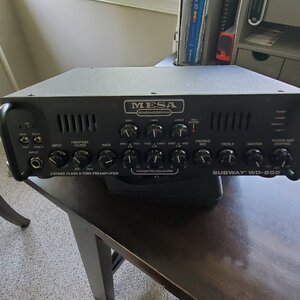
how do you folks who use it with a passive p bass have your initial input setup? just curious, I run mine right around 12 oclock

TalkBass has been independent since 1998. Add your voice.
Create a free account to reply to discussions, view embedded media, and browse with fewer display ads.
Join free Log in
Want zero display ads or expanded classifieds tools? Compare plans.
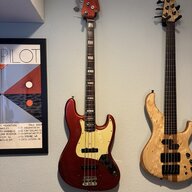
depends on the P and pickups, I have a few and they have various levels of hotness, also depends on the tone I'm going for - how I want to heat that tube. The input knobbing being super important for saturation.how do you folks who use it with a passive p bass have your initial input setup? just curious, I run mine right around 12 oclock
depends on the P and pickups, I have a few and they have various levels of hotness, also depends on the tone I'm going for - how I want to heat that tube. The input knobbing being super important for saturation.
for passive clean I usually have it around 11. I crank it up to 1ish if I want more tube warmth from a bass.


It's never a bad idea to get suggestions from others who have the same equipment. One thing to note about the WD, and Mesa Subway heads across the lineup, is that those controls are useful throughout their entire ranges of rotation. I'd suggest using the suggestions you get here as a starting point, but it's really fun and insightful to play around with all those knobs. I've learned a ton from the WD about the effects of boosting and cutting different frequencies to tailor the tone. I feel like I can get the broadest range of tones from the WD, compared with the TT and the Subway+ DI (which I run through the TT's effects return, kind of making the TT a 3-preamp head). My band is all R&R all the time, but I like to play a wider variety of music. I can get old school Jamerson thump, modern metal, mids-dominant grind, and anything in between from that amp. And it's the best room-taming amp in the lineup as far as I'm concerned, due to the HPF and Parametric EQ section.how do you folks who use it with a passive p bass have your initial input setup? just curious, I run mine right around 12 oclock



WOW is the only word that comes to mind on that master setting! Looks to me like you could potentially have a deaf band after a few rehearsals.


Fair points. I simply assumed that "...we have a loud band" meant dbase was likely using his SW115 (one of the cabs I believe he owns). As for DI out I know that it is pre-master in either source setting and the effects out is pre-master as well. If he was using DI or effects out none of the settings (except the non relevant master in that case) seem "high" at all to me.Amp settings are irrelevant unless you know the cabinet configuration you are using, notwithstanding going ampless and sending through the DI or fx send.
Generally the more gain on that amp, the more (slightly) overdriven it will sound.

I would expect to get some overdriven tones with the amp set for passive, gain above 1:00 (depending on the setup of your bass and how hard you play).How about old-school P-Bass w/pick punk? Not obnoxious grind, but a tone where you're like, yep, that's a P-Bass getting pushed.
IME with my basses on the passive setting at 2 or 3 o'clock you start to get a hint of breakup when you dig in a bit. I'm a clean player that appreciates a little character to the tone that is still "musical" sounding (i.e. adds some additional harmonics without sounding like the notes have totally ragged or rough edges). I think many people would describe the sound as reminiscent of classic tube warmth you get when playing right on the edge of break-up.I would expect to get some overdriven tones with the amp set for passive, gain above 1:00 (depending on the setup of your bass and how hard you play).

My experience with my WD-800 is to start with the sample settings in the owner’s manual. Given time and experience this is an extremely versatile amp, but it’s well worth the effort to twist som knobs. .how do you folks who use it with a passive p bass have your initial input setup? just curious, I run mine right around 12 oclock
I seem to recall setting it somewhat like that when I was trying to get loud and clean. How hot of a signal into the head has a huge effect on that too. Mine is packed for the next gig, although probably a backup to the SW+ DI on my board. Traveling light suits me fine!
That looks like it would give you good thump with some definition. I have to push the mids pretty hard in my mostly metal band. It sounds great with them. The versatility of the WD is well beyond anything I've ever owned. The TT has 2 different preamps and I'm still not sure which one is the more versatile of the two.My experience with my WD-800 is to start with the sample settings in the owner’s manual. Given time and experience this is an extremely versatile amp, but it’s well worth the effort to twist som knobs. .
This is a setting I use in my Motown review band. I play a passive MIA Fender JB V with fresh round wound strings. The VVT controls are all wide open. If this is a little bright roll off a bit of treble on the bsss. It took me a lot of knob twisting to come up with this. It’s a great live setting for ensemble work.I hope you find this useful.
I dont use the amp for rehersals.. we use in-ears in a studio.. but when playing out, I want to feel my pant legs flapping when I play. At this time my band is shutting me out of the mains (2 18" and 2 15"subs) because I'm too loud and wants me to turn down my amp volume to the point where I cant hear or feel myself playing. Next gig I will start using in-ears with no amp like the rest of the band. I'm not happy about that.. I love this amp, it has been a workhorse for me with no complaints. I dont want to see baby sitting in the closet.WOW is the only word that comes to mind on that master setting! Looks to me like you could potentially have a deaf band after a few rehearsals.
I did notice the input gain switch set to active and the input gain and HPF controls at around 10 o'clock so maybe it's probably not full on insane kind of loud.

I hear you. I truly love playing ambiently with musicians that know how play “in concert” (balanced volume) with each other. But when you get into larger ensembles, especially with multiple vocals and or horns, in most venues FOH provides a much better experience for the paying customers. A taking that a step further, creating a lot of stage wash which is easy to do with “pant flapping “ levels of low end, counter productive when trying to get a good mix in the house.I dont use the amp for rehersals.. we use in-ears in a studio.. but when playing out, I want to feel my pant legs flapping when I play. At this time my band is shutting me out of the mains (2 18" and 2 15"subs) because I'm too loud and wants me to turn down my amp volume to the point where I cant hear or feel myself playing. Next gig I will start using in-ears with no amp like the rest of the band. I'm not happy about that.. I love this amp, it has been a workhorse for me with no complaints. I dont want to see baby sitting in the closet.
I like how you thinkI hear you. I truly love playing ambiently with musicians that know how play “in concert” (balanced volume) with each other. But when you get into larger ensembles, especially with multiple vocals and or horns, in most venues FOH provides a much better experience for the paying customers. A taking that a step further, creating a lot of stage wash which is easy to do with “pant flapping “ levels of low end, counter productive when trying to get a good mix in the house.
But man do I miss the power trio days of plugging in and letting it rip! A PA for vocals only and maybe a bass drum mic, an SVT for the bass, a 50 watt Marshal with a 412 Marshall cab and a drum set (no stinking monitor either). That and 4 hour gig was an awesome experience!