• TalkBass has been independent since 1998. Add your voice.
    Create a free account to reply to discussions, view embedded media, and browse with fewer display ads.
    Join freeLog in
    Want zero display ads or expanded classifieds tools? Compare plans.

Microphone for recording acoustic bass guitar

Hi all,

I've been playing my Washburn semi-acoustic a lot lately and I really like the ambient sound of it. Much more so than the plugged in sound in fact. So I'm wondering what type of microphone you'd recommend for recording acoustic bass guitar to capture that ambient sound. I'm after a general idea of what type of mic, not a specific brand/model... but any suggestions would be appreciated.

Cheers for now.
 
Does the unplugged sound has enough low end? Acoustic basses tend to sound without low end...

anyway, for recording acoustic instruments ill recommend you condenser mics, specially large diafragm ones. (they need phontom power, so you´ll need an interface with that).
 
If you like the ambient sound in the particular room you are playing then get a pair of omni mics, you'll basically be mic'ing the room. Think of the room as an instrument by itself that you trigger with your bass. Find a spot in the room that you like with your ears and put the mics there. If by 'ambient' you just mean the acoustic sound of your bass then I'd go with a tight pattern hypercardioid dynamic like the Sennheiser 441, specifically to minimize room effects. Large diaphragm condensors can emphasize the clackiness of those things and will pick up more room sound. They wouldn't be my first choice but you can get good results with a variety of types of mics as long as you have a good room and good fingers.
 
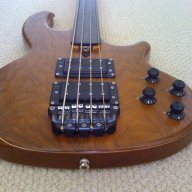
I ripped apart an old electric guitar and mounted the Pick-up inside my acoustic...put the volume controls in a Tupper ware container and it works excellent. I super glued it in crooked this time :hmm: doesn't really matter...you can hear it on my latest tune Over and Over on my myspace...I play through my bass amp also..

Picture020.gif
 
My friend was telling me how he and his band (commercially very successful) had access to £20,000 worth of microphones while they were recording the album, and as they did blind tests and things like that, they ended up using SM57's for the acoustic guitars and ABGs! They had one close up to the soundhole, and one further away, behind, pointing at the body.

Sounds great....try a 57!
 
My friend was telling me how he and his band (commercially very successful) had access to £20,000 worth of microphones while they were recording the album, and as they did blind tests and things like that, they ended up using SM57's for the acoustic guitars and ABGs! They had one close up to the soundhole, and one further away, behind, pointing at the body.

Sounds great....try a 57!
I'm sure they also had access to expensive preamps which most people don't have. The SM57 is an entirely different mic when plugged into a cruddy preamp vs. an amazing one. Just because you hear some studio uses SM57's on everything and it sounds great, don't assume you can reproduce those results without the rest of the signal chain they're using. I guarantee you it costs a hell of a lot more than an SM57.
 
Lawson MP 47, Pearlman, Peluso & Telefunken also with some nice LDC's

Mercenary Km69 comes to mind for SDC, also check out DPA & Lauten


PS: an SM57 is not a suitable mic to record acoustic bass.
 
IMO cic placement is more important than the mic's. I would use two mic's one in front a little below the sound hole pointing up to the sound hole. The second mic in back again close, but not so close the player can't move. It would be point to the exposed bottom area of the body. Like mic'ing the bottom of a piano to add the soundboard's tone. Being an acoustic I would probably use a condensers. I would also make this a two man job. Have someone go out and loosen the mic stand boom enough they can move it around. Show them the basic position you want, then have them move the mic around as you monitor it. You can find the sweet spot for that specific instrument. Then can repeat for the back mic.

Discovering where the sound is projecting from an instrument can get you a great sound, better than twisting knobs forever. Also can help to avoid phase cancelation. This technique is good for mic'ing drums too especially tom's. A lot of sound is coming up the side of the drum if you get the right angle you can as fat sound head and shell tone.
 
Thanks for the advice everyone. Its ounds like I've got a bit of "trial and error" to do. I'll see if I can borrow a few of those different mic types recommended and experiment wit different techniques for a bit.

A lot to learn!

Cheers!
 
... If by 'ambient' you just mean the acoustic sound of your bass then I'd go with a tight pattern hypercardioid dynamic like the Sennheiser 441, specifically to minimize room effects. Large diaphragm condensors can emphasize the clackiness of those things and will pick up more room sound. They wouldn't be my first choice...
good points . . . FWIW, I record a lot of guitarron, which is the bass instrument in mariachi music. It's similar to an acoustic bass guitar . . . I usually use a Sennheiser 421 pointed at the sound hole, fairly close in (20-30cm or 8-12 inches) for the "traditional" guitarron sound with a little bit of "attack" or "clarity" provided by a Countryman IsoMax hypercardiod mini condenser mounted INSIDE the body of the instrument (hanging from the mic's cord) . . . works for me!

IMO mic placement is more important than the (type of) mic's...Have someone go out and loosen the mic stand boom enough they can move it around. Show them the basic position you want, then have them move the mic around as you monitor it. You can find the sweet spot for that specific instrument...Also can help to avoid phase cancelation...
I often go out in the room MYSELF . . . I'll ask the musician to lend me his headphones, then I'll move the mic(s) around to get the "best" sound, and then when I return to the control room I usually check phase on multi-mic setups . . .


IMO mic placement is more important than the (type of) mic's...Discovering where the sound is projecting from an instrument can get you a great sound, better than twisting knobs forever...
I repeated that "mic placement" stuff because IT'S SO TRUE!

If the mic(s) are NOT in a "good" place, you'll NEVER get a good sound , no matter HOW MUCH you try "twisting knobs" . . .

And remember, it's usually better to record WITHOUT EQ . . . or, at least, to use "cut" instead of "boost" EQ . . .
but don't be afraid to use EQ when needed . . . I'll often have ALL of the bands max'd out (with "cuts" AND "boosts"), especially when recording drums and percussion (or other instuments that I really want to get the transients strong and punchy).
 
I'm sure they also had access to expensive preamps which most people don't have. The SM57 is an entirely different mic when plugged into a cruddy preamp vs. an amazing one. Just because you hear some studio uses SM57's on everything and it sounds great, don't assume you can reproduce those results without the rest of the signal chain they're using. I guarantee you it costs a hell of a lot more than an SM57.

Well, this is true, but the OP isn't asking about preamps, and to be fair, the buck always stops with the pre, so whether its a 57 or a u87 or anything, thats gonna be a problem, but the 57 is still gonna sound great and do the job, IMO.

(In my friend's case, the 57's went straight into a Mackie Onyx, as that's what they were using for tracking)
 
PS: an SM57 is not a suitable mic to record acoustic bass.

Why? Work very well micing my bass cab, work very well for acoustic guitar also, so what would be difference in micing an acoustic bass?

As a side note, I just ordered a CAD M179 and I'm thinking the adjustable polar pattern might be just the ticket for the kind of situation the OP mention, but i haven't tested yet. I'll try to remember to post back once the mic gets here.