
Enjoy the benefits of a premium membership!
Upgrade Account
-
TalkBass has been independent since 1998. Add your voice.
Create a free account to reply to discussions, view embedded media, and browse with fewer display ads.
Join free Log in
Want zero display ads or expanded classifieds tools? Compare plans.
You are using an out of date browser. It may not display this or other websites correctly.
You should upgrade or use an alternative browser.
You should upgrade or use an alternative browser.
Mixing bass for songs
- Thread starter Bassom
- Start date
More options
Who Replied?
In a pop or rock context with a 4-string I EQ and compress the bass substantially:
High pass everything below 30hz. Low pass everything above 5-10khz (depending on the bass and the technique used). Find the boomiest/most resonant frequencies in the low mids and notch filter them. Find find the frequencies in the upper mids that cut the most musically through the mix and boost judiciously with a wide Q. Compress at around 4:1 with a fast attack and moderate release (avoid pumping sounds). Add a low amount of distortion to taste. Limit to remove any transient peaks that are unnecessary.
The result sounds like garbage when solo'd but sounds great in the mix for pop and rock recordings. Even, warm, with just enough detail to sound interesting without getting in the way.
High pass everything below 30hz. Low pass everything above 5-10khz (depending on the bass and the technique used). Find the boomiest/most resonant frequencies in the low mids and notch filter them. Find find the frequencies in the upper mids that cut the most musically through the mix and boost judiciously with a wide Q. Compress at around 4:1 with a fast attack and moderate release (avoid pumping sounds). Add a low amount of distortion to taste. Limit to remove any transient peaks that are unnecessary.
The result sounds like garbage when solo'd but sounds great in the mix for pop and rock recordings. Even, warm, with just enough detail to sound interesting without getting in the way.

Tom_RCJ said:Are you recording in 24-bit/192kHz? If you have a golden sound, pushing it thru a crappy conversion will do bad things to it, no mater how good you are at mixing.
With all due respect, even the crappiest Behringer USB interface is capable of cleaner recording than the best tape deck from the seventies. If you can't get acceptable results from the gear you have, then the gear isn't the problem.
Sure, nice expensive gear makes getting good sound easier, but you can get good sound from cheap gear if you work at it.
Also, there's absolutely no reason to record at 192kHz. 88.2kHz is good enough for anything anyone on this forum is doing. The only reason to go higher is if you're recording dolphins or bats.

- Jan 4, 2010
- 233
- 13
- 49
- Disclosures
- Band is sponsored by Trinity Amps and Sennheiser.
With all due respect, even the crappiest Behringer USB interface is capable of cleaner recording than the best tape deck from the seventies. If you can't get acceptable results from the gear you have, then the gear isn't the problem.
Sure, nice expensive gear makes getting good sound easier, but you can get good sound from cheap gear if you work at it.
Also, there's absolutely no reason to record at 192kHz. 88.2kHz is good enough for anything anyone on this forum is doing. The only reason to go higher is if you're recording dolphins or bats.
Define "clean". Anything analogue will colour things up a bit. From a purely engineering point of view, digital is better in most ways (maybe not head room, but even that can be argued). Yet most people find an old vinyl record sounds better than a CD. Weird things happen when you convert to digital. If you've converted cheap, then everything you do to the file will be less precise than if your file was massive. I don't think I'm good enough to get what I'm trying to say across, but basically better conversion means you have more data to work with. Anything you do to them afterwards will sound much better. It's often argued that you end up crunching it down anyway once you put it on a CD or even worse, MP3. But if you EQ a small crapy file you won't get quite the same effect as if you EQ a gigantic file. Your mix will have a bit less data to it and crunching it down will turn it to mush.
You're right that for most people, this isn't an issue. If you want to put a demo on Facebook there's no point in bothering with any of this. But if you want more than "acceptable" then eventually you're gonna have to look at the box you're plugging into. Mind you, only a master studio veteran will hear the difference once you get to a certain level of quality. I personally can't hear any difference between converters unless you start using the real cheap stuff. But I do hear it at that level. My original point was that if you plug into something real junky, you're shooting yourself in the leg. Getting any kind of good sound will be hard.
If none of this makes any sense then I respectfully bow out. I'm not a full fledged expert and explaining my own understanding is a bit rough at this point. I'm confident enough in my own understanding and opinions to give suggestions, encouragement or even things to look into, but not enough to argue technical details. So I hope none of this sounded like "I'm right and you're wrong". That's really not what I'm trying to say.

... Yet most people find an old vinyl record sounds better than a CD...
Most wouldn't I would hope.
There's a good read here
Invalid Link Removed
"THE ANALOGUE SOUND RECORDED ONTO A CD IS PRESERVED 100%."
LP's are full of artifacts that fool audiophiles - it's not blind testing, they know what they're listening to because of the artifacts.
In summary it works like this, if an audiophile prefers LP sound, then make a CD or digital recording of the LP. Then ask if the audiophile can hear a difference. They can't.
CD's really aren't that big of sellers these days anyhow compared to digital downloads. So it's really heading towards "What's a CD?"

Back on topic, I think if mixing bass is tough for someone, then a $100 plugin "Bass Rider" would be a good investment. Try a demo, if you like the results, you can watch what it does and mimic the results with practice.
Clean (to me) means input = output, with minimal 'coloration'.Tom_RCJ said:Define "clean".
Of course. But that doesn't mean that a cheap pre is necessarily worse than an expensive one. Just different.Tom_RCJ said:Anything analogue will colour things up a bit.
Digital has about 30dB more headroom than the best analog recording medium. But that's neither here nor there.Tom_RCJ said:From a purely engineering point of view, digital is better in most ways (maybe not head room, but even that can be argued).
As already said, not true. The medium is mostly irrelevant; the deciding factor in a sound quality debate is the master. Mastering for digital allows you to do some absolutely stupid things to your music, but that isn't the fault of the medium; it's the fault of the mastering engineer.Tom_RCJ said:Yet most people find an old vinyl record sounds better than a CD.
Tom_RCJ said:Weird things happen when you convert to digital. If you've converted cheap, then everything you do to the file will be less precise than if your file was massive. I don't think I'm good enough to get what I'm trying to say across, but basically better conversion means you have more data to work with. Anything you do to them afterwards will sound much better. It's often argued that you end up crunching it down anyway once you put it on a CD or even worse, MP3. But if you EQ a small crapy file you won't get quite the same effect as if you EQ a gigantic file. Your mix will have a bit less data to it and crunching it down will turn it to mush.
If you're discussing recording directly to .mp3 as opposed to .wav, then you're absolutely correct.
But high samplerate recording doesn't really help anything, truthfully. Recording at 192kHz does nothing but waste disk space and CPU cycles. Do some research into Nyquist theory if you don't know why that is.
Tom_RCJ said:You're right that for most people, this isn't an issue. If you want to put a demo on Facebook there's no point in bothering with any of this. But if you want more than "acceptable" then eventually you're gonna have to look at the box you're plugging into. Mind you, only a master studio veteran will hear the difference once you get to a certain level of quality.
If only a master will be able to tell the difference, then how is that difference important? There is no such thing as 'golden ears'. If it sounds good, it is good. All you need is ears.
Tom_RCJ said:I personally can't hear any difference between converters unless you start using the real cheap stuff. But I do hear it at that level. My original point was that if you plug into something real junky, you're shooting yourself in the leg. Getting any kind of good sound will be hard.
It may be hard, but it isn't impossible. I've heard great music made with downright shoddy equipment. I've also heard multimillion dollar records that sound like garbage. Money doesn't buy good recordings. Only your ears can tell you what is good and what isn't. Gear is always secondary.
Tom_RCJ said:If none of this makes any sense then I respectfully bow out. I'm not a full fledged expert and explaining my own understanding is a bit rough at this point. I'm confident enough in my own understanding and opinions to give suggestions, encouragement or even things to look into, but not enough to argue technical details. So I hope none of this sounded like "I'm right and you're wrong". That's really not what I'm trying to say.
Please, don't bow out; if you have something to say, please do so, and I will do the same. Only through open discussion can learning take place. I know I still have a lot to learn, but I'll never learn it if there is no discussion.
To the original poster: my apologies for the off-topicness of these posts; I just feel the need to refute information that I know isn't completely accurate.
There is no reason to get hung up on gear. If you can get a reasonably accurate recording of your bass into your computer, then you have everything you need to record bass tracks. The rest is just careful listening (hopefully in a good environment with adequate monitoring). Best of luck to you.
Yep. The only way that method would MAYBE benefit bass guitar was if you record them twice. I don't think other methods of 'stereofying' (like you would other instruments) would work so well with BG.
ive taken a clean track and an overdriven track and panned them slightly to either side. a minuscule amount of separation between the 2 sounds. if you really want to hear both. theres a lot going on in the center. i also pan my snare drum and people like to freak out about that. makes it pop.
I always compress my bass, only a little though, it helps sweeten the sound up, as well as evening it out. For most situations, I remove the super low frequencies, since I usually boost those in the kick drum. I also make a copy of what I've recording on the bass, so I have two identical, and I pan them hard L and hard R. This frees room for the kick drum.
Hope that helps!
im not particular about making a bass sound really natural. i compress it to death in a big rock mix. i want it flat, loud and mean. big brick wall foundation to build a mix upon. i suppose that wont work for jazz, but most other times, its appropriate. i met a guy that said "im not afraid to turn a kick drum inside out with compression". the same is true for me and bass. if its peaky but the mix is quiet, speed up attack and turn the track up. remain obliterated with compression and overdrive.
i will cut sub bass if it is mucking up my track. normally its the 80-150hz BOOM area thats a problem. my RTA often finds a peak there. smash it.
and making a copy and panning, as already stated, is useless. unless they are heavily effected differently, you might as well leave it in the center. the real key here is to find frequencies in either one to give and take so that they play nice. watch 200 hz or you will have a wimpy snare drum. guitars are the real culprit there. especially when they are recorded with the same mic

the trick to getting bass to sit nice in a mix is a combination of compression and proper EQ
you want to set your comp up as a limiter...fast attack, high or infinite ratio then pull your threshold down so the gain reduction is - 3db to -6db (some guys go as far as -6 to -9) .....make sure you don't hit it so hard that it has a pumping sound and dull tone . - you can fix some "pumping" sound with the release knob! now push the output gain on the comp up to reinstate the starting volume of the bass.
now to your EQ .....many basses have energy in the 200 - 500 range you don't need - pull some o that out but you don't want to go too far in the 200 area or you'll loose punch ...you just want to clean it up a bit for the other instruments in that range like guitar and voice.
you can make the bass more audible in the mix by giving it a little boost around 800 - 1k.
depending on you bass you may need a slight roll off down low at 40-60 but be very careful! this is the bass of your bass
check headphones - car stereo and studio monitors and find the sweet spot for balance....make it work for all speakers and you've got it!
don't get hung up on audio gear ...you need a good bass and a good player and lot's of EQ study!
I got a very favorable review in Recording Mag last year for my band's CD which i recorded with an M audio fast track pro and sonar 8 ....good players, decent mics!
the power of the modern DAW today is unprecedented ...we are only limited by our mixing experience!
you want to set your comp up as a limiter...fast attack, high or infinite ratio then pull your threshold down so the gain reduction is - 3db to -6db (some guys go as far as -6 to -9) .....make sure you don't hit it so hard that it has a pumping sound and dull tone . - you can fix some "pumping" sound with the release knob! now push the output gain on the comp up to reinstate the starting volume of the bass.
now to your EQ .....many basses have energy in the 200 - 500 range you don't need - pull some o that out but you don't want to go too far in the 200 area or you'll loose punch ...you just want to clean it up a bit for the other instruments in that range like guitar and voice.
you can make the bass more audible in the mix by giving it a little boost around 800 - 1k.
depending on you bass you may need a slight roll off down low at 40-60 but be very careful! this is the bass of your bass
check headphones - car stereo and studio monitors and find the sweet spot for balance....make it work for all speakers and you've got it!
don't get hung up on audio gear ...you need a good bass and a good player and lot's of EQ study!
I got a very favorable review in Recording Mag last year for my band's CD which i recorded with an M audio fast track pro and sonar 8 ....good players, decent mics!
the power of the modern DAW today is unprecedented ...we are only limited by our mixing experience!
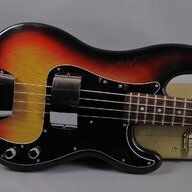
I have a very simple recording setup and I've found that recording the bass through the amp's direct output sounds really cool. Then in the mix I put an HPF at 60 Hz. I leave the kick with an HPF at 30 Hz. It sounds good to me.
There are mixing techniques which can help.How do you mix so that it sounds good both ways?
One of them is duplicating the bass track and applying saturation/drive to mids... have a look at the following videos:
Last edited:
Not sure this pertains but I've achieved what is for my taste the best recorded bass sound working (as a rank beginner) in my DAW, in this case an Apollo twin interface into Luna, so all UAD. Yes I do send a decent signal in, already eq'd via a filter and opto compressed 4/1, but then thru a tape sim, channel strip and additional compressor.
Passive 5-string with very old flatwounds-sounds punchy and defined.
Ps....in the world of plugins, or hardware of course, do look under the hood of a well known gizmo what name rhymes with 'mistress or'
Passive 5-string with very old flatwounds-sounds punchy and defined.
Ps....in the world of plugins, or hardware of course, do look under the hood of a well known gizmo what name rhymes with 'mistress or'
Last edited:
Latest posts
-

-
 Do stainless steel strings loose there sound quicker than other material
- Latest: 5StringBlues
-

-

