• TalkBass has been independent since 1998. Add your voice.
    Create a free account to reply to discussions, view embedded media, and browse with fewer display ads.
    Join freeLog in
    Want zero display ads or expanded classifieds tools? Compare plans.

Modding an Ibanez SR800 to make it passive?

Hi Talkbass, I am very inexperienced as far as modding bass guitars is concerned, and not super savvy when it comes to electronics in general, so please forgive any questions here that seem like basic knowledge.

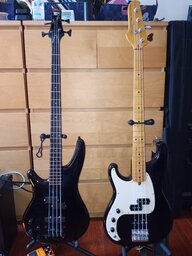
I have a 1998 Ibanez SR800AM, an instrument that belonged to my brother. Invalid Link Removed. It's my backup bass, but I don't play it very often because I just don't care for the sound. I'm not sure if it's the pickups, the preamp, or the two in combination, but no matter how I fiddle with the knobs on this thing it sounds kind of thin and insubstantial next to my Fender P Bass. In particular it really doesn't play nice with my SansAmp, I cannot for the life of me get even a halfway decent overdrive sound from it. I have changed the battery in it, which boosted the output a bit but hasn't made me like the sound. I particularly dislike the sound of the mids on this, even when I sweep the frequencies it either sounds muddy or tinny.

Tonal complaints aside, I love the way this instrument feels in my hands. I would absolutely make it my main instrument if I could get the sounds I want out of it. So I am considering modding the bass to add new pickups. Since I have a SansAmp already I don't really feel like I need to keep the onboard preamp. I would like to preserve as much of the original aesthetic of the bass as possible, so I'm looking at something likeInvalid Link Removed which have a solid black cap covering the magnets.

Questions:

1) Does it matter at all that the Ibanez has its split P pickups reversed, i.e. with the bass side closer to the bridge and the treble side closer to the neck? Doesn't seem like it should matter but I just don't know for sure.

2) I am guessing I would have to replace some knobs, I don't imagine I could use the stacked knobs on a regular pot. Is that correct? Is there a way to tell what kind of knob will fit the pots on these (or any other) pickup set? I know not all knobs are universally compatible.

3) Since there are 4 knobs on the bass, one of the current knobs will be a dummy. Is there something I could do with that extra knob? It's not really a problem for me if it's just there and not doing anything, but if I can do something useful with it, maybe I will.

4) Bonus question, I am open to suggestions for other pickups as long as they have the solid black plastic cap covering the magnets, what do you like? I play in a rock band and want something that will sound good with a bit of dirt on it.
 
1) Does it matter at all that the Ibanez has its split P pickups reversed, i.e. with the bass side closer to the bridge and the treble side closer to the neck? Doesn't seem like it should matter but I just don't know for sure.

It does not matter, at least not in the sense of impacting which pickups you can choose. Any P pickup will work in your bass. You just put the halves in their respective cavities.

2) I am guessing I would have to replace some knobs, I don't imagine I could use the stacked knobs on a regular pot. Is that correct? Is there a way to tell what kind of knob will fit the pots on these (or any other) pickup set? I know not all knobs are universally compatible.

3) Since there are 4 knobs on the bass, one of the current knobs will be a dummy. Is there something I could do with that extra knob? It's not really a problem for me if it's just there and not doing anything, but if I can do something useful with it, maybe I will.

Yes, you will likely want new knobs to go with the new controls. Your bass has four holes. You have two pickups. The first decision you need to make is what controls you want. You could do blend-volume-tone, and have a spare hole. or go the Jazz bass route: vol-vol-tone. Or vol-tone for each pickup and use all 4 holes.

If you go with the EMG pickups you mentioned, they come with control pots, so that's sorted for you.

Pots generally come with either smooth shafts or knurled. Knobs are either smooth bore with a set screw (meant for smooth shaft pots) or knurled. There are some different knurling standards but the vast majority of knobs and pots out there are coarse (18 tooth) and some are fine (24 tooth). Smooth shaft pots are often sold in 6mm size but some are 1/4". It can seem overwhelming but there are lots of parts to choose from. If there's a knob you really, really like then just buy it and find pots that will fit - or you can get conversion bushings, for instance to make a 1/4" knob fit on a 6mm pot.

4) Bonus question, I am open to suggestions for other pickups as long as they have the solid black plastic cap covering the magnets, what do you like? I play in a rock band and want something that will sound good with a bit of dirt on it.

EMG's passive pickups are probably the most popular no-poles-exposed pickups. That said, many aftermarket P and J pickups follow Fender's original design, where the pickup coil and flatwork is a discrete separate assembly from the actual pickup cover - and the cover is removable. There are solid (no-hole) pickup covers available, so if there's a traditional PJ pickup set you really like, go ahead and buy it, and just swap the covers.
 
Last edited:
It does not matter, at least not in the sense of impacting which pickups you can choose. Any P pickup will work in your bass. You just put the halves in their respective cavities.


Yes, you will likely want new knobs to go with the new controls. Your bass has four holes. You have two pickups. The first decision you need to make is what controls you want. You could do blend-volume-tone, and have a spare hole. or go the Jazz bass route: vol-vol-tone. Or vol-tone for each pickup and use all 4 holes.

If you go with the EMG pickups you mentioned, they come with control pots, so that's sorted for you.

Pots generally come with either smooth shafts or knurled. Knobs are either smooth bore with a set screw (meant for smooth shaft pots) or knurled. There are some different knurling standards but the vast majority of knobs and pots out there are coarse (18 tooth) and some are fine (24 tooth). Smooth shaft pots are often sold in 6mm size but some are 1/4". It can seem overwhelming but there are lots of parts to choose from. If there's a knob you really, really like then just buy it and find pots that will fit - or you can get conversion bushings, for instance to make a 1/4" knob fit on a 6mm pot.

EMG's passive pickups are probably the most popular no-poles-exposed pickups. That said, many aftermarket P and J pickups follow Fender's original design, where the pickup coil and flatwork is a discrete separate assembly from the actual pickup cover - and the cover is removable. There are solid (no-hole) pickup covers available, so if there's a traditional PJ pickup set you really like, go ahead and buy it, and just swap the covers.[/QUOTE]

Thanks, very comprehensive response!
 
That's a great option you have chosen (especially if the covered magnets are a big deal to you).

My suggestion? Wire it volume/volume/tone and use the 4th hole for a series/parallel switch. It's simply another tonal option that will make your bass more versatile. Those EMG sets come with everything you need to wire up the pickups with no solder! Super easy.

Here's one more thing to consider. The same strings don't always work on every bass. What strings do you have on your P bass? And what strings do you have on the Ibanez? Being that it's a backup, is there any chance those strings are dead? Also, trying different strings may bring about more of the tone you're looking for. So, if you install the new pickups, and still "aren't quite there' tone wise, post a thread in the strings section and tell us what you're "missing" from your tone.

I'm not lecturing. I'm simply giving you something else to consider.
 
That's a great option you have chosen (especially if the covered magnets are a big deal to you).

My suggestion? Wire it volume/volume/tone and use the 4th hole for a series/parallel switch. It's simply another tonal option that will make your bass more versatile. Those EMG sets come with everything you need to wire up the pickups with no solder! Super easy.

Here's one more thing to consider. The same strings don't always work on every bass. What strings do you have on your P bass? And what strings do you have on the Ibanez? Being that it's a backup, is there any chance those strings are dead? Also, trying different strings may bring about more of the tone you're looking for. So, if you install the new pickups, and still "aren't quite there' tone wise, post a thread in the strings section and tell us what you're "missing" from your tone.

I'm not lecturing. I'm simply giving you something else to consider.

Thanks for your input. As I said I'm a little bit inexperienced when it comes to electronics stuff, can you expand a bit on series/parallel switching? I know some basses have this but I don't entirely understand what it does. Could I get one from EMG that works with their solderless wiring? I do have access to a soldering iron and someone who knows a little more what they're doing, as long as I have a wiring diagram to work off, so that's not strictly necessary but the solderless system does appeal to me as it seems like something I can easily do myself.

I do have different strings on both instruments and I will be trying out something new first to see if that makes a difference. Currently my p bass has LaBella flats on it, and I have newish D'addario rounds on the Ibanez (I think I put them on back in July or so). I have ordered a new set of flats to try on the Ibanez before I go for new pickups to see if that makes a difference.
 
Thanks for your input. As I said I'm a little bit inexperienced when it comes to electronics stuff, can you expand a bit on series/parallel switching? I know some basses have this but I don't entirely understand what it does. Could I get one from EMG that works with their solderless wiring? I do have access to a soldering iron and someone who knows a little more what they're doing, as long as I have a wiring diagram to work off, so that's not strictly necessary but the solderless system does appeal to me as it seems like something I can easily do myself.

I do have different strings on both instruments and I will be trying out something new first to see if that makes a difference. Currently my p bass has LaBella flats on it, and I have newish D'addario rounds on the Ibanez (I think I put them on back in July or so). I have ordered a new set of flats to try on the Ibanez before I go for new pickups to see if that makes a difference.

Here's a guy doing a (pretty OK) demo of the "S1" switch on a Fender, which is a series/parallel switch if I recall. It's just another tonal option.

S-1 Switch Jazz Bass demo - YouTube

Here's a simple wiring diagram for a series/parallel switch on a guitar. (There are lots of them out there. This was a quick-n-dirty search.)
switch.gif


I have two main players. Both are all passive. Both have lots of switching options to take advantage of various coil and wiring configurations. So I'm biased in this regard. :D Again, I'm just tossing stuff out there for you to think about....especially since you already have the extra hole. Good luck with your project.

 
  • Like
Reactions: Isaac_James
Series/parallel describes the relationship between the two pickups in the overall circuit, from an electrical perspective. Think of it this way: parallel puts them next to each other, both directly connected to controls and the jack. Series puts them in line - one pickup's output connects to the other pickup's input, and that second pickup's output connects to the controls and jack.

Generally speaking, in series, output will be higher and there will be more mids present in the signal and slightly less highs. In parallel, the bass will be a little lower in output, and the tone will have a scooped mids effect.

The majority of two pickup basses are wired in parallel by default - for instance, Jazz basses and most PJs. If you're used to the tone of a Jazz with both pickups turned all the way up, that's classic parallel tone.

I don't think EMG sells series/parallel switches that work with their solderless harnesses, but series/parallel is pretty easy to wire and very common. It's a good way to use the 4th hole if you can't think of anything else. Think of it this way: leave it in parallel for "normal bass" tones, and switch to series for "turbo boost with extra mids."
 
  • Like
Reactions: Isaac_James
IMHO:
1. No, they are split because they are too large to put side by side.
2. Replace Pots and Knobs
3. Put in a switch that goes between 2 different capacitors. That way the tone will change but the volume won't be so effected like series, parallel. I use a capacitor switch and change to bright when I take a solo live.
4. For passives I like seymour duncan quarter pounders...you can always paint them solid black with a rattle can.
 
The good news is that what you are considering is a complete electronics swap, which means it will be a relatively easy process to finish once you start. You can pretty much pre-assemble everything including the jack, and then pull everything that's in there out in one motion, then install the new stuff. The only thing you'd have to worry about is connecting the bridge ground wire.

Personally, I'm not enamored with EMG pickups. If you want the all-black aesthetic, there are other ways to get it. Aguilar, Bartolini, Delano, all make pickups with solid black covers. The Delanos are a bit expensive, but they're absolutely brilliant -- in fact, you could probably wire them up to the preamp you now have and they would probably sound a lot better than what you have.
 
  • Like
Reactions: Isaac_James
EMG's are very easy to install. You will only need to solder the jack. I went with the active Frank Bello signature for my SR800 and had no issues considering that I had never done any electronic work ever before. Be prepared though! make sure you watch a few videos, have all the required tools and diagrams. All in all I was very pleased with the outcome and had a lot of fun doing the work.
20210312_181344.jpg
20210315_183015.jpg