• TalkBass has been independent since 1998. Add your voice.
    Create a free account to reply to discussions, view embedded media, and browse with fewer display ads.
    Join freeLog in
    Want zero display ads or expanded classifieds tools? Compare plans.

Double Bass Mr. Carter

Don Kasper

Gold Supporting Member
Dec 30, 2012
7,600
14,483
71
Los Angeles/Burbank, CA
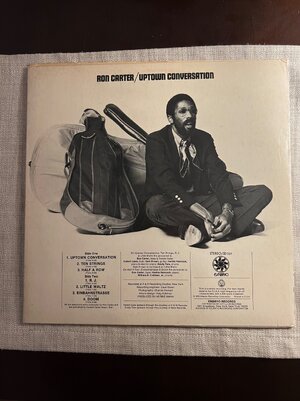
From his 1969 (recorded) release "Uptown Conversation", his 2nd as a leader.
Does anybody like this? Anybody else owned this?
(The intonation "issues" are significant throughout the album, IMFO, and predate his use of the non-bowable LaBella strings.)
Ouch.
I am not sure how nobody in the booth, or in the room, said "...let's try another one."
Again, IMFO,
Thx.
 
Last edited:
  • Like
Reactions: Ross Kratter
Since we’re stating opinions here, I feel the need to weigh in with mine regarding the idea of starting a thread to talk negatively about another living player of our instrument, a practice which I find to be of questionable taste at best. While not technically against the site rules because the person in question is not a member of the site, I don’t think such a thread represents the site in any positive way.

This is not what the site is supposed to be about, IMO.
 
Yes, I own this record. I bought it used for $4.00 decades ago. I like the album a lot, especially his ‘Little Waltz’. Great band, including H. Hancock. 👍👍
 

Attachments

  • IMG_5277.jpeg
    IMG_5277.jpeg
    1.2 MB · Views: 21
  • IMG_5278.jpeg
    IMG_5278.jpeg
    1.4 MB · Views: 19
Yes, I own this record. I bought it used for $4.00 decades ago. I like the album a lot, especially his ‘Little Waltz’. Great band, including H. Hancock. 👍👍
See, this is what I'm talkin' about.
the Mods allow and encourage the exchange of diverse, and often opposing, opinions
Thanks for your interest and opinion, ...53.
 
Don, you do create a conundrum... How does a person speak up in favor of the double bass work on this album, without being accused of having poor intonation? Speaking as someone who knows my intonation is never even close to perfect, it took guts to speak up.

Regarding the album, personally to me RC's work is in line with the bebop expressionism of that time. I think he couldn't have done it accidentally, the whole work is built around dissonance; Isn't that what his message was?
 
  • Like
Reactions: gcb and yodedude2
Since we’re stating opinions here, I feel the need to weigh in with mine regarding the idea of starting a thread to talk negatively about another living player of our instrument, a practice which I find to be of questionable taste at best. While not technically against the site rules because the person in question is not a member of the site, I don’t think such a thread represents the site in any positive way.

This is not what the site is supposed to be about, IMO
Maybe TB could start a "Disparaging the Intonation of the Masters" forum.
But then you'd have to move 1/3 of all the threads there....
 
So, in my early college days, before the Standards Trio, Gary Peacock played with Keith Jarrett, and recorded a ‘solo album’ in 1977. There is some amazing playing, occasional intonation aside. I have to believe that RC had some influence, having done his some 7 years earlier.


  • Like
Reactions: Ross Kratter
I don't feel the need to call the player out by name (you can google him and see he was not that prolific), but I found this album unfortunately unlistenable because of the bassist's intonation.


Yeah Ron Carter doesn't have the best intonation. It's pretty well known.

For the first time a couple days ago I watched Round Midnight and I was fascinated watching his effortless technique in both hands, something I often struggle with. The man also has ENORMOUS hands. He sounded fine to me on the soundtrack.
 
  • Like
Reactions: edwinhurwitz
pardon my asking: do 'we' hear intonation differently these days in a post-autotune world as opposed to how most folks heard intonation 50+ years ago?

anecdotally, i know that i do ....

Not just autotune, but the perfectionist approach to recording that typically wasn't the case 50+ years ago, at least not in jazz. It was usually 2 or 3 takes, and use the best one with whatever mistakes were there left in.
 
I would also warn about having explored my own intonation issues due to file compassion and sampling rates, I wouldn’t be surprised if Mr Carter heard little intonation issues during the recording and they get exposed far later after also format changes that lose fidelity over subsequent conversions.

In addition, I’ll be happy to trade his intonation for mine any day of the week along with his mastery that goes with it.
 
Well, I didn't listen to the whole cut in the OP, but sampling it here and there what I find is what I would prefer to call a flexible approach to pitch.

I find that classically-trained musicians have a tendency to identify pitch manipulations done by practicioners of African American improvised music as "bad intonation" when it's not really so. I"m sure that with the advent of auto-tune and electronic tuners always at the ready, this attitude has affected people who may not have that training, but have mostly been exposed to sanitized recordings.
 
I listened to the entire recording in the OP twice now and had more or less the same thought. It sounded like intentional pitch manipulation to my ears. It sounded very free(ish) jazzy to me, which is not exactly my cup of tea, so kind of hard to listen to closely for me. (Although i do dig some Eric Dolphy.)

The bass and strings sound really good on my little Bluetooth speaker. Perhaps my opinions will change (for better or worse) when i listen to the full album through better speakers/headphones.
 
In answer to the OP, I don’t own this rekkid, nor do I have any recognition of hearing it. I will say that my desire to play double bass is because of Mr. Carter’s participation in two recordings-Flora Purim’s STORIES TO TELL and the Rahsaan Roland Kirk/Al Hibbler collaboration A MEETING OF THE TIMES. Additionally, his work with a variety of artists on the Blue Note label in the early 60s is likely my favorite of his career. Likewise the Miles “second quintet”.
His solo output is not something I have particularly followed, I enjoy his work as a sideman rather than a leader.

For your consideration; I think a close perusal of any one of our record collections/playlists will evidence any number of performances that contain issues with form ambiguities, tempo fluctuations, “wrong” notes, “wrong” chords, harmony that is other than that of the original presentation during the melody, and other such aberrations. So why didn’t “someone in the control room” either re-record the track or just can it? Certainly, as someone suggested earlier, budget concerns and economic exploitation can be an issue. But, especially in the case of working groups and labels like Blue Note (which paid for 3 days of rehearsal prior to the recording date), the reason must lie elsewhere.

Jazz is almost universally understood as a “music of the moment”. It is a conversation that occurs in real time rather than a”play” that has been conceived, edited, and preserved at some prior time and unfolds as designed, even with the “slings and arrows” of directorial and personal interpretive input. Additionally, it is a collaborative art form (in general) rather than an individual one. I would offer that the predominant determining factor is, and should be, the sum total of ALL participants and the feeling of immediacy and expression of the performance of the ensemble.

At the risk of treading close to the sociocultural/political line (and moderators if this crosses that line, if this could be judiciously edited to remove the offending language but the bulk of the comment left, it would be much appreciated), experience has shown that there is a cultural difference in the African American community than in the Euro American community. In the former the predominant determinant for a musical performance is “did we sound good or bad” rather than the latter’s “did I sound good or bad”…
 
Last edited: