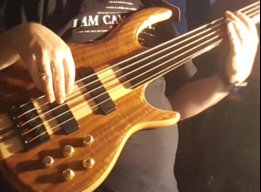
The dual preamp Sterling is finished ... and it's everything I was hoping for.
A little history, I acquired the Sterling at a dirt cheap price because the previous owner
tried a DIY mod putting a Duncan "Stingray" pickup in and trying to attach it to the stock
Sterling preamp, they did not play well together. Rather than get a Sterling style pickup
I decided to use a variation on the Warwick Pro M pickup/preamp system, as I had fond
memories of that setup in my 1997 Warwick Pro M 5.
The system uses each coil as a separate pickup, with a volume control and 2 band preamp
on each coil. Because this is designed to be my go-to live bass having hum-cancelling was a
priority, lots of neon and wiring issues in some of these venues, so my pickup of choice was
the Nordstrand MM4.4 quad coil. For preamps I called David Meadows at Audere and he made
me a system using two of the "classic" series preamps wired together.
I play mostly blues, classic R and B, and some blues rock, and for years had been using a
1973 Fender Jazz Bass or my 1968 Precision, the Jazz when I send the signal through a pedal
board as I need the ability to adjust the signal depending on the effect used. The Precision when
I need the fat classic P-bass sound straight to the amp, the Sterling had to pull off the "essence" of
each of those classic sounds plus the Stingray vibe when needed.
When I got the bass home I set about the task of setting up the presets if you will, with the switch
in the neck position
(only the neck coil) I set the volume and tone to get close to the P-bass vibe using
a simple A/B between the two basses using a Mark Bass LM II set flat through a Euphonic Audio VL-110 cab.
Using the same method I set the bridge position
(only the bridge coil) to emulate the bridge pickup on the
73 Jazz, the set screws on the knobs all facing up tells me the gain and tone are in what I call the
"classic stock" positions. The middle position is both coils on and it has a fat warm sound with just a
hint of the Music Man top end zing. If I want more, just roll more highs, in fact the tonal possibilities
are almost infinite, and the Classic Ray tone is there and easy to dial in
(its wired parallel).
For me it's the perfect gig bass it wears Ernie Ball series 4 flat wounds
( the Fenders have TI flats)
and it has the smaller body and fast J-Bass style neck. The tones are easy and fast to dial in; a real
plus on stage ... I very pleased with this different take on the MM design.
Thanks to Carey Nordstrand and David Meadows for their help in the project
(and such great products)
And special thanks to my tech Mike Stoker Memphis TN for making it happen ...