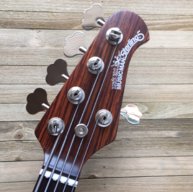
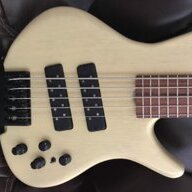
Niiice!
A passive baxandall tone circuit acts like an active bass and treble. Flat is with both controls centered. The midrange in an Ampeg is a separate active circuit with true cut and boost. Center is flat. The bass and treble are not interactive.That's what they call a Baxandall tone circut, IIRC, Bass is flat at 2, Mids are flat at 10, and Treble is flat at 2 or there abouts.
The Fender tone stack is highly interactive and there is an inherent mid cut, thus requiring turning the bass and treble down and cranking the mid to get close to "flat." Marshall and Vox, as well as Mesa and many others use variations of the same tone stack.
Ampeg's tone controls are much different. There is no interaction between controls. Other characteristics of the preamp cause the "flat" settings to be slightly off noon, but noon is pretty close.
The inherent mid cut of the Fender tone stack is not a bad thing. It produces the characteristic guitar tone we all know and love. With say, a B15, with baxandall bass and treble, boosting the bass and treble creates something that sounds like cut mids. Cut the bass and treble (turning up the volume to compensate for any loss) causes what sounds like a mid boost.
I have a Bassman 100 I heavily modified. The bass channel is an Ampeg B-15 type preamp, and the normal channel is a Fender type, tuned down and octave for bass. The B-15 channel, while more simple than the other channel's interactive bass, treble, midrange, and mid slope control, has more clarity, punch and presence.








 . I'm considering an as-yet-undetermined replacement pup (probably a Nord as they have served me so well in my two Fenders) and an East replacement preamp. Since I don't use the onboard EQ, will either East 2b or 3b preamp have the same tone?