• TalkBass has been independent since 1998. Add your voice.
    Create a free account to reply to discussions, view embedded media, and browse with fewer display ads.
    Join freeLog in
    Want zero display ads or expanded classifieds tools? Compare plans.

My 15/6 cab I'm building... (pics)

Have never built a bass cab before, plenty of speakerboxes for home and car audio, but not a bass cab. Also my first time using plywood for a box. Finally, my first time dado/rabbet grooving.

I chose to use 18mm birch plywood to ensure it was extra strong. I would rather have a non-flexing and near indestructable enclosure than a light-weight one (I tend to overkill). I used 1 5/8" screws everywhere except on far edges where the dado/rabbet bit well. Gorilla wood glue and well clamped all around while drying. Drivers are Eminence 3015LF and Alpha A6. Crossover componets are Dayton caps and resistors with Jantzen 15awg P-core inductors.

Just a note: made a big mistake and bought the wood from home depot. Guess I learned my lesson...

I can't remember all the specs, i believe i did 4 cubes ported 44Hz for the 3015LF and .15 cubes sealed for the midrange. Once assembled, Ill get the crossover built (all higher end and almost overkilled components). Ill put all the hardware on (handles, jacks plate, drivers) and test it out. If all checks out, ill pull all the hardware off, then

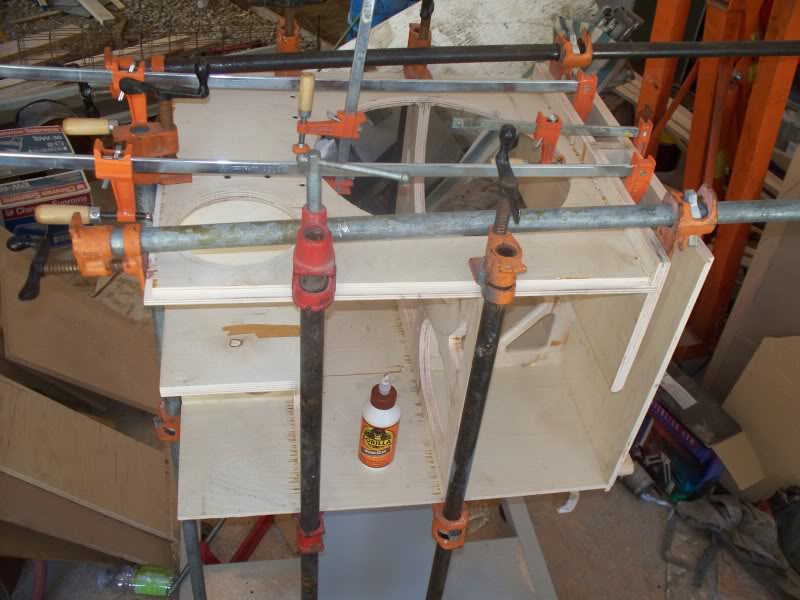
Here is the bottom/rear getting put together...
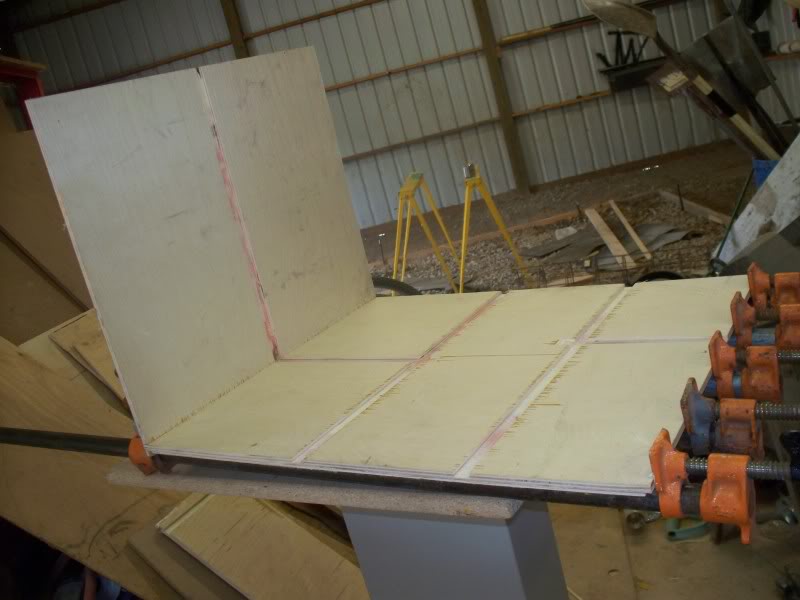
100_3524.jpg


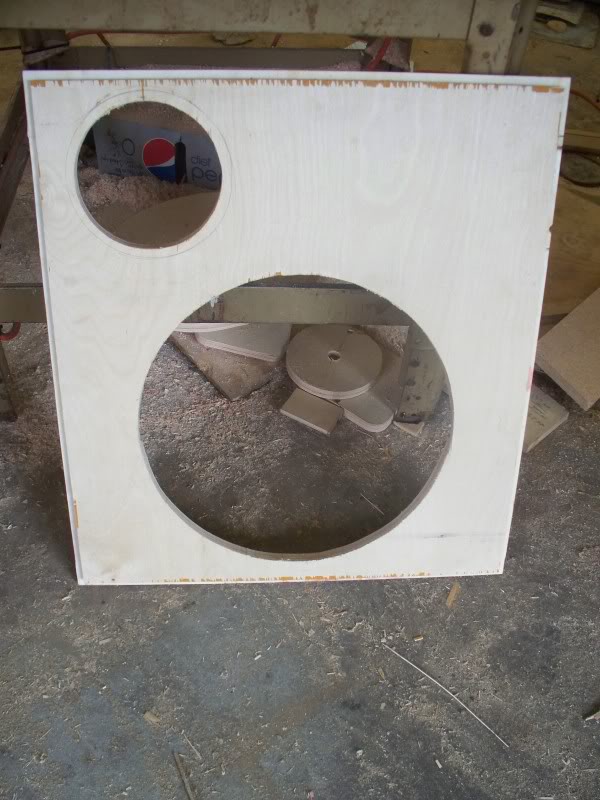
Front baffle...
100_3525.jpg


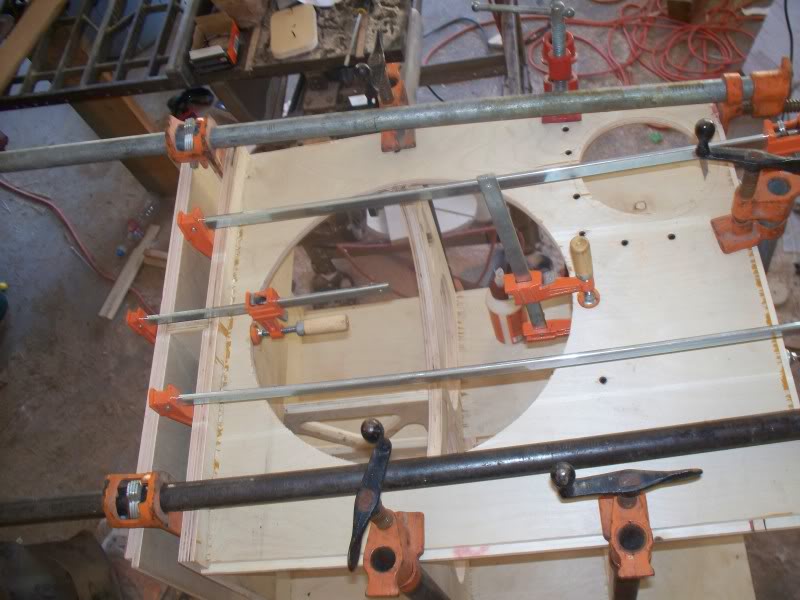
Top bracing and midrange enclosure...
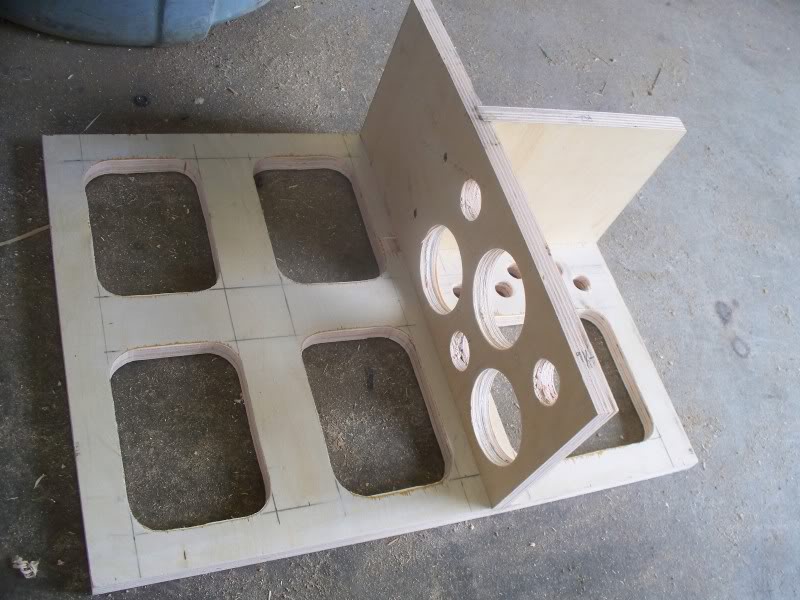
100_3526.jpg


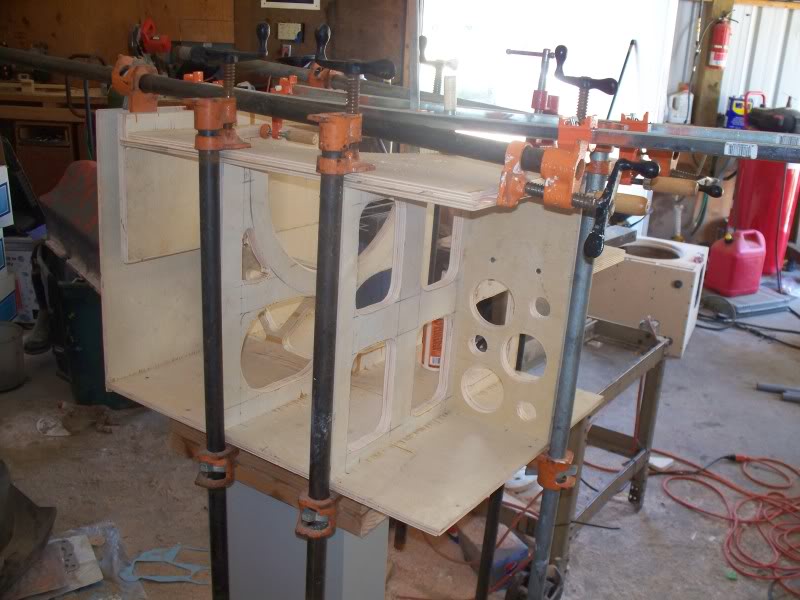
Thrown all together (how it sits right now)...
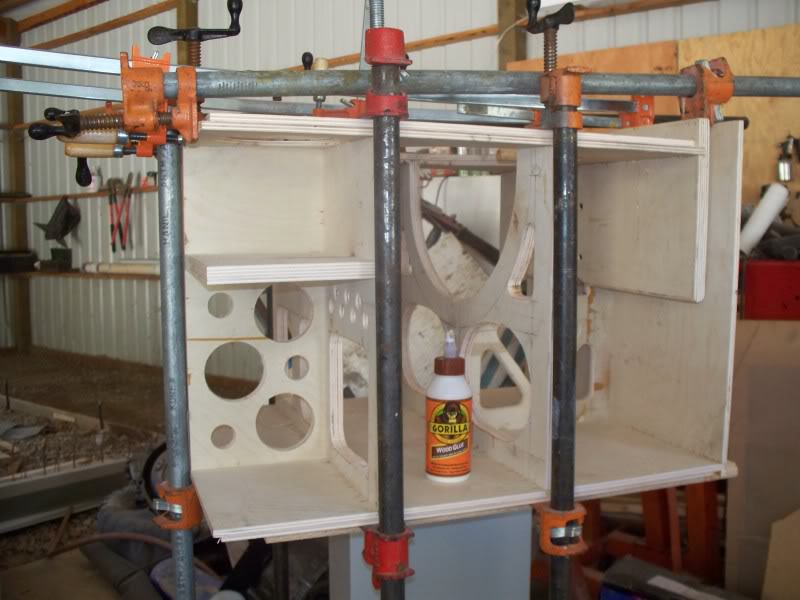
100_3527.jpg

100_3528.jpg

100_3529.jpg

100_3530.jpg


And finally, whats left to throw on there...
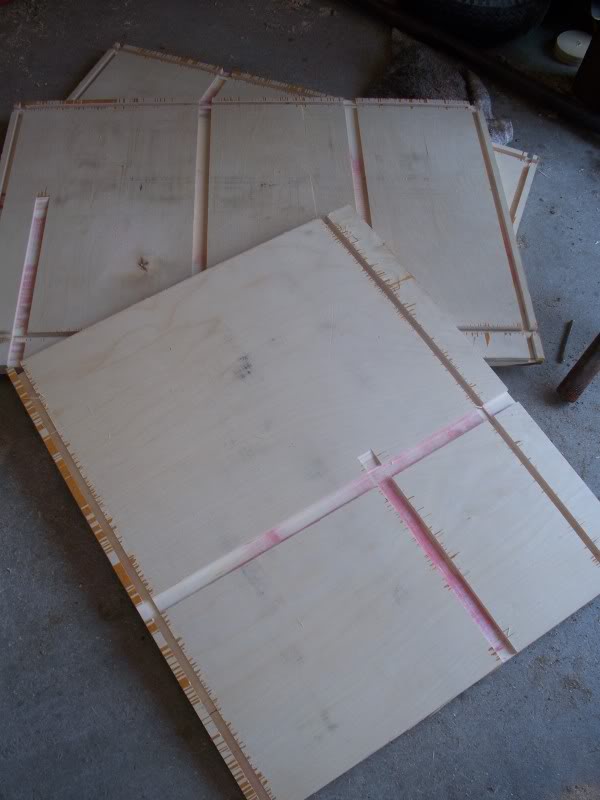
100_3531.jpg


Ill get more pics up as I get more done.

 
Too late now, but with that level of bracing 1/2" plywood is all you needed to use. Manufacturers use 3/4" because thicker wood is cheaper than the labor cost of bracing. Bracing works better than thicker materials, and allows for a lighter cab, but only if you use 1/2". For that matter shelf bracing of the type you used need only be made from 1/4", as there's no flexing stress on the bracing.
 
Too late now, but with that level of bracing 1/2" plywood is all you needed to use. Manufacturers use 3/4" because thicker wood is cheaper than the labor cost of bracing. Bracing works better than thicker materials, and allows for a lighter cab, but only if you use 1/2". For that matter shelf bracing of the type you used need only be made from 1/4", as there's no flexing stress on the bracing.

Im all for overkill ;) I have done plenty of boxes with extensive bracing (used to do dB Drags competition years ago). I was originally planning to use 1/2" for the bracing and 3/4" for all the outsides/port, but since I had a bunch left over and would have used just under a full sheet using 3/4", figured, why not? The weight savings at that point would have been minimal.

Really, thus far, this thing weighs near nothing (Especially since Im used to running MDF!). Ill get a final weight count when its complete before/after all the drivers and hardware.

Thumbs up! Can't wait for some more pics. What kind of covering are you going to use? Carpet? Just wood?

At first I thought, man this wood looks good... then after the first cut and the first layer just shredded, I went back to the original plan: To get it rynolined (truck bed liner). This will add to the final layer of overkill in making it uber tough. Might do aluminum on all the corner seems under the steel corner covers (kind of like Mesa Boogie "roadready" cabs)

Grill wise, I'm still trying to decide how I want to go about mounting it. I am thinking about routing off 3/8" from all the inside and flush mounting it to the rest of the box.
 
Hey great job! You put a lot of three-dimensional thought into that design and it shows - impressive work without the benefit of a cnc machine!

That looks like import (chinese) birch you used... the delamination is a real problem. In case you're not familiar with this, if you shoot the box with rhino (or any other) bedliner product you will need to seriously prime it with an high-quality oil or polyester primer, 2-3 coats is better. The moisture in the wood will vent and blister the coating and you'll get a lot of pinholes, craters, etc when it snap cures. Again, you may already know this, but if you didn't, please don't skip this or you'll be crying later.

We have a lot of experience with Duratex and if you have access to someone that can spray the rhino liner, and you are ok with cost difference, we'd recommend you go that route. Duratex is a fine product but there is really no comparing the two systems.

Again - great job!
 
You might consider a gallon of Duratex instead of the bed liner. See www.speakerhardware.com. It goes on very easily and it provides a super tough, textured surface.

Awesome, I will look into this. Thanx!

Hey great job! You put a lot of three-dimensional thought into that design and it shows - impressive work without the benefit of a cnc machine!

That looks like import (chinese) birch you used... the delamination is a real problem. In case you're not familiar with this, if you shoot the box with rhino (or any other) bedliner product you will need to seriously prime it with an high-quality oil or polyester primer, 2-3 coats is better. The moisture in the wood will vent and blister the coating and you'll get a lot of pinholes, craters, etc when it snap cures. Again, you may already know this, but if you didn't, please don't skip this or you'll be crying later.

We have a lot of experience with Duratex and if you have access to someone that can spray the rhino liner, and you are ok with cost difference, we'd recommend you go that route. Duratex is a fine product but there is really no comparing the two systems.

Again - great job!

Thanx, and no, I did not know that. Again, this is my first time really working with plywood. Next time I do though, Ill hunt down better stuff!

Also, I know a guy who did his truck bed with a drywall hopper sprayer. Something that can be done with the duratex?
 
We have a lot of experience with Duratex and if you have access to someone that can spray the rhino liner, and you are ok with cost difference, we'd recommend you go that route. Duratex is a fine product but there is really no comparing the two systems.
Your conclusion got lost in the translation. What are you saying? One is better than the other (Duratex/Rhino)? And if so which?
 
Awesome, I will look into this. Thanx!


Thanx, and no, I did not know that. Again, this is my first time really working with plywood. Next time I do though, Ill hunt down better stuff!

Also, I know a guy who did his truck bed with a drywall hopper sprayer. Something that can be done with the duratex?

Yeah you could use a hopper for Duratex, but it's an evaporative cure product (water based), where the bedliner products are a 2-part system that are chemical cure. Even a low-pressure bedliner system like Scorpion (stuff that can be shot from a hopper gun) is going to greatly outperform Duratex unless you have a full IR cure setup, and even then the Duratex won't hold up as long. If you shoot the cab with a bedliner from a hopper gun, you won't need to prime it. But if you go industrial (LineX, Rhino, etc) you absolutely need to.

Again - not trying to knock on Duratex. We've used it, I know the Acrytech guys, it's a great product for what it does. But it is extremely different than 2-part bedliner systems, and it's not fair to compare a $50 gal of Duratex with a $5 roller to a iso-based Rhino system that kicks in 4 seconds and shoots from a $25k pressured Graco rig.

Good luck and let me know if you have any questions.
 
That's a nice picture Bill has posted and as it shows, you can get a good cosmetic texture and final result using Duratex.

Duratex is self-priming, it is water-based (no VOCs, easy cleanup), it is relatively cheap (compared to even low-end bedliner systems), and can be applied with minimal equipment or investment. It can be re-worked, sanded down, and top coated again for added durability. If you make a mistake you can DA sand it off and try again. Even on your first try, you'll probably get a good result with Duratex and you'll be happy with the cosmetics. These are all advantages of Duratex over any bedliner-type system that I'm aware of.

There is a cost to all those "advantages" and that is durability. Again this is not a knock on Duratex, it's a fact, plain and simple. There is (again, to my knowledge) no one out there shooting a truck bed with Duratex. Comparing Duratex to even a low-pressure bedliner system is apples to oranges.

If you want to DIY, want to save some money, don't want a lot of hassle, and can live with lower durability of what is essentially a paint, then you should consider Duratex.

If you want the added durability, you'll probably spend about $100 more (minimum) and will likely not want to DIY. That's what it takes to buy your way in to the durability you get from a true 2-part plural system, even a low priced epoxy system.

Like everything else in life, there's no right or wrong, there's just "what do you want and how much do you want to spend".

Good Luck!
 
bill, that cab looks excellent. And only a quart? Definitely good to hear that!

red, I am looking for an easier to use application since I have never used truckbed liner (watched a friend do his with "herculiner" from one of the local "marts", he just poured it like paint then rolled it on).

I will probably end up getting a gal of that duratex.
 
As said, with that amount of bracing you couldn've gone with thinner, lighter wood but too late now. It does look like a heckuva a strong build though, like you said overkill.

Something to consider if you haven't purchased drivers or crossover components yet. The Kappalite3015LF plays at an honest 98-99db below any common crossover point. The Alpha6 plays around 93-94db. The cab is going to be voiced heavily towards the lower end. So much so you might not like the results. I'd consider using a pair of the Alpha6's and adjusting the crossover components to deal with the lower impedance on the top half or finding a different, higher SPL mid-driver to find a closer SPL match to the 15. As far as eminence's stuff, the Alpha8mr plays loud but response is a little choppy on the top end. There are lots of other manufacturers with good mid-drivers too. The 3015LF is a top-notch driver, I'd look for something closer to that type of performance to couple with it. The Alpha6 seems akin to "putting skinny tires on a muscle car." Then if you want to voice the cab bass heavy you can do it with eq afterwards, that particular 15 will handle it.
 
^^^ I am well aware of the sensitivity difference. I mapped everything out to see if its what I wanted. On paper, it will add a lot of low end between 50-500 and drop down ~4-5 db until 5K. But then, real world baffle step will kick in and change whats on paper. This could easily drop the low end enough to make this thing pretty darn flat in response. Really, without an RTA and some time on my hands, I won't know for sure. But i'll let my ears be the judge in the end.

Honestly, I wouldn't mind if the 50-500 stood out. Its where I want my concentration of sound to be as thats how I often EQ it anyways. Find out soon enough! (I hope... I need to go work on this dang cab instead of surf the net!)
 
If that's how you want it, that's why we DIY. Might sound great this way up close but more from the mid would help people hear you better out front. A simple $10 L-pad will take it out if you don't want it but you can't add what's not there.
 
Question for those who have done these kinds of enclosures before.

With the dado setup, how important is running a sealant? Ill probably do it anyways, but was curious if the tight fitting actually sealed well.
 
Looks nice! :-)

Priming and painting also the inside will save glue and improve adhesion when attaching whatever foam/padding you use.

Agree with you on the baffle step. Many people do not understand the impact it has on the response. I have built similar cabs before (but not with the 3015LF) using the Alpha 6 and calculated an almost flat response. In the end I still had to pad it down a couple of dB and tune the crossover to acheive "flat"...

/Alexander
 
Agree with you on the baffle step. Many people do not understand the impact it has on the response.
Placed on or near the floor the woofers are operating into half-space, as is the predicted response of box programs. Baffle step is a critical concern with narrow hi-fi cabs that are placed at ear level, but with electric bass cabs not so much.
 
That's a nice picture Bill has posted and as it shows, you can get a good cosmetic texture and final result using Duratex.

Duratex is self-priming, it is water-based (no VOCs, easy cleanup), it is relatively cheap (compared to even low-end bedliner systems), and can be applied with minimal equipment or investment. It can be re-worked, sanded down, and top coated again for added durability. If you make a mistake you can DA sand it off and try again. Even on your first try, you'll probably get a good result with Duratex and you'll be happy with the cosmetics. These are all advantages of Duratex over any bedliner-type system that I'm aware of.

There is a cost to all those "advantages" and that is durability. Again this is not a knock on Duratex, it's a fact, plain and simple. There is (again, to my knowledge) no one out there shooting a truck bed with Duratex. Comparing Duratex to even a low-pressure bedliner system is apples to oranges.

If you want to DIY, want to save some money, don't want a lot of hassle, and can live with lower durability of what is essentially a paint, then you should consider Duratex.

If you want the added durability, you'll probably spend about $100 more (minimum) and will likely not want to DIY. That's what it takes to buy your way in to the durability you get from a true 2-part plural system, even a low priced epoxy system.

Like everything else in life, there's no right or wrong, there's just "what do you want and how much do you want to spend".

Good Luck!

Curious about Duratex.
Can a person make it more durable by using 2 or 3 coats?
Is it pretty easy to touch-up if the finish is damaged?

Thanks in advance!
 
But then, real world baffle step will kick in and change whats on paper. This could easily drop the low end enough to make this thing pretty darn flat in response.

The baffle step is primarily a nearfield phenomenon, assuming we're talking about an indoor venue. In the farfield, where most audience members will be, the reverberant energy dominates and the baffle step ceases to be a factor. And in most cases, a bass cab will get enough boundary reinforcement from the floor that baffle step isn't much of a factor up close anyway.

That being said, I think you have a killer cab there whether you stick with the Alpha 6a or go to something else that gives a bit different voicing.
 

Latest posts