• TalkBass has been independent since 1998. Add your voice.
    Create a free account to reply to discussions, view embedded media, and browse with fewer display ads.
    Join freeLog in
    Want zero display ads or expanded classifieds tools? Compare plans.

NAD - '67 B-15NF!

Just picked up this beaut, totally original B-15NF! All original (even the tubes!) except for a missing fuse holder cap and a botched 3 prong cord install that will rank among mankind's worst crimes... but overall, probably the best Craigslist find since my '70 Les Paul Deluxe. And in this shape, price was $1600!

I've done a ton of digging into the Wiki and every other place I can see, but I have a couple specific questions I couldn't get explicit answers to that I'd like to post here.

1) Is there anything specific to know about working on these old PCBs? I assume I will have to replace at least some of the electrolytics and I don't want to risk destroying anything. Any advice would be appreciated. I figure work hot and fast, apply fresh solder/flux so the old stuff flows more easily, low pressure, try desperately not to rip any pads or traces off...

2) I don't see a lot of talk about switching these from fixed to adjustable fixed bias. Is that not commonly done like on Fender guitar amps?

3) I consider this thing a piece of history and will keep it as original as possible. Obviously a grounded cord is going in, I'm going to disconnect the ground switch. Would it be a crime to replace that with a switch to go from fixed to cathode bias? It's not that invasive... Also wouldn't hate a channel 2 mod to make the '64 circuit, but I haven't studied the layout enough yet to know just how invasive that would be. I know a few values are different, not sure if it would be as simple as reversing the way the stages are hooked up, etc. I don't really know how different they sound anyway, might not go that far.

Anyway, haven't had the thing running because of the missing fuse and power cord, I bought a variac and a ESR meter, I plan on replacing only the caps that need it and reforming as necessary, and bringing it back online very gently at lower voltage and through a bulb limiter just in case. Apparently it sat in a basement of a hoarder's house for a couple decades, and the seller got it from the guy clearing the house out. He says it worked when he got it, which I imagine means he plugged it in and fired it up without consideration for how long it hadn't run, hope it didn't destroy anything. I also assume he then tried to install the power cord, literally tied neutral and ground together at the ground switch and secured it to the chassis with duct tape because he couldn't figure out the strain relief, blew the fuse, threw his hands up and then sold it to me lol.
 

Attachments

  • IMG_0711.jpeg
    IMG_0711.jpeg
    926.5 KB · Views: 125
  • IMG_0712.jpeg
    IMG_0712.jpeg
    1.5 MB · Views: 121
  • IMG_0720.jpeg
    IMG_0720.jpeg
    1.5 MB · Views: 121
1. Don’t overheat the pcb, you can end up with lifted traces, but otherwise I’ve had a few of these and they weren’t difficult to service. Just take your time and do things right, don’t rush.

2. If you go through the technical pages on the wiki there is a link to a oshpark page set up by @beans-on-toast which has drop in pcbs to add adjustable bias. My last few B15Ns have been cathode biased, so I haven’t done on one of those, but I have used those boards on my B25 and V4 amps.

3. For the fixed/cathode this is also detailed well in the wiki if you want to try it. Doing the 64 vs 65 switch would essentially require lifting the tube socket grid connections and reversing them for channel 2. The earlier preamps went tone > volume, the later volume > tone.
 
1. Don’t overheat the pcb, you can end up with lifted traces, but otherwise I’ve had a few of these and they weren’t difficult to service. Just take your time and do things right, don’t rush.

2. If you go through the technical pages on the wiki there is a link to a oshpark page set up by @beans-on-toast which has drop in pcbs to add adjustable bias. My last few B15Ns have been cathode biased, so I haven’t done on one of those, but I have used those boards on my B25 and V4 amps.

3. For the fixed/cathode this is also detailed well in the wiki if you want to try it. Doing the 64 vs 65 switch would essentially require lifting the tube socket grid connections and reversing them for channel 2. The earlier preamps went tone > volume, the later volume > tone.

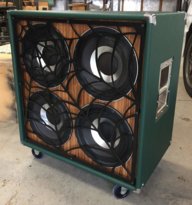
Awesome, appreciate the info! Yeah I'm going to start by getting it running. After that I'll assess the other stuff. But I would love to have the '64 channel and fixed/cathode bias options. Figure make it as versatile as possible. Later (once I know it's all working) I'm going to order a new cab from @Vintage-Blue so I don't have to lug the original around, and so I have the OG double baffle sound!
 
A wonderful amp in great condition. The inside of the chassis appears to be all original. Nice find.

I usually start with a good cleaning. Remove any flux. Your amp looks very clean as it is. There are circuit washes available or 99% pharmacy isopropyl alcohol. Soaking in solvents can lift traces. Use a Q-tip and apply just what you need.

The advice to get it working and up to spec is the best approach. Then worry about revising the circuit if you want to experiment.

As for soldering. The traces are adhered to the PCB with an adhesive. Too much heat can damage the traces and lift them off the board. Care has to be taken. I find it best to use a soldering iron with an adjustable temperature. Applying some flux can help, use just enough heat to melt and remove the solder. Too little heat and the area gets too hot and can cause damage, too much heat can also cause damage. If removing a component, clip it away, then remove the leads. Use lead/tin solder.

Your amp is fixed bias. An adjustable multi-turn bias pot is a good thing. Cathode biased amps do sound a little different. It’s subtle and more about how the amp reacts when you hit a hard note from quiet. Cathode bias is 25W, fixed bias is 30W.

If any caps needs to be changed, it would be the power supply and bias electrolytics. Don’t touch the green caps, they are usually good and what you want to see in an amp. Check the black death cap.

Build or buy a capacitor discharge stick.

Snuffer Stick – Weber Speakers

Do the power cord correctly.

Feel free to visit the TB Portaflex Club.

Official Ampeg Portaflex Club
 
A wonderful amp in great condition. The inside of the chassis appears to be all original. Nice find.

I usually start with a good cleaning. Remove any flux. Your amp looks very clean as it is. There are circuit washes available or 99% pharmacy isopropyl alcohol. Soaking in solvents can lift traces. Use a Q-tip and apply just what you need.

The advice to get it working and up to spec is the best approach. Then worry about revising the circuit if you want to experiment.

As for soldering. The traces are adhered to the PCB with an adhesive. Too much heat can damage the traces and lift them off the board. Care has to be taken. I find it best to use a soldering iron with an adjustable temperature. Applying some flux can help, use just enough heat to melt and remove the solder. Too little heat and the area gets too hot and can cause damage, too much heat can also cause damage. If removing a component, clip it away, then remove the leads. Use lead/tin solder.

Your amp is fixed bias. An adjustable multi-turn bias pot is a good thing. Cathode biased amps do sound a little different. It’s subtle and more about how the amp reacts when you hit a hard note from quiet. Cathode bias is 25W, fixed bias is 30W.

If any caps needs to be changed, it would be the power supply and bias electrolytics. Don’t touch the green caps, they are usually good and what you want to see in an amp. Check the black death cap.

Build or buy a capacitor discharge stick.

Snuffer Stick – Weber Speakers

Do the power cord correctly.

Feel free to visit the TB Portaflex Club.

Official Ampeg Portaflex Club

Thank you! I have experience working on amps so I'm pretty confident I can get this all done without damaging anything. I have a discharger already. I plan on lightly scraping up the flux and as you said, 99% IPA on a cotton swab to clean it. I generally use 60/40 leaded solder anyway, so should be good there. Do you have a specific temperature you like to use for these? I have a Weller that I normally run around 750, which I know is probably a bit hotter than is necessary for leaded solder, I could drop it closer to 700, might be safer.

And yes, I fully plan on just getting it running initially. Apparently it ran fairly recently, so it might just need the fuse/fuse cap and power cord. But I'll wait until I have my Variac and make sure I'm careful. Good to know the green caps are usually good, I don't want to change anything I don't have to. My plan was to disconnect the ground switch/death cap, leaving it in place just for looks. I don't know how necessary it is for noise, and the last thing I want is potential on the chassis lol. I could grab a class Y cap if it's better, but I figure up front I'll just eliminate.

Once it's running I'll look into adding adjustable fixed bias, probably will add switchable cathode bias in place of the ground switch and if it's just as simple as swapping the tube stages I'll probably change channel 2 to the older spec. But I still need to learn the layout of everything, so that's all down the road. Either way, very excited!

Thanks for all the info!
-Ryan
 
Well, it ended up needing a new power transformer. I swapped that out along with the 4 electrolytic caps and it's back in action! Got a little more cleaning to do, but it sounds great! Channel 2 is picking up some 60 cycle hum, gotta investigate that, could just be lead dress on the wire to the hum pot. But overall a great success. Thanks to everyone for the advice!
 

Attachments

  • IMG_0761.jpeg
    IMG_0761.jpeg
    1.2 MB · Views: 43
  • IMG_0767.jpeg
    IMG_0767.jpeg
    730.8 KB · Views: 43
Just picked up this beaut, totally original B-15NF! All original (even the tubes!) except for a missing fuse holder cap and a botched 3 prong cord install that will rank among mankind's worst crimes... but overall, probably the best Craigslist find since my '70 Les Paul Deluxe. And in this shape, price was $1600!

I've done a ton of digging into the Wiki and every other place I can see, but I have a couple specific questions I couldn't get explicit answers to that I'd like to post here.

1) Is there anything specific to know about working on these old PCBs? I assume I will have to replace at least some of the electrolytics and I don't want to risk destroying anything. Any advice would be appreciated. I figure work hot and fast, apply fresh solder/flux so the old stuff flows more easily, low pressure, try desperately not to rip any pads or traces off...

2) I don't see a lot of talk about switching these from fixed to adjustable fixed bias. Is that not commonly done like on Fender guitar amps?

3) I consider this thing a piece of history and will keep it as original as possible. Obviously a grounded cord is going in, I'm going to disconnect the ground switch. Would it be a crime to replace that with a switch to go from fixed to cathode bias? It's not that invasive... Also wouldn't hate a channel 2 mod to make the '64 circuit, but I haven't studied the layout enough yet to know just how invasive that would be. I know a few values are different, not sure if it would be as simple as reversing the way the stages are hooked up, etc. I don't really know how different they sound anyway, might not go that far.

Anyway, haven't had the thing running because of the missing fuse and power cord, I bought a variac and a ESR meter, I plan on replacing only the caps that need it and reforming as necessary, and bringing it back online very gently at lower voltage and through a bulb limiter just in case. Apparently it sat in a basement of a hoarder's house for a couple decades, and the seller got it from the guy clearing the house out. He says it worked when he got it, which I imagine means he plugged it in and fired it up without consideration for how long it hadn't run, hope it didn't destroy anything. I also assume he then tried to install the power cord, literally tied neutral and ground together at the ground switch and secured it to the chassis with duct tape because he couldn't figure out the strain relief, blew the fuse, threw his hands up and then sold it to me lol.
Good deal. Price under market, lucky!
 
Well, it ended up needing a new power transformer. I swapped that out along with the 4 electrolytic caps and it's back in action! Got a little more cleaning to do, but it sounds great! Channel 2 is picking up some 60 cycle hum, gotta investigate that, could just be lead dress on the wire to the hum pot. But overall a great success. Thanks to everyone for the advice!
What was the problem with the power tranny?

You got one from Fliptops (Heyboer) or Mercury Magnetics?

**Edit: ok, I’ve read again and PO wired it incorrectly, hence the blown fuse… and he probably smoked the PT!
 
  • Like
Reactions: bobyoung53
Well, it ended up needing a new power transformer. I swapped that out along with the 4 electrolytic caps and it's back in action! Got a little more cleaning to do, but it sounds great! Channel 2 is picking up some 60 cycle hum, gotta investigate that, could just be lead dress on the wire to the hum pot. But overall a great success. Thanks to everyone for the advice!
Could be the 6SL7 too. Try to swap them.
 
Could be the 6SL7 too. Try to swap them.
Thanks! Yeah, he absolutely smoked the PT. I inevitably determined it had a dead short as I disconnected things. He said he left it on overnight in a practice space and it never worked again and hey, I believe him haha. I grabbed a Heyboer from Fliptops.

And yeah, the 6SL7s are definitely not in great shape. I found a slightly quieter arrangement, but I'm just going to have to grab 3 new ones. I haven't tried the original power tubes or the Mullard GZ34 yet. Going to break the bulb limiter out again just in case, but I'm hopeful at least for the rectifier!
 
Well, it ended up needing a new power transformer. I swapped that out along with the 4 electrolytic caps and it's back in action! Got a little more cleaning to do, but it sounds great! Channel 2 is picking up some 60 cycle hum, gotta investigate that, could just be lead dress on the wire to the hum pot. But overall a great success. Thanks to everyone for the advice!

Replacing the power transformer is not unusual with these vintage amps. If it’s not too late, the one sold at fliptops.net is an excellent Heyboer transformer.
 
Thanks! Yeah, he absolutely smoked the PT. I inevitably determined it had a dead short as I disconnected things. He said he left it on overnight in a practice space and it never worked again and hey, I believe him haha. I grabbed a Heyboer from Fliptops.

And yeah, the 6SL7s are definitely not in great shape. I found a slightly quieter arrangement, but I'm just going to have to grab 3 new ones. I haven't tried the original power tubes or the Mullard GZ34 yet. Going to break the bulb limiter out again just in case, but I'm hopeful at least for the rectifier!


I had to have the PT replaced on my B-15N(C) after I played an outdoor festival, where the portable generators weren’t providing proper amperage (I knew something
something was bogus because all the tubes had blue “halos”. At the time, the only options were to have the transformer rewound or source a NOS transformer.
It several years to find a NOS one. Things are so much better now that Fliptops has replacements for them and virtually anything else you need to restore a B-15N.
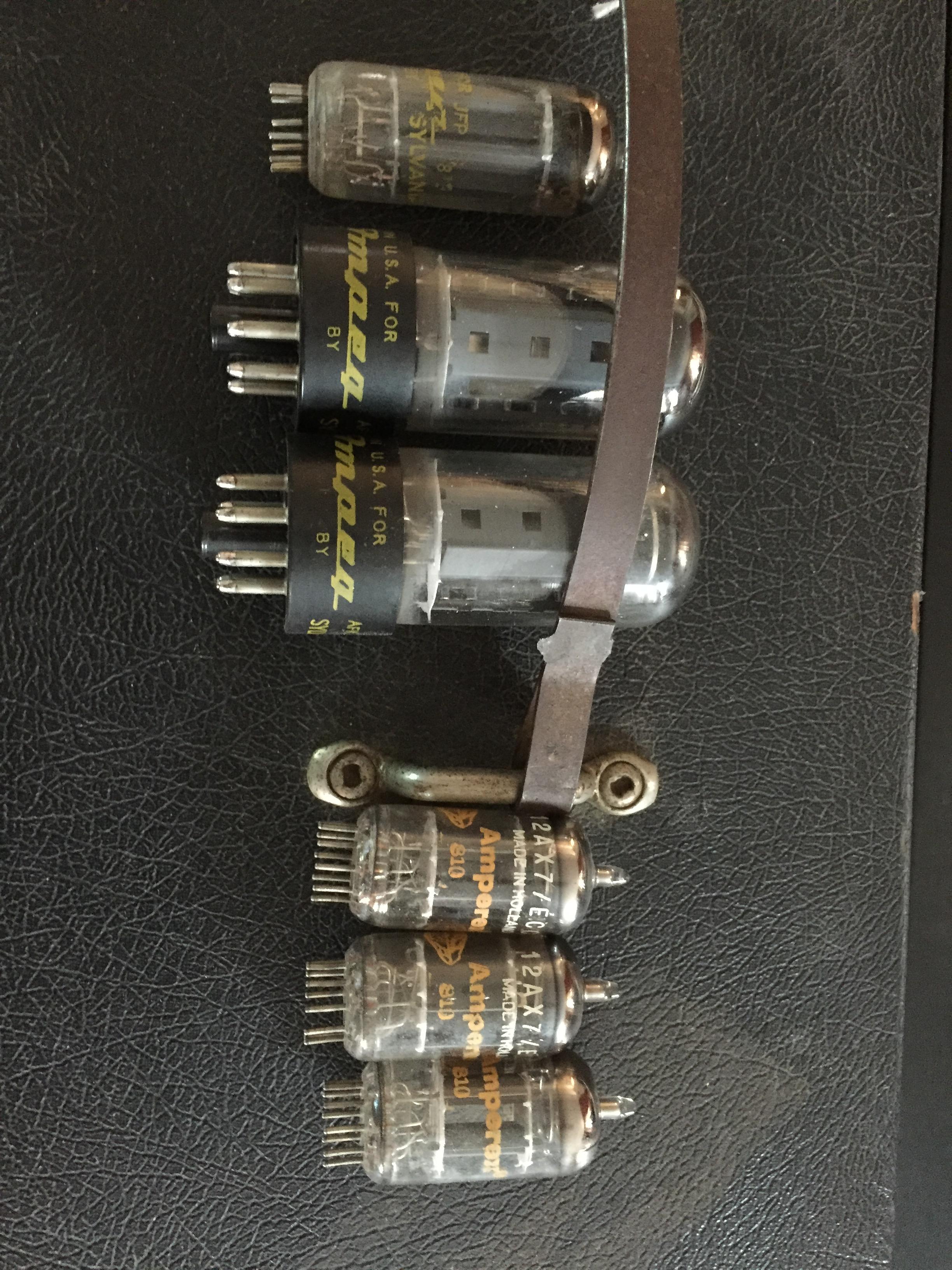
I was able to get a full set of Ampeg branded Sylvania 6SL7’s for my B-15N. They are really nice :)
 
I had to have the PT replaced on my B-15N(C) after I played an outdoor festival, where the portable generators weren’t providing proper amperage (I knew something
something was bogus because all the tubes had blue “halos”. At the time, the only options were to have the transformer rewound or source a NOS transformer.
It several years to find a NOS one. Things are so much better now that Fliptops has replacements for them and virtually anything else you need to restore a B-15N.
I was able to get a full set of Ampeg branded Sylvania 6SL7’s for my B-15N. They are really nice :)
I've placed several orders from Fliptops already. Seriously so glad he's there for us. Would you mind me asking where you got the Ampeg branded tubes? Not that they'd necessarily have more, but I'd give it a shot. I'd love direct replacements, closest I can find so far is Sylvania from the same era.
 
  • Like
Reactions: Patrice B
I've placed several orders from Fliptops already. Seriously so glad he's there for us. Would you mind me asking where you got the Ampeg branded tubes? Not that they'd necessarily have more, but I'd give it a shot. I'd love direct replacements, closest I can find so far is Sylvania from the same era.

They were just a lucky find on Reverb several years ago. I haven’t seen any since them. My guess is that Ampeg had a special deal with Sylvania to purchase large lots of tubes of tubes with custom lettering. They put their illuminated lucite logo on the head, the chrome script logo was mounted to the cabinet, white detail logo with the EQ knobs. The open tube cage and Portaflex head were a genius advertising and marketing campaign.
 
Last edited:
  • Like
Reactions: Patrice B
They were just a lucky find on Reverb several years ago. I haven’t seen any since them. My guess is that Ampeg had a special deal with Sylvania
to purchase large lots of tubes of tubes with custom lettering. They put their illuminated lucite logo on the head, the chrome script logo was mounted to the cabinet,
white detail logo with the EQ knobs. The open tube cage and Portaflex head were a genius advertising and marketing campaign.
Ah, gotcha. Well I ended up grabbing a set of Sylvania from the 60s anyway (couldn't find Ampeg branded ones), so it should sound authentic. And with a hell of a lot less noise haha. Thanks!
 
  • Like
Reactions: Patrice B
Ah, gotcha. Well I ended up grabbing a set of Sylvania from the 60s anyway (couldn't find Ampeg branded ones), so it should sound authentic. And with a hell of a lot less noise haha. Thanks!

I don’t think there’s anything unique about the tubes with the Ampeg logo vs a of the shelf Sylvania 6SL7. Their just cool looking. To my knowledge they only put the logos on the 6SL7’s.
 
  • Like
Reactions: Patrice B
I don’t think there’s anything unique about the tubes with the Ampeg logo vs a of the shelf Sylvania 6SL7. Their just cool looking. To my knowledge they only put the logos on the 6SL7’s.

They branded a lot of tubes. Interestingly I’ve had a few R12R amps and both came with ampeg branded 6SL7 but not 6SN7. Not really saying much as the amps were 40-50 years old as I got them. But I also had an old G15 with ampeg branded 6CG7 and 7591A

DKj4Xi4.jpg


The fliptops/heyboer PT is a good choice, installed one in one of my B15Ns. I actually sent my old can to Bruce and had him pot the new PT in the original can.