• TalkBass has been independent since 1998. Add your voice.
    Create a free account to reply to discussions, view embedded media, and browse with fewer display ads.
    Join freeLog in
    Want zero display ads or expanded classifieds tools? Compare plans.

NAD and a Shootout: Acoustic B100C (vs. Rumble 100)

SunByrne

trained monkey
Supporting Member
Aug 29, 2019
2,277
6,296
Pearland, TX
TLDR version: the B100C sounds better than the Rumble. Read on if you want the details.

Backstory
(skippable)
A few months ago I upgraded from a Rumble25 (passable cheap starter amp) to a Rumble 100, and I've been kind of lukewarm on it. The larger driver and the extra power are great, but at the same time it just didn't do much for me. I got some unexpected discretionary money recently and decided I'd try an alternative, and one in the same price range, since lots of us are really just playing at home right now and aren't in the market for big stage rigs.

Now, the Fender Rumble Club is pretty large and active, so the Rumble 100 is a really popular choice around here in this price range. However, recently there's been a thread that's quite down on the Rumbles, the 100 in particular. Of course, this being TalkBass most of the suggestions for alternatives were 2-5x more expensive, so maybe not as much help for the budget-conscious bassist.

So, I picked up the B100C and thought people might want a bit of a comparison.

Common Features
The two combos are similar in a lot of ways in terms of features:
  • 1 x 12"
  • Listed at 100w
  • 4-band EQ
  • Separate gain and volume
  • Overdrive
  • XLR out w/ground lift
  • Aux in
  • Headphone jack
  • Effects loop

The Rumble 100 lists for $300, the Acoustic B100C for $280.

Feature differences
  • Weight is for sure the biggest one. Rumble is 22 lbs, B100C is 37.5 lbs. That's 1.7x. It's a substantial difference in terms of luggability.
  • The B100C can be set up in a "wedge" configuration.
  • The DI out on the B100C has a level control, and can be set to post-EQ or pre-EQ. Could be a big deal for some FOH applications.
  • The B100C has a -10dB pad for active or hot basses.
  • The B100C has a clipping indicator on the preamp.
  • The EQs are different. The B100C has a settable notch filter while the Rumble has essentially three canned EQ-curve settings ("bright," "contour," and "vintage.")
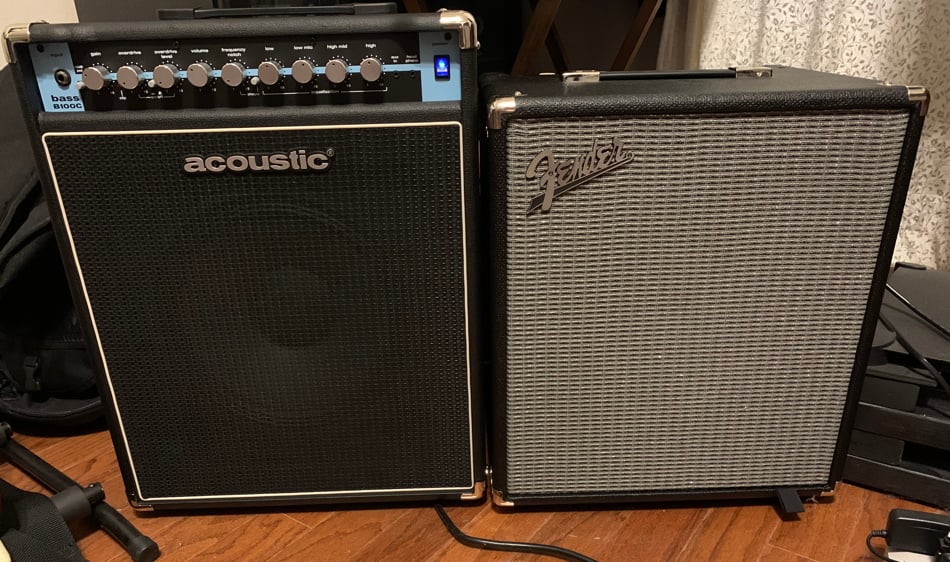
  • Besides being heavier, overall the B100C is also definitely bigger—it's taller and a bit wider. Depth is about the same.

Here they are side-by-side:

r100_b100c.jpg


In my opinion, the other big feature difference between the two is exterior design. While the Fender looks cleaner from the front (though I prefer the Acoustic's black to the Fender's silver), well, it's obvious Fender has never even spoken to a human factors specialist. (This is my day job so I'm picky about this.)

From the front of it, you can't see what any of the knobs are set to. Not a deal-breaker, but mildly grating. (To be fair, the knobs on the Acoustic suck from a readability perspective even when you can see them.) The real stupid on the Rumble, though, is the location of the headphone and aux in jacks. They are on the back. Yeah, that's it, I want to have to either turn the unit around or fumble around trying to plug into them without being able to see them. I would like to bring the genius who came up with this into my lab and have them do this for me a few times and then explain themselves. Clearly, they think nobody ever uses this. Now, they might be right for some people; if you never use the headphone jack or the aux in, no big deal. If you're just gigging or practicing with others, this will never come up. So you might not care about this, and that's fine.

But I'm at home pretty much all the time these days and so is everyone else in the family, and they don't always want to hear me. Sure, I could use like a Vox headphone amp (and that's what I have been doing), but then no pedals. It's just a really poorly thought-out design, at least for the case where you might actually use the headphones or aux in. (Frankly, I should have thought of this before I bought the Fender. Oops.) Anyway (in case you couldn't tell), I hate this about the Rumble. This is what actually first caused me to start thinking about getting something else.

Oh, and Sweetwater doesn't carry the B100C, whereas everybody and their brother sells the Rumble.

Sound Quality
Screw all that stuff, we're musicians—what do they sound like? That's probably what a lot of you came here for.

The knock on the Rumbles from the anti-Rumble crowd is that they sound "boxy." Sometimes described as boomy or muddy, too. I don't think it's that bad, given the price, but that's what I figured I was stuck with without spending more—I am still relatively new to this whole bass thing. I know what to expect from music/HT subwoofers (I have a Rythmik L22 in my home theater), and compared to something like that, yes, I'd certainly characterize the Rumble 100 as being on the boxy side. Not as bad as the worst complaints (set the EQ, it really helps—see the testing notes) but definitely a thing.

So, how about the Acoustic? Well, turns out I was wrong (happens a lot)—the vagueness of the Rumble is not what you're stuck with for $300. The biggest fundamental difference between the two is clarity. Hard to lay out more specifically, but when you play a note through the Rumble, you get a bass note. When you play a note through the Acoustic, you clearly get the sound of a string vibrating, if that difference makes any sense. There's a crispness to the sound that's just not there with the Rumble. More definition, sharper attack, quicker decay. Not night-and-day different, but certainly a sizable improvement. When I would switch back and forth, playing through the Rumble kind of sounded like someone threw a blanket over the B100C. (I almost did this just for grins but I spent enough time on this as it is.)

Pretty much no matter which bass I used or what I played, I liked the sound of the B100C better. Now, with some effects turned on the difference was smaller. In particular, with heavier distortion, where things are kind of smeared anyway, the difference was not that big. Modulation effects (phaser and chorus) also made the difference smaller, but not as much as distortion.

But here's the thing: when I played along to music (not through the amp, but music coming from separate speakers), I knew the difference was there and I still felt the Acoustic was better, but I'm not sure anyone just casually listening would actually notice. Especially with distortion turned on.

There is one other thing, though, that made the difference larger: standing up. I have always thought the Rumble doesn't sound as good when I stand up, which isn't surprising since it's basically aimed at my shins. First, the 100C is just better about this in general, but being able to put the B100C into the "wedge" orientation just made this so much better. Minor detail but it does make a real difference.

Recommendation
So, if I could keep only one, what would I keep? Well, right now, the Acoustic B100C for sure. I'm not playing out, often playing alone (though sometimes with my son on guitar), and the improvements in sound quality and convenience make this a no-brainer. The B100C is a really awesome practice amp for the money. Plus, you save $20 vs. the Fender, enough for a pizza and a couple beers.* Win!

But if I were regularly playing out I'd probably keep the Rumble. Yes, I'd be sacrificing sound quality but if I'm mostly going into FOH I'm not sure how much difference it'd make to the audience. The Rumble is just so much smaller and lighter that consideration kind of takes over. It might depend a little on what was being played, too: if I'm playing distorted punk or metal in a loud bar with FOH, there's no way anyone would hear the difference; Rumble for sure. If it's a jazz trio in a coffee shop and there's no FOH, well, then it might be worth lugging the Acoustic. Maybe, if there aren't a lot of stairs.

Hope this was helpful for someone!


Testing Notes (skippable)
First, there's the problem of EQ. If you have all the knobs at 12:00 on the Fender, well, it's mid-scooped, and pretty substantially so. (Comedy tip: turn on the "contour" button on the Rumble and listen to the mids completely vanish!) Within two days of first getting it I backed off the bass to about 10:00 because it was just boomy. Within two weeks I was looking on TB for other advice, which I found: to get it to be close to flat, you need to turn down the bass and treble to about 10:00, the lower mids to about 1:00, and the upper mids to about 2:00. One of the best pieces of advice I've gotten here on TB, made the Rumble sound a lot better. This is what I'd been used to.

So, what to set the B100C to? This I mostly did by ear. The Fender I left at its usual settings. Out of the box with everything at noon, the Acoustic has a much more even response than the Fender. Touch trebly, so I dialed that back to around 10:00 and it sounded pretty even. I did a real-time spectrograph to make sure they both had similar-looking responses. Not a perfect procedure but I think they were pretty close.

The next challenge was level-matching. The Fender is a lot louder at the same gain and volume levels. Either they are not really both 100w or the Fender is more efficient; the latter seems more likely. I tried to level-match by ear but that's not very accurate. Tried with a sound level meter but it's hard to guarantee you play at the same volume and even with that, the Fender always seemed louder. Solution? Played pink noise through them both (not the aux jack, the actual instrument in) with level meter to get it even. That seemed to work well.

Played three different basses: Yamaha BB734a, SBMM Ray34, Sire M2. For the Yamaha and the Sire, played both active and passive, neck pickup only, bridge pickup only, and 50/50. Left EQ flat for all of it. Also played with multiple pedals: compression (Darkglass Hyper Luminal), synth octave (DOD Meatbox), distortion (DOD Boneshaker), phaser (MXR Phase 90), chorus (EHX Bass Clone) and delay (Boss DD-3T). Didn't bother with the fuzzes. I don't think I played every pedal on every setting of each bass (or if I did, I forgot to take notes on some), but I tried to make sure I got a pretty good sampling.

One thing I realized I didn't do was play with the overdrive on the amps. I never use amp-based overdrive so I just forgot. Oops. Sorry if that's a feature you care about.

*Or enough to hire Geddy Lee to sing on your "hit single," twice. Don't worry if you don't get this, but gold star if you do.
 
Last edited:
Backstory (skippable)
A few months ago I upgraded from a Rumble25 (passable cheap starter amp) to a Rumble 100, and I've been kind of lukewarm on it. The larger driver and the extra power are great, but at the same time it just didn't do much for me. I got some unexpected discretionary money recently and decided I'd try an alternative, and one in the same price range, since lots of us are really just playing at home right now and aren't in the market for big stage rigs.

Now, the Fender Rumble Club is pretty large and active, so the Rumble 100 is a really popular choice around here in this price range. However, recently there's been a thread that's quite down on the Rumbles, the 100 in particular. Of course, this being TalkBass most of the suggestions for alternatives were 2-5x more expensive, so maybe not as much help for the budget-conscious bassist.

So, I picked up the B100C and thought people might want a bit of a comparison.

Common Features
The two combos are similar in a lot of ways in terms of features:
  • 1 x 12"
  • Listed at 100w
  • 4-band EQ
  • Separate gain and volume
  • Overdrive
  • XLR out w/ground lift
  • Aux in
  • Headphone jack
  • Effects loop

The Rumble 100 lists for $300, the Acoustic B100C for $280.

Feature differences
  • Weight is for sure the biggest one. Rumble is 22 lbs, B100C is 37.5 lbs. That's 1.7x. It's a substantial difference in terms of luggability.
  • The B100C can be set up in a "wedge" configuration.
  • The DI out on the B100C has a level control, and can be set to post-EQ or pre-EQ. Could be a big deal for some FOH applications.
  • The B100C has a -10dB pad for active or hot basses.
  • The B100C has a clipping indicator on the preamp.
  • The EQs are different. The B100C has a settable notch filter while the Rumble has essentially three canned EQ-curve settings ("bright," "contour," and "vintage.")
  • Besides being heavier, overall the B100C is also definitely bigger—it's taller and a bit wider. Depth is about the same.

Here they are side-by-side:

View attachment 3920603

In my opinion, the other big feature difference between the two is exterior design. While the Fender looks cleaner from the front (though I prefer the Acoustic's black to the Fender's silver), well, it's obvious Fender has never even spoken to a human factors specialist. (This is my day job so I'm picky about this.)

From the front of it, you can't see what any of the knobs are set to. Not a deal-breaker, but mildly grating. (To be fair, the knobs on the Acoustic suck from a readability perspective even when you can see them.) The real stupid on the Rumble, though, is the location of the headphone and aux in jacks. They are on the back. Yeah, that's it, I want to have to either turn the unit around or fumble around trying to plug into them without being able to see them. I would like to bring the genius who came up with this into my lab and have them do this for me a few times and then explain themselves. Clearly, they think nobody ever uses this. Now, they might be right for some people; if you never use the headphone jack or the aux in, no big deal. If you're just gigging or practicing with others, this will never come up. So you might not care about this, and that's fine.

But I'm at home pretty much all the time these days and so is everyone else in the family, and they don't always want to hear me. Sure, I could use like a Vox headphone amp (and that's what I have been doing), but then no pedals. It's just a really poorly thought-out design, at least for the case where you might actually use the headphones or aux in. (Frankly, I should have thought of this before I bought the Fender. Oops.) Anyway (in case you couldn't tell), I hate this about the Rumble. This is what actually first caused me to start thinking about getting something else.

Oh, and Sweetwater doesn't carry the B100C, whereas everybody and their brother sells the Rumble.

Sound Quality
Screw all that stuff, we're musicians—what do they sound like? That's probably what a lot of you came here for.

TLDR version: the B100C sounds better than the Rumble. Read on if you want the details.

The knock on the Rumbles from the anti-Rumble crowd is that they sound "boxy." Sometimes described as boomy or muddy, too. I don't think it's that bad, given the price, but that's what I figured I was stuck with without spending more—I am still relatively new to this whole bass thing. I know what to expect from music/HT subwoofers (I have a Rythmik L22 in my home theater), and compared to something like that, yes, I'd certainly characterize the Rumble 100 as being on the boxy side. Not as bad as the worst complaints (set the EQ, it really helps—see the testing notes) but definitely a thing.

So, how about the Acoustic? Well, turns out I was wrong (happens a lot)—the vagueness of the Rumble is not what you're stuck with for $300. The biggest fundamental difference between the two is clarity. Hard to lay out more specifically, but when you play a note through the Rumble, you get a bass note. When you play a note through the Acoustic, you clearly get the sound of a string vibrating, if that difference makes any sense. There's a crispness to the sound that's just not there with the Rumble. More definition, sharper attack, quicker decay. Not night-and-day different, but certainly a sizable improvement. When I would switch back and forth, playing through the Rumble kind of sounded like someone threw a blanket over the B100C. (I almost did this just for grins but I spent enough time on this as it is.)

Pretty much no matter which bass I used or what I played, I liked the sound of the B100C better. Now, with some effects turned on the difference was smaller. In particular, with heavier distortion, where things are kind of smeared anyway, the difference was not that big. Modulation effects (phaser and chorus) also made the difference smaller, but not as much as distortion.

But here's the thing: when I played along to music (not through the amp, but music coming from separate speakers), I knew the difference was there and I still felt the Acoustic was better, but I'm not sure anyone just casually listening would actually notice. Especially with distortion turned on.

There is one other thing, though, that made the difference larger: standing up. I have always thought the Rumble doesn't sound as good when I stand up, which isn't surprising since it's basically aimed at my shins. First, the 100C is just better about this in general, but being able to put the B100C into the "wedge" orientation just made this so much better. Minor detail but it does make a real difference.

Recommendation
So, if I could keep only one, what would I keep? Well, right now, the Acoustic B100C for sure. I'm not playing out, often playing alone (though sometimes with my son on guitar), and the improvements in sound quality and convenience make this a no-brainer. The B100C is a really awesome practice amp for the money. Plus, you save $20 vs. the Fender, enough for a pizza and a couple beers.* Win!

But if I were regularly playing out I'd probably keep the Rumble. Yes, I'd be sacrificing sound quality but if I'm mostly going into FOH I'm not sure how much difference it'd make to the audience. The Rumble is just so much smaller and lighter that consideration kind of takes over. It might depend a little on what was being played, too: if I'm playing distorted punk or metal in a loud bar with FOH, there's no way anyone would hear the difference; Rumble for sure. If it's a jazz trio in a coffee shop and there's no FOH, well, then it might be worth lugging the Acoustic. Maybe, if there aren't a lot of stairs.

Hope this was helpful for someone!


Testing Notes (skippable)
First, there's the problem of EQ. If you have all the knobs at 12:00 on the Fender, well, it's mid-scooped, and pretty substantially so. (Comedy tip: turn on the "contour" button on the Rumble and listen to the mids completely vanish!) Within two days of first getting it I backed off the bass to about 10:00 because it was just boomy. Within two weeks I was looking on TB for other advice, which I found: to get it to be close to flat, you need to turn down the bass and treble to about 10:00, the lower mids to about 1:00, and the upper mids to about 2:00. One of the best pieces of advice I've gotten here on TB, made the Rumble sound a lot better. This is what I'd been used to.

So, what to set the B100C to? This I mostly did by ear. The Fender I left at its usual settings. Out of the box with everything at noon, the Acoustic has a much more even response than the Fender. Touch trebly, so I dialed that back to around 10:00 and it sounded pretty even. I did a real-time spectrograph to make sure they both had similar-looking responses. Not a perfect procedure but I think they were pretty close.

The next challenge was level-matching. The Fender is a lot louder at the same gain and volume levels. Either they are not really both 100w or the Fender is more efficient; the latter seems more likely. I tried to level-match by ear but that's not very accurate. Tried with a sound level meter but it's hard to guarantee you play at the same volume and even with that, the Fender always seemed louder. Solution? Played pink noise through them both (not the aux jack, the actual instrument in) with level meter to get it even. That seemed to work well.

Played three different basses: Yamaha BB734a, SBMM Ray34, Sire M2. For the Yamaha and the Sire, played both active and passive, neck pickup only, bridge pickup only, and 50/50. Left EQ flat for all of it. Also played with multiple pedals: compression (Darkglass Hyper Luminal), synth octave (DOD Meatbox), distortion (DOD Boneshaker), phaser (MXR Phase 90), chorus (EHX Bass Clone) and delay (Boss DD-3T). Didn't bother with the fuzzes. I don't think I played every pedal on every setting of each bass (or if I did, I forgot to take notes on some), but I tried to make sure I got a pretty good sampling.

One thing I realized I didn't do was play with the overdrive on the amps. I never use amp-based overdrive so I just forgot. Oops. Sorry if that's a feature you care about.

*Or enough to hire Geddy Lee to sing on your "hit single," twice. Don't worry if you don't get this, but gold star if you do.
I prefer the Acoustic also, but I would keep both and use a Sansamp for a splitter, running them in stereo for extra volume and coolness. I'd run the unaffected (clean) out from the Sansamp into the Acoustic (EQ for fullness) and the grindier affected signal out to the Fender. Also maybe put the Fender on a stand. Now you got a 200w stereo poor man's Chris Squire thing happening.
 
Thank you for the detailed notes.

I've played through the GC "Acoustic" stuff briefly on a few occasions (in store -- also know someone with one of the combos -- a 210, I think). It has its limitations, obviously -- and I've never played any of the stuff in performance or pushed it -- but I liked that they seemed to be going for a fairly natural, un-hyped sound. I thought that they sounded alright, everything considered.

I found myself playing through a Rumble 500 last year for a performance. I don't remember exactly what I did with the EQ, but I think it was similar to what you describe (boosting the mid bands, rolling back bass and treble) to get something approximating an even response. I find the Rumbles more "boomy" than "boxy" but think that they can sound good in the right setting. I'm not sure exactly what's going on with the cabinet design and tuning on the Rumbles, but I feel like the "boom" is the result of an attempt to get too much free (or faux) bass out of the speakers and cabs they're using. I could be wrong. Again, they can sound good in the right settings -- played my P with flats through the little 25, earlier this year, during a low-key jam with a vocalist and he remarked on how sweet the bass sounded in that setting -- he was right; there was a nice synergy with the bass, the amp, and the acoustic -- but my opinion remains. EQ adjustments can help (and should be employed), but don't address the issue entirely.

As for...
The next challenge was level-matching. The Fender is a lot louder at the same gain and volume levels. Either they are not really both 100w or the Fender is more efficient; the latter seems more likely.
It could be that the Fender is in fact more efficient or capable of going louder, but you can't determine that by the knob position. The Fender might just use a different taper on its pots (potentiometers), which is, in fact, a common phenomenon with amps (makes you think it's capable of going louder than it really can, when it's flapping your pants on "3" at the store). Some amps have a usable sweep through most of the volume pot's travel, others blow through most of it by "4".

If you turn the amps up (sometime when the neighbors are away) and one starts complaining (Note: Don't blow your speakers.) while the other remains dynamic and keeps going, that's another story, but the positions of the knobs, in and of themselves, is not necessarily indicative of anything with regard to their respective volume capabilities.
 
The Fender might just use a different taper on its pots (potentiometers), which is, in fact, a common phenomenon with amps (makes you think it's capable of going louder than it really can, when it's flapping your pants on "3" at the store). Some amps have a usable sweep through most of the volume pot's travel, others blow through most of it by "4".

Yep, you're totally right, that's another possible—and frankly, more likely—explanation. The Fender is uniformly louder up to about 2:00 on the volume knob, but I never went past that, so it could easily be a difference in pots.
 
  • Like
Reactions: nixdad
Nice.
I have the acoustic B200 115 combo (1st version) got it used for a song at GC. I love it. Nothing wrong with the sounds I get out of it. I use it for practice w a full band. (well, when we were practicing).
For gigs I use a GB Shuttle 6 with 2- 112 epiphany cabs. Yea, I guess that setup sounds a little better, but really, in a band mix, the audience don't care.

37 Pounds?, that's light son. My B200 V1, 15" Combo is 67 pounds. :jawdrop:


People just gotta hate - cuz it aint a "fender" or ampeg or what have you. :bassist:

I will say that although heavier, the knobs on the 1st version look and feel more substantial that this latest version. But I recommend these acoustics whenever someone asks.

YMMV.

T$
 
Backstory (skippable)
A few months ago I upgraded from a Rumble25 (passable cheap starter amp) to a Rumble 100, and I've been kind of lukewarm on it. The larger driver and the extra power are great, but at the same time it just didn't do much for me. I got some unexpected discretionary money recently and decided I'd try an alternative, and one in the same price range, since lots of us are really just playing at home right now and aren't in the market for big stage rigs.

Now, the Fender Rumble Club is pretty large and active, so the Rumble 100 is a really popular choice around here in this price range. However, recently there's been a thread that's quite down on the Rumbles, the 100 in particular. Of course, this being TalkBass most of the suggestions for alternatives were 2-5x more expensive, so maybe not as much help for the budget-conscious bassist.

So, I picked up the B100C and thought people might want a bit of a comparison.

Common Features
The two combos are similar in a lot of ways in terms of features:
  • 1 x 12"
  • Listed at 100w
  • 4-band EQ
  • Separate gain and volume
  • Overdrive
  • XLR out w/ground lift
  • Aux in
  • Headphone jack
  • Effects loop

The Rumble 100 lists for $300, the Acoustic B100C for $280.

Feature differences
  • Weight is for sure the biggest one. Rumble is 22 lbs, B100C is 37.5 lbs. That's 1.7x. It's a substantial difference in terms of luggability.
  • The B100C can be set up in a "wedge" configuration.
  • The DI out on the B100C has a level control, and can be set to post-EQ or pre-EQ. Could be a big deal for some FOH applications.
  • The B100C has a -10dB pad for active or hot basses.
  • The B100C has a clipping indicator on the preamp.
  • The EQs are different. The B100C has a settable notch filter while the Rumble has essentially three canned EQ-curve settings ("bright," "contour," and "vintage.")
  • Besides being heavier, overall the B100C is also definitely bigger—it's taller and a bit wider. Depth is about the same.

Here they are side-by-side:

View attachment 3920603

In my opinion, the other big feature difference between the two is exterior design. While the Fender looks cleaner from the front (though I prefer the Acoustic's black to the Fender's silver), well, it's obvious Fender has never even spoken to a human factors specialist. (This is my day job so I'm picky about this.)

From the front of it, you can't see what any of the knobs are set to. Not a deal-breaker, but mildly grating. (To be fair, the knobs on the Acoustic suck from a readability perspective even when you can see them.) The real stupid on the Rumble, though, is the location of the headphone and aux in jacks. They are on the back. Yeah, that's it, I want to have to either turn the unit around or fumble around trying to plug into them without being able to see them. I would like to bring the genius who came up with this into my lab and have them do this for me a few times and then explain themselves. Clearly, they think nobody ever uses this. Now, they might be right for some people; if you never use the headphone jack or the aux in, no big deal. If you're just gigging or practicing with others, this will never come up. So you might not care about this, and that's fine.

But I'm at home pretty much all the time these days and so is everyone else in the family, and they don't always want to hear me. Sure, I could use like a Vox headphone amp (and that's what I have been doing), but then no pedals. It's just a really poorly thought-out design, at least for the case where you might actually use the headphones or aux in. (Frankly, I should have thought of this before I bought the Fender. Oops.) Anyway (in case you couldn't tell), I hate this about the Rumble. This is what actually first caused me to start thinking about getting something else.

Oh, and Sweetwater doesn't carry the B100C, whereas everybody and their brother sells the Rumble.

Sound Quality
Screw all that stuff, we're musicians—what do they sound like? That's probably what a lot of you came here for.

TLDR version: the B100C sounds better than the Rumble. Read on if you want the details.

The knock on the Rumbles from the anti-Rumble crowd is that they sound "boxy." Sometimes described as boomy or muddy, too. I don't think it's that bad, given the price, but that's what I figured I was stuck with without spending more—I am still relatively new to this whole bass thing. I know what to expect from music/HT subwoofers (I have a Rythmik L22 in my home theater), and compared to something like that, yes, I'd certainly characterize the Rumble 100 as being on the boxy side. Not as bad as the worst complaints (set the EQ, it really helps—see the testing notes) but definitely a thing.

So, how about the Acoustic? Well, turns out I was wrong (happens a lot)—the vagueness of the Rumble is not what you're stuck with for $300. The biggest fundamental difference between the two is clarity. Hard to lay out more specifically, but when you play a note through the Rumble, you get a bass note. When you play a note through the Acoustic, you clearly get the sound of a string vibrating, if that difference makes any sense. There's a crispness to the sound that's just not there with the Rumble. More definition, sharper attack, quicker decay. Not night-and-day different, but certainly a sizable improvement. When I would switch back and forth, playing through the Rumble kind of sounded like someone threw a blanket over the B100C. (I almost did this just for grins but I spent enough time on this as it is.)

Pretty much no matter which bass I used or what I played, I liked the sound of the B100C better. Now, with some effects turned on the difference was smaller. In particular, with heavier distortion, where things are kind of smeared anyway, the difference was not that big. Modulation effects (phaser and chorus) also made the difference smaller, but not as much as distortion.

But here's the thing: when I played along to music (not through the amp, but music coming from separate speakers), I knew the difference was there and I still felt the Acoustic was better, but I'm not sure anyone just casually listening would actually notice. Especially with distortion turned on.

There is one other thing, though, that made the difference larger: standing up. I have always thought the Rumble doesn't sound as good when I stand up, which isn't surprising since it's basically aimed at my shins. First, the 100C is just better about this in general, but being able to put the B100C into the "wedge" orientation just made this so much better. Minor detail but it does make a real difference.

Recommendation
So, if I could keep only one, what would I keep? Well, right now, the Acoustic B100C for sure. I'm not playing out, often playing alone (though sometimes with my son on guitar), and the improvements in sound quality and convenience make this a no-brainer. The B100C is a really awesome practice amp for the money. Plus, you save $20 vs. the Fender, enough for a pizza and a couple beers.* Win!

But if I were regularly playing out I'd probably keep the Rumble. Yes, I'd be sacrificing sound quality but if I'm mostly going into FOH I'm not sure how much difference it'd make to the audience. The Rumble is just so much smaller and lighter that consideration kind of takes over. It might depend a little on what was being played, too: if I'm playing distorted punk or metal in a loud bar with FOH, there's no way anyone would hear the difference; Rumble for sure. If it's a jazz trio in a coffee shop and there's no FOH, well, then it might be worth lugging the Acoustic. Maybe, if there aren't a lot of stairs.

Hope this was helpful for someone!


Testing Notes (skippable)
First, there's the problem of EQ. If you have all the knobs at 12:00 on the Fender, well, it's mid-scooped, and pretty substantially so. (Comedy tip: turn on the "contour" button on the Rumble and listen to the mids completely vanish!) Within two days of first getting it I backed off the bass to about 10:00 because it was just boomy. Within two weeks I was looking on TB for other advice, which I found: to get it to be close to flat, you need to turn down the bass and treble to about 10:00, the lower mids to about 1:00, and the upper mids to about 2:00. One of the best pieces of advice I've gotten here on TB, made the Rumble sound a lot better. This is what I'd been used to.

So, what to set the B100C to? This I mostly did by ear. The Fender I left at its usual settings. Out of the box with everything at noon, the Acoustic has a much more even response than the Fender. Touch trebly, so I dialed that back to around 10:00 and it sounded pretty even. I did a real-time spectrograph to make sure they both had similar-looking responses. Not a perfect procedure but I think they were pretty close.

The next challenge was level-matching. The Fender is a lot louder at the same gain and volume levels. Either they are not really both 100w or the Fender is more efficient; the latter seems more likely. I tried to level-match by ear but that's not very accurate. Tried with a sound level meter but it's hard to guarantee you play at the same volume and even with that, the Fender always seemed louder. Solution? Played pink noise through them both (not the aux jack, the actual instrument in) with level meter to get it even. That seemed to work well.

Played three different basses: Yamaha BB734a, SBMM Ray34, Sire M2. For the Yamaha and the Sire, played both active and passive, neck pickup only, bridge pickup only, and 50/50. Left EQ flat for all of it. Also played with multiple pedals: compression (Darkglass Hyper Luminal), synth octave (DOD Meatbox), distortion (DOD Boneshaker), phaser (MXR Phase 90), chorus (EHX Bass Clone) and delay (Boss DD-3T). Didn't bother with the fuzzes. I don't think I played every pedal on every setting of each bass (or if I did, I forgot to take notes on some), but I tried to make sure I got a pretty good sampling.

One thing I realized I didn't do was play with the overdrive on the amps. I never use amp-based overdrive so I just forgot. Oops. Sorry if that's a feature you care about.

*Or enough to hire Geddy Lee to sing on your "hit single," twice. Don't worry if you don't get this, but gold star if you do.
Thanks for such a thorough review, @SunByrne!

I’ve used an Acoustic B100C as my primary amp for the last 2 years in my acoustic/electric Beatles band, and before then used the Acoustic 50 watt wedge monitor combo. We run everything through the P.A. and everyone has their own personal monitors, so we’re able to keep stage volume very manageable.

Prior to purchasing the B100C I had bought a Rumble 100 because I wanted the lighter weight, but I could not stand the sound so I exchanged it for the Acoustic.

The wedge-monitor shape is a key factor for me, and as you stated in your review, you can see the controls. I mount mine on an amp stand next to my ear (we perform seated,) which is ideal for our setup. Not being able to see the knobs with this setup was another strike against the Fender.

Anyway, the Acoustic B100C has performed well for my needs. I wish it was a tad lighter, but it’s manageable.

Here’s our promo video. You can see the B100C in several of the video clips.


Chris
 
…….and to think my very first bass amp combo was a brand new 1974 Acoustic Control 136.....that sucker weighed 75 lbs! Thank God it came with casters. I actually tried a couple of the new Ac combos out at GC back in the early spring...thought they sounded pretty decent. I'm just not a big fan of rear controls and the grill covers on the Rumbles - fairly flimsy. But...doesn't mean they sound bad, and I guess that's the final decision, along with the other intangibles, to make.
 
  • Like
Reactions: Ronzo and nixdad
37 Pounds?, that's light son. My B200 V1, 15" Combo is 67 pounds. :jawdrop:

Sure, in an absolute sense, 37 isn't that much—the Ampeg BA-112 (also $300) weighs in at 42 lbs. But 37 is a lot compared to the Rumble 100's insanely light 22 lbs.


People just gotta hate - cuz it aint a "fender" or ampeg or what have you. :bassist:

I've not heard people hating on the Acoustic... it's that here on TB they hardly get talked about at all. It's all, as you note, Fender and Ampeg, with some GK and Hartke sprinkled in, maybe an occasional mention of a Peavey, a Markbass, or a Roland Cube. It's like they don't exist. I guess that's what you get for being the new kid on the block; the current version of Acoustic hasn't been around that long. 2008 or so?
 
The more direct sound of the Acoustic is at least partially due to the the extra weight of the more solid cabinetry, IMO. I know some high-end cab makers can built strong cabs that are still light but they are expensive. One high-end lightweight 12" cab (not a combo amp) by itself is like 600 - 800 bucks these days. Yes the speaker cost more (than these two combos) but not that much more. Maybe 50 - 100 extra bucks for the speaker. Therefore there's money in making the cabinet strong but still light. The Fender is light but it's only 300 bucks for the combo. There has to be some cutting corners to achieve this. The Acoustic took a more traditional approach to building the cabinet (apparently) by using more substantial woods in order to achieve the sound at a reasonable (but not light) weight. Regardless, I like the look and the extra features on the Acoustic, and if I was in the market for a 100 watt 12" combo for 300 or less, it's at the top of my list.
 
Last edited:
Today's Acoustic amps are exclusively sold by Guitar Center and it's partners Musician's Friend, Music and Arts, etc.

That's a definite negative, to be sure.

Fellow Rythmik sub owner, too! (I've got the F12G, and plan to add a second at some point.)

Yeah, my Rythmik L22 is just fantastic, but I really do need to add a second sub to even out the room response. TBH I'm also looking at the Seaton JS-12 (they also sound fantastic) just because they're so small, and in the living room, spouse acceptance is a thing.
 
Yeah, my Rythmik L22 is just fantastic, but I really do need to add a second sub to even out the room response. TBH I'm also looking at the Seaton JS-12 (they also sound fantastic) just because they're so small, and in the living room, spouse acceptance is a thing.

Luckily I only have to worry about cat acceptance, and she can be easily bribed with catnip treats.

I also want to add that it's nice to see someone employing some objective testing. Having only started learning to play an instrument pretty recently, I'm quite surprised at the lack of objective information out there about a lot of gear, but especially cabs. I thought it was bad in the audiophile world when it comes to getting objective information about speakers, but it's way worse for bass cabs!
 
I also want to add that it's nice to see someone employing some objective testing.

Thanks. I only did a little. I know enough psychoacoustics to know it's pointless to compare if things aren't level-matched. If they're not, people have a strong tendency to just prefer the louder one.


Having only started learning to play an instrument pretty recently, I'm quite surprised at the lack of objective information out there about a lot of gear, but especially cabs. I thought it was bad in the audiophile world when it comes to getting objective information about speakers, but it's way worse for bass cabs!

You and I are on the same wavelength. I've been the speaker world for ages and in the actual making music world for only a little over a year, and it's been a bit of a transition. In the speaker world, while there's still a tremendous amount of nonsense, real data is slowly starting to creep in. I may never buy another new model of speaker without seeing a full spinorama for it first. (Still want to hear it, though.)

I think the instrument world is fundamentally different. While to a first order of approximation all serious hifi speakers are aiming at the same target--that is, what comes out is exactly what went in--instrument cabs are playing a different game. They're supposed to sound different, in fact, that's actually the whole point. People want to find "their" sound so manufacturers cater to this desire for difference. I think measurements make less sense in this world: response is non-flat on purpose and so you have to figure out which flavor of non-flat suits the sound you're trying to achieve. But yeah, it's still weird not to see any measurements at all, ever.

And I'm threadjacking my own thread...
 
Thanks for this write up.
Could the 15 lb difference be due purely to the cabinetry or does the speaker and electronics also factor in?

I believe the OP was referring to my thread about being the only guy who dislikes the Rumble 100.
I have to admit that the suggestion about getting it off the floor (20" in my case) made a positive difference although it still took a ton of outboard EQ to make it sound decent.
That is something they did not learn from SWR or GB.
 
Thanks for this write up.

My pleasure, glad you enjoyed it.

Could the 15 lb difference be due purely to the cabinetry or does the speaker and electronics also factor in?

I don't know. My guess is probably not electronics since they're both solid state, but could be both cabinet and driver.

I believe the OP was referring to my thread about being the only guy who dislikes the Rumble 100.

I was. Your thread certainly caused a lot of other people to come out of the woodwork and proclaim their dislike for Rumbles. I was kinda surprised how many there were.

I have to admit that the suggestion about getting it off the floor (20" in my case)

Wow, 20" is a lot; that more than doubles the effective height! So much for "small." Still super light, though!