• TalkBass has been independent since 1998. Add your voice.
    Create a free account to reply to discussions, view embedded media, and browse with fewer display ads.
    Join freeLog in
    Want zero display ads or expanded classifieds tools? Compare plans.

NAD: Bugera Veyron BV1001t (I know, I know...)

So I picked this guy up used, for a pretty good price IMO, to pair with my bigger cabs (Ampeg 810 and V4 4x12 with new Basslites). I had been wanting a TC Electronic BH800 for this purpose, as I liked the BH250 with my 210s, but this guy piqued my interest when it popped up locally.

I know about all the concerns/criticisms regarding the Music Tribe brands (ludicrous power ratings, alleged design infringement, etc.), but it was a good price and I can return it within 45 days, so I figured I'd give it a shot.
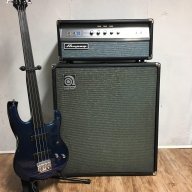
IMG_1985.JPG

My first impression, run through the 4x12, was "Whoa!!" The notes were BIG, fat and knock-down punchy. It really woke the cab up. My Band Leader asked "what's that?!" after the first few notes. I know it's not 2,000 watts (maybe 2,000 Ulis...) but it clearly can get stupid loud.

I was able to dial in a good sound with the EQ pretty much flat; I even had to back the bass off to about 10 o'clock on the 4x12. I tried it with the 2 210s too, and boosted the mids at 220 hz. and it sounded good to me. I was able to get some tube grit going too, with the Gain dimed.

I do have a couple of gripes, but they are really just "why would they have done that?" things.

1) The LEDs illuminating the interior to "simulate" tube illumination is just silly. I could have done without that.
2) Would have liked the 5-freq selector of the M version of the Veryon vs 3 on the T
3) "Veyron"? Sorry this is no super-car...

Bottom line is I think this is a very good amp, especially for the price. I think it's gotten a bit of bad rap with all the other Music Tribe history. Only question I have now is do I keep the BH250, or not. I really don't think I'm going to need it any further.
 
Last edited:
Don't tell the TB wattage police, but my Veyron M is my favorite amp I've ever owned. It beat out US made "real wattage specced" Peavey, Hartke, and SWR. In my opinion the Veyron is cleaner, louder, lighter, and better. Keep on rocking and let the haters hate. It's seen plenty of rehearsals, almost 100 gigs, and I still have 3 years left on the extended warranty. I hope you enjoy yours as much as I do mine.
 
Picked up one of these earlier this week- Very deep ended amp. The first day I was crushed because even with the -15dB on, the input was easily driven to a "splattery" sound that no one wants to hear. None of the input gain/vol knobs seemed to be able to adjust out this splatter- leading me to believe that the input hits some fixed gain op-amp stage before getting to any of the adjustments. (Why does it seem that so many vendors don't actually put enough attenuation in the amp to make it play well with an active bass?) Any way-The only way to get rid of it was to turn down the bass control at my bass to a level that I could hit the loudest note without splatter. - Once I got to that point the rest of the controls at the amplifier started to act somewhat "normal"- and the tone was great.

On the second day I decided to add an attenuator right before the input and this allowed me to run my bass at least at the center detent on my bass's bass control. Its aggravating to have to have the attenutator in the line , but with it that way I am now able to run the gain knob anywhere I want- and with it really high- I getting great tones that are starting to get close with my 70's Ampeg tube head. (But that all tube head is still the gold standard). BTW the rest of the knobs I have almost exactly where they are in your pic above (with teh exception of the bass knob because I am on a cab with an 18" in it)

I am impressed with it now- will be keeping it.

I agree the LED's inside the preamp area are lame. Tube glow rules.... why on earth would any one ruin it with the LED's glaring up the face.

Looks like a great setup you have there. I wonder if there is a good 2x10 cab that goes along with this thing? I have a Peavey 1810 cab and a hartke 15, but might be in the market to see what all the fuss over these 2x10's is all about.
 
Looks like a great setup you have there. I wonder if there is a good 2x10 cab that goes along with this thing? I have a Peavey 1810 cab and a hartke 15, but might be in the market to see what all the fuss over these 2x10's is all about.

Thanks; I'm pretty happy with the amp and cabs I can pair with it at this point.

As far as the 2x10s, I do prefer the Ampegs (Svt210av), but Bugera makes a 2x10 bass cab that is around $200. I've got no experience with them, but they seem to be well liked from the reviews on Sweetwater. 2 cabs stacked vertically sound best to my ear when using 2x10s, and will present a 4 Ohm load (assuming 8 Ohm cabs).

Might be worth a try, especially if you can demo them in a shop with your amp before buying.
 
Last edited:
  • Like
Reactions: Nate Johnson
Does anybody actually know the power output (W) of this amp? I know that it's not electrically possible for it to be 2,000W under any circumstance using USA electricity in a building that meets safety code. That's because 4 OHM, 2,000W output would pull almost 17A which is more than legally allowed on a common US plug load, even in a commercial setting due to NEC derating. I know you could assume 277VAC in a lab setup but that's not a plug load Voltage and that would only make 2,000W at 38 Ohms so the whole thing is BS. 4 Ohm at 120V gives 3,6000 and 30A according to Ohm's Law which is pretty well established no matter what my local store sales guy says. So given any one of the 12 iterations of basic power formula the math can't be made to work out.
I played one and like the way it sounds but don't want to break stuff downstream. The music store clerk was sticking to his guns. Any idea how many actual Watts at 4 or 8 Ohm?

I've seen some threads about Watts and non-standard Watts which is not a thing. The sad truth is Watts, Amps, Volts and Ohms, any 2 can be variables fixes the other 2 units, Voltage is fixed by the supply circuit (assume 120V) so that means ONLY 1 of Amps, Ohms, OR Watts can be variable. If speakers are designed for 4 or 8 Ohms that means only Amps and Watts can be variable. Just good ole physics.

Please reply if you happen to know the actual output that isn't just whizzed out but the marketing department.
I'm okay with +/- 10% but not +/- 1,000W.
 
Does anybody actually know the power output (W) of this amp? I know that it's not electrically possible for it to be 2,000W under any circumstance using USA electricity in a building that meets safety code. That's because 4 OHM, 2,000W output would pull almost 17A which is more than legally allowed on a common US plug load, even in a commercial setting due to NEC derating. I know you could assume 277VAC in a lab setup but that's not a plug load Voltage and that would only make 2,000W at 38 Ohms so the whole thing is BS. 4 Ohm at 120V gives 3,6000 and 30A according to Ohm's Law which is pretty well established no matter what my local store sales guy says. So given any one of the 12 iterations of basic power formula the math can't be made to work out.
I played one and like the way it sounds but don't want to break stuff downstream. The music store clerk was sticking to his guns. Any idea how many actual Watts at 4 or 8 Ohm?

I've seen some threads about Watts and non-standard Watts which is not a thing. The sad truth is Watts, Amps, Volts and Ohms, any 2 can be variables fixes the other 2 units, Voltage is fixed by the supply circuit (assume 120V) so that means ONLY 1 of Amps, Ohms, OR Watts can be variable. If speakers are designed for 4 or 8 Ohms that means only Amps and Watts can be variable. Just good ole physics.

Please reply if you happen to know the actual output that isn't just whizzed out but the marketing department.
I'm okay with +/- 10% but not +/- 1,000W.
Where do you get your power theory? You might want to study up on how a transformer works, how duty cycle is used in all audio power consumption ratings.
This is independent of their claimed audio power.
 
  • Like
Reactions: DJ Bebop
OK I'm confused again. So are you saying it really can generate 2,000W? In my experience best practice usually falls somewhere between engineering and marketing.
No.

I am saying that your general comments about a (true) 2000 watt ("RMS") rated amp exceeding the legal limits of a 120V plug connected circuit (say a 20 amp circuit) is incorrect on several accounts.

1. Audio equipment does not fall under the continuous current derating rule for the NEC. That applies to CONTINUOUS loads that occur for a period of 3 hours or more. On a 20 amp circuit, 2400 VA (or watts if resistive) may be drawn on a short term basis, and thermal-magnetic circuit breakers for branch circuits are rated for this application. On a 15 amp branch circuit, 1800 VA is allowed.

2. In spite of the above, the safety regulations and all testing labs define the power consumption as the greater of 1/8 rated audio power into the lowest rated load impedance, or higher if the product is designed for a specific atypical application. This reflects the crest factor that the audio signal represents as average power over time. Without this crest factor, there would be no dynamics and that really doesn't occur in music. In practice, this is a good number to use for audio consumption, and this derated number would (or may, under engineering calculation) be applied to (or defined as) the continuous load.

As an example of a calculation that would be done, say the amp was 2000 watts RMS, divide this by 8 (or multiply by .125) to get the 1/8-power figure and that is 250 watts. For most SMPS/class D amps, the efficiency will be around 80% at 1/8 power, so to find the rated 1/8-rated power AC line consumption, 250W/0.8 = will be about 312 watts.

THIS is why comments about a 2000 audio watt amp being impossible to power from a simple 15 amp, 120 volt branch circuit is an absurd statement. I do these kinds of calculations in this both the audio and power systems industries every day, this confusion comes up on talkbass with predictable regularity and it's understandable without learning more about why the simple calculations do not and can not apply.
 
OK. Got it I think.

For reference my Mesa is 800W rated. I Must admit it's impressive. My rack rig has 2 500W output channels from power amp at similar resistance. It's also a Class D system. Trying to move away from the larger stuff.

I'm going to take your advice and try one. It it's anything close to my 800W Mesa in terms of speaker driving power I would be very happy for the value.