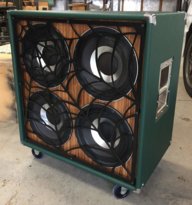
I recently joined a regular jam session as the only bassist amongst a collection of acoustic instruments including guitars, a banjo, mandolin and violin (no drums/percussion). Pretty eclectic, and good fun. I dragged along my usual portable rig of TCE RH450 (pretty much verboten ‘round these parts, I know, but I still like it as a convenient all-in-one head) and Markbass NY 121 cab. It sounded good, but the space is cramped; not an issue for the cab’s footprint, but just for pfaffing about with even minimal cables, having an extra bag, and so on. In addition, it was way overpowered for the context, with the master barely at 8 o’clock. I’m playing a new-model G&L L1000, with TI Jazz flats, just to complete the picture.
So, accepting any excuse to audition some new gear, I betook me to Ye Olde Musick Shoppe (we still have them in NZ). I was looking for something in the ballpark of a Fender Rumble 40, which seemed like the safe option. As a lifelong contrarian, though, I do tend to shy away from the stuff that everyone else has, so I was very much prepared to pick something else unless I was completely blown away.
As it happens, the Rumble 40 was sold out (a mark against it my book) and the 100 was clearly going to be too much amp. What they did have was the new Markbass CMB 101 (40 W, 10” driver, ~10 kg), an Ampeg RB 110 (50 W, 10” driver, ~10 kg), and the Orange Crush Bass 50 (50 W, 12” driver, ~14 kg). Another potential contender would have been the Ashdown Studio 10, but that was at a different store. I used a store Fender player P-bass with stock rounds for the comparison.
I’m a Marbass fan, and still love my old special edition red F1 and the aforementioned NY 121 cab. Ampeg has never really done it for me, but that may be in part due to my baseline contrarianism, as mentioned. The Markbass was … fine. Clean, a familiar EQ (although without the VLE/VPF filters that I like), and loud enough, strictly speaking, but with unpleasant speaker distortion from about 2 o’clock on the volume. The Ampeg was better, louder before it started to complain, and I quite liked the overdrive channel, although it sounds exactly as you would expect. Not a bad thing, and probably a testament to whatever emulation they’re using, if not to the name of it (Super Grit Technology, good grief), but not my preference for the mildly saturated tone I always run from my pedalboard (courtesy of Fairfield and Hudson. No, not the law firm).
I’ve always been a bit intrigued by Orange. We were born in the same year, but at opposite ends of the Commonwealth. Nevertheless, I grew up in England, pretty much soaked by its music as much as by its weather, and a sort of Creamy Purple Zeppelin hybrid tone worked its way into my unconscious. I don’t know how much Orange actually contributed to that sound (Glenn Hughes’ association came later, I think), but it was certainly part of the scene. Anyway, I’d never played one, but was looking forward to it.
I really like it. The base tone with EQ flat is mid-forward, but not overwhelmingly so; “punchy” seems to be the term of art for this sort of thing. The EQ is very responsive, and the semi-parametric mid-control covers a useful range. I don’t know exactly where the centre frequencies are, but they work. The overdrive circuit is where it’s at, though. The gain knob increases saturation without adding volume, but the overdrive channel has its own volume control, labelled “blend”. Again, I don’t have chapter and verse on this, but the amp behaves as though the master volume and blend controls are stacked volume controls for the clean and drive channels, respectively. One upshot of this is that if the blend is turned all the way down (effectively disabling the drive circuit), the amp does not seem to get as loud as the Ampeg or Markbass. Turning the gain down and blend up adds volume without distortion, and diming both is plenty loud without any but the tiniest bit of speaker complaint, making its volume range much more usable than the competitors. Playing with the gain and blend knobs enables me to get exactly the flavour of dirt I like, all the way up to a pretty heavy fuzz, true 60s-London style. My understanding is that there is no emulation here, it’s all analogue circuitry, except for the onboard tuner, which is a very handy touch, and tracks quickly and cleanly, and a cabsim for the headphone out. I can only imagine the power section is class D, and I don’t care either way, but I stand to be corrected. There will be those who complain about the absent DI, although I’m not sure I’d want to rely on the built in DI from an entry-level combo amp in any case. It has an effects loop for those who want that sort of thing, although I can’t see myself using it, and an auxilliary in.
In short, the Ampeg and Markbass were entirely respectable, and if the Orange hadn’t been there, I likely would have purchased one of them, in that order. But for me, all relevant biases disclosed above, there really was no contest.
So, accepting any excuse to audition some new gear, I betook me to Ye Olde Musick Shoppe (we still have them in NZ). I was looking for something in the ballpark of a Fender Rumble 40, which seemed like the safe option. As a lifelong contrarian, though, I do tend to shy away from the stuff that everyone else has, so I was very much prepared to pick something else unless I was completely blown away.
As it happens, the Rumble 40 was sold out (a mark against it my book) and the 100 was clearly going to be too much amp. What they did have was the new Markbass CMB 101 (40 W, 10” driver, ~10 kg), an Ampeg RB 110 (50 W, 10” driver, ~10 kg), and the Orange Crush Bass 50 (50 W, 12” driver, ~14 kg). Another potential contender would have been the Ashdown Studio 10, but that was at a different store. I used a store Fender player P-bass with stock rounds for the comparison.
I’m a Marbass fan, and still love my old special edition red F1 and the aforementioned NY 121 cab. Ampeg has never really done it for me, but that may be in part due to my baseline contrarianism, as mentioned. The Markbass was … fine. Clean, a familiar EQ (although without the VLE/VPF filters that I like), and loud enough, strictly speaking, but with unpleasant speaker distortion from about 2 o’clock on the volume. The Ampeg was better, louder before it started to complain, and I quite liked the overdrive channel, although it sounds exactly as you would expect. Not a bad thing, and probably a testament to whatever emulation they’re using, if not to the name of it (Super Grit Technology, good grief), but not my preference for the mildly saturated tone I always run from my pedalboard (courtesy of Fairfield and Hudson. No, not the law firm).
I’ve always been a bit intrigued by Orange. We were born in the same year, but at opposite ends of the Commonwealth. Nevertheless, I grew up in England, pretty much soaked by its music as much as by its weather, and a sort of Creamy Purple Zeppelin hybrid tone worked its way into my unconscious. I don’t know how much Orange actually contributed to that sound (Glenn Hughes’ association came later, I think), but it was certainly part of the scene. Anyway, I’d never played one, but was looking forward to it.
I really like it. The base tone with EQ flat is mid-forward, but not overwhelmingly so; “punchy” seems to be the term of art for this sort of thing. The EQ is very responsive, and the semi-parametric mid-control covers a useful range. I don’t know exactly where the centre frequencies are, but they work. The overdrive circuit is where it’s at, though. The gain knob increases saturation without adding volume, but the overdrive channel has its own volume control, labelled “blend”. Again, I don’t have chapter and verse on this, but the amp behaves as though the master volume and blend controls are stacked volume controls for the clean and drive channels, respectively. One upshot of this is that if the blend is turned all the way down (effectively disabling the drive circuit), the amp does not seem to get as loud as the Ampeg or Markbass. Turning the gain down and blend up adds volume without distortion, and diming both is plenty loud without any but the tiniest bit of speaker complaint, making its volume range much more usable than the competitors. Playing with the gain and blend knobs enables me to get exactly the flavour of dirt I like, all the way up to a pretty heavy fuzz, true 60s-London style. My understanding is that there is no emulation here, it’s all analogue circuitry, except for the onboard tuner, which is a very handy touch, and tracks quickly and cleanly, and a cabsim for the headphone out. I can only imagine the power section is class D, and I don’t care either way, but I stand to be corrected. There will be those who complain about the absent DI, although I’m not sure I’d want to rely on the built in DI from an entry-level combo amp in any case. It has an effects loop for those who want that sort of thing, although I can’t see myself using it, and an auxilliary in.
In short, the Ampeg and Markbass were entirely respectable, and if the Orange hadn’t been there, I likely would have purchased one of them, in that order. But for me, all relevant biases disclosed above, there really was no contest.