• TalkBass has been independent since 1998. Add your voice.
    Create a free account to reply to discussions, view embedded media, and browse with fewer display ads.
    Join freeLog in
    Want zero display ads or expanded classifieds tools? Compare plans.

Double Bass NBD: 1964 Kay M1 But I got a question.....

Hmmm... I don't think you have to stretch quite as far in those lower positions. :)
Not sure. I play four finger on slab, and pretty much stick with Simandl in the lower positions on upright, so I think the finger stretches are similar. I've never felt quite as home with left hand form on slab, even though I've played both for like 35 years. Upright just feels more natural to me.
 
Last edited:
Not sure. I play four finger on slab, and pretty much stick with Simandl in the lower positions on upright, so I think the finger stretches are similar. I've never felt quite as home with left hand form on slab, even though I've played both for like 35 years. Upright just feels more natural to me.
Sure feels more natural to me too! You're doing better than me. I'm a one-trick pony and stay away from EB. I understand the vibrating string length on EB to be roughly 34". No? That's why I figured the stretches were shorter.
 
Sure feels more natural to me too! You're doing better than me. I'm a one-trick pony and stay away from EB. I understand the vibrating string length on EB to be roughly 34". No? That's why I figured the stretches were shorter.
Well yes, the scale is shorter, but if you play three half steps between one and four on slab, compared to two on upright, then the calculation becomes more complicated than simple scale length.
 
Well yes, the scale is shorter, but if you play three half steps between one and four on slab, compared to two on upright, then the calculation becomes more complicated than simple scale length.
Oh, I see what you mean. I never think about three half-steps between 1 and 4. :) Then again, you mentioned that you stick to Simandl in the lower positions, so there, at least, it's less of a stretch than on DB. EB is a big "stretch" for me anyway. :D
 
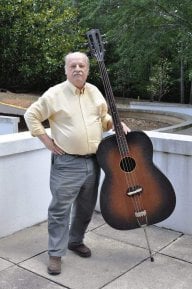
Ok, no pics = no bass so.....

1964%20Kay_zpsdez3pfa6.jpg


The issue is impossible to photograph. You can see daylight ever so slightly between the fingerboard and the neck from about G on the E string till about B or C. it seems stable enough, is this a major issue? Both ends seem very solid and this doesn't appear to be causing any problems.

Thoughts? I'm a total noob here, previous to this all I have owned are EB's and an Ergo EUB.

Thanks in advance, and be gentle, I'm really lost here.

Edit: Thanks Mr. deVilliers for the awesome stand plans!!! Easy as pie to throw together and perfection in its most simplistic form!
 
For a more conventional medium neck profile shape, a shim underneath one of the thin original Kay fingerboards or a thicker replacement ebony fingerboard (the superior choice) would provide a better neck shape for healthy bass playing. The thin Kay neck profile combined with a thin fingerboard does indeed promote bad guitar-like left hand technique and injuries that can become permanent.
 
For a more conventional medium neck profile shape, a shim underneath one of the thin original Kay fingerboards or a thicker replacement ebony fingerboard (the superior choice) would provide a better neck shape for healthy bass playing. The thin Kay neck profile combined with a thin fingerboard does indeed promote bad guitar-like left hand technique and injuries that can become permanent.

Okay; these dots still are not connecting for me. My first two DBs were Kays, and now I am rocking a Lidl and a Strunal. And I have short, stubby fingers that make stopping the strings on the Czech basses more of an ordeal than stopping the Kays ever was. Can't you guys do better than

thin neck = poor technique and possible severe injury

?

How? Why?
 
What I said was "I play four finger on slab, and pretty much stick with Simandl in the lower positions on upright". I dunno. Whenever I post to an internet forum I try to break it down and put it into the simplest words possible. Never seems to help.
I guess I deserved that. :) Sorry, was just not paying close enough attention. I usually read carefully, as you likely know. I'll try to do better.
 
Okay; these dots still are not connecting for me. My first two DBs were Kays, and now I am rocking a Lidl and a Strunal. And I have short, stubby fingers that make stopping the strings on the Czech basses more of an ordeal than stopping the Kays ever was. Can't you guys do better than

thin neck = poor technique and possible severe injury

?

How? Why?
If one has very small hands, then I suppose that a thinner neck profile might actually be preferable. One way or another, those finger spans need to be achieved. In terms of explaining, I tried to do better in a previous post in this thread. I'll try again with something I posted earlier:
I'll give it a try. Think about the left-hand claw that is the "proper" technique and shape for the left hand. Now, imagine trying to squeeze down with the force required to hold the strings but onto a smaller radius. An absurdly extreme example would be trying to make that claw on a pencil. In addition, as pointed out here recently, the smaller the radius into which you fold your left hand, the harder it is to space your fingers the required amount for positions near the nut (half and first position), Give it a try just sitting and reading this. That is, spread your fingers and then fold your hand further toward a fist. The result of playing on a thin neck profile for me and for many other players is that after a prolonged period, the left hand can feel extremely fatigued. When that happens, players typically collapse the thumb and go for the "baseball bat" hold. I played on a Kay for quite a few years when I started. It was all my family could afford. Years later, when I switched to a thicker neck profile, the initial discomfort gave way quickly to a new ease of playing. I realized that I had been laboring against that thin neck profile for all those years. Many players share my experience.
 
If one has very small hands, then I suppose that a thinner neck profile might actually be preferable. One way or another, those finger spans need to be achieved. In terms of explaining, I tried to do better in a previous post in this thread. I'll try again with something I posted earlier:
I'll give it a try. Think about the left-hand claw that is the "proper" technique and shape for the left hand. Now, imagine trying to squeeze down with the force required to hold the strings but onto a smaller radius. An absurdly extreme example would be trying to make that claw on a pencil. In addition, as pointed out here recently, the smaller the radius into which you fold your left hand, the harder it is to space your fingers the required amount for positions near the nut (half and first position), Give it a try just sitting and reading this. That is, spread your fingers and then fold your hand further toward a fist. The result of playing on a thin neck profile for me and for many other players is that after a prolonged period, the left hand can feel extremely fatigued. When that happens, players typically collapse the thumb and go for the "baseball bat" hold. I played on a Kay for quite a few years when I started. It was all my family could afford. Years later, when I switched to a thicker neck profile, the initial discomfort gave way quickly to a new ease of playing. I realized that I had been laboring against that thin neck profile for all those years. Many players share my experience.

OK, drurb; thanks for taking the time and trouble to explain. Just as an experiment, I tried the claw grip on both my Czechs and, as an extreme comparison, on an Englehardt EM-3. If, by baseball bat grip, you mean that the thumb wraps around so that the curve of the neck actually nestles in the web between thumb and forefinger, I see what you mean about the claw being impossible to maintain. The (or at least my) fingers won't spread; they morph into the fisticuffs grip. But I don't collapse my thumb into the baseball bat grip, simply because when I do, my ring and pinky fingers collapse as well. I am reduced, essentially, to playing "Django" bass.

I think what makes me so persnickity in a lot of these threads is 1) the lack of close reading, and 2) the tendency to expand a generalization into a universal, begging a lot of questions in the process.
 
OK, drurb; thanks for taking the time and trouble to explain. Just as an experiment, I tried the claw grip on both my Czechs and, as an extreme comparison, on an Englehardt EM-3. If, by baseball bat grip, you mean that the thumb wraps around so that the curve of the neck actually nestles in the web between thumb and forefinger, I see what you mean about the claw being impossible to maintain. The (or at least my) fingers won't spread; they morph into the fisticuffs grip. But I don't collapse my thumb into the baseball bat grip, simply because when I do, my ring and pinky fingers collapse as well. I am reduced, essentially, to playing "Django" bass.

I think what makes me so persnickity in a lot of these threads is 1) the lack of close reading, and 2) the tendency to expand a generalization into a universal, begging a lot of questions in the process.
I agree with you, although I made a mess of things a bit earlier by not reading carefully. Actually, I read closely but misinterpreted. Similar ill effect. :)
 
Drurb's explanation is quite good IMO. I think of it as this: Pretend you are holding a grapefruit, with fingers spread out wide. Then slowly move your thumb in toward the center of your hand. If you're like me, not only will the finger span reduce, but resisting it will cause tension.

This doesn't mean you are going to injure your hand playing an unaltered Kay (or slab for that matter). Lot's of people have been doing it for a long time, after all. Just that it's a greater risk, and developing a good form is more challenging.
 
Last edited:
Glad you like the stand. :thumbsup: You need to take your bass to someone who is familiar with Kays and with CF neck reinforcement and let them help you with these decisions.

Its not something we can diagnose over the phone. Good luck!

SWMBO got a kick out of the stand. "You spent all this money on a bass and you used the leftover scraps from building the garage for the stand?" I had the bass about 18 hours and I already had it built and modded to secure it in it's new home. Simple sturdy cheap. Sometimes thats the best solution.

Regarding the bass, I think it's going to Guarneri. Not sure what the outcome will be but, Aaron did some work on it before I bought it so he has already looked at it once (at least) so I'm leaning in that direction. Just gotta find time to get it there.
 
  • Like
Reactions: Jake deVilliers
Angling the outermost limb of the thumb (more) inside the hand may help playing on a bass with a thinner neck.
If I understand correctly, that's the opposite of what robobass just said. I think robobass is correct and that's why players end up with the "baseball bat" hold or just pointing the thumb straight up toward the scroll when playing on thin necks. Specifically, the thumb is moved away from the center of the hand in order to reduce the tension.