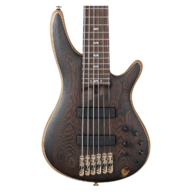
About ten minutes after I thought I might want what I’ve taken to calling a “bass baritone guitar”—an instrument tuned B0–B2, an octave below a common baritone guitar tuning—Ibanez actually came out with an instrument that just might do it, and at a price I could justify for what remains an experiment for me. They call it the SRC6MS; I call it THE ABOMINATION! 


Even at an attractive price, I still wanted to sell something to fund it, and I had a number of repair jobs lined up as well, so it took me over a year to get around to finally acquiring this thing.
To be clear, Ibanez didn’t explicitly design this for B0–B2. It came tuned E1–E3 like more conventional Bass-VI-style instruments, and even though I prefer low tension on my strings, I have to agree with those who say the .084 bottom string in the default D’Addario set (that came on it) doesn’t handle the low E1 very well. I have an Eastwood Hooky Bass VI set by GHS on the way which has a .105 on the bottom, which can certainly handle E1 at 30” scale; even though the tension with that set won’t be any higher than that of the stock set, I tuned the .105 on my 28.6” scale Ibanez MiKro down to B0 and found it plenty playable, so I feel hopeful about those. Check this out, though:
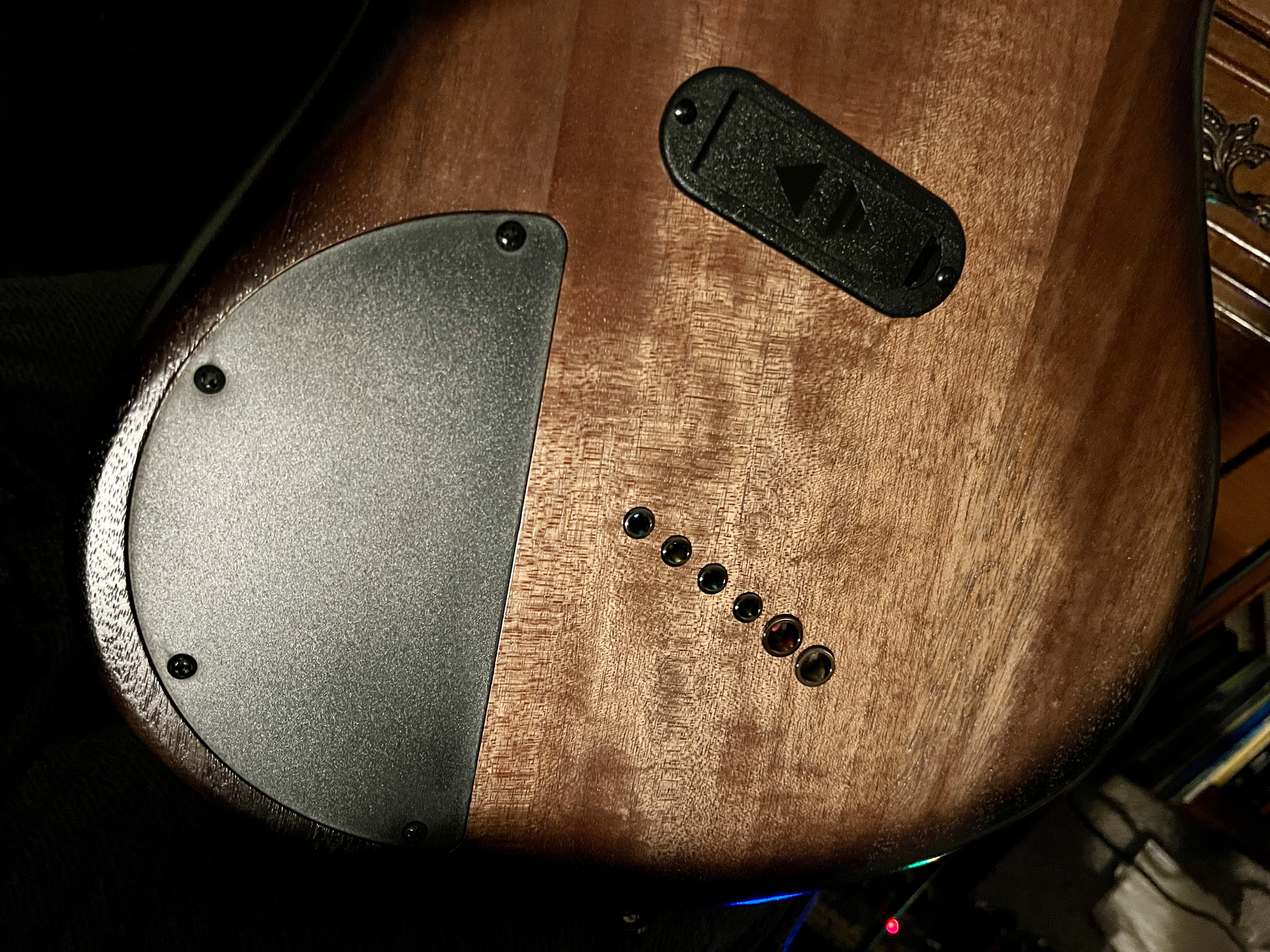
The ferrules for the two lowest strings will accommodate the ball ends typically used on bass strings, so I could try thicker short scale bass strings for the bottom end!
I obviously haven’t had it long but so far I would say it feels and sounds like both and neither a bass and guitar at the same time in any event, it felt comfortable right out of the box, with a good setup and no fret sprout or any other unwelcome surprises. The electronics seem versatile but most clean tones sound a lot like a hi-fi P/J bass; soloing or favoring the bridge pickup starts to sound more guitar-like, especially when boosting the mids and playing with dirt.
Right away, I hear what some said in my earlier thread about playing chords; on more conventional six-string basses and even basses vi, chords tend to get muddled in the lower positions. I might take a deep dive into Robert Smith’s bass vi parts with The Cure for some inspiration. I can count on one thing: this instrument will take me to some entirely new sonic spaces
Even at an attractive price, I still wanted to sell something to fund it, and I had a number of repair jobs lined up as well, so it took me over a year to get around to finally acquiring this thing.
To be clear, Ibanez didn’t explicitly design this for B0–B2. It came tuned E1–E3 like more conventional Bass-VI-style instruments, and even though I prefer low tension on my strings, I have to agree with those who say the .084 bottom string in the default D’Addario set (that came on it) doesn’t handle the low E1 very well. I have an Eastwood Hooky Bass VI set by GHS on the way which has a .105 on the bottom, which can certainly handle E1 at 30” scale; even though the tension with that set won’t be any higher than that of the stock set, I tuned the .105 on my 28.6” scale Ibanez MiKro down to B0 and found it plenty playable, so I feel hopeful about those. Check this out, though:
The ferrules for the two lowest strings will accommodate the ball ends typically used on bass strings, so I could try thicker short scale bass strings for the bottom end!
I obviously haven’t had it long but so far I would say it feels and sounds like both and neither a bass and guitar at the same time
in any event, it felt comfortable right out of the box, with a good setup and no fret sprout or any other unwelcome surprises. The electronics seem versatile but most clean tones sound a lot like a hi-fi P/J bass; soloing or favoring the bridge pickup starts to sound more guitar-like, especially when boosting the mids and playing with dirt.Right away, I hear what some said in my earlier thread about playing chords; on more conventional six-string basses and even basses vi, chords tend to get muddled in the lower positions. I might take a deep dive into Robert Smith’s bass vi parts with The Cure for some inspiration. I can count on one thing: this instrument will take me to some entirely new sonic spaces
Last edited: