

Enjoy the benefits of a premium membership!
Upgrade Account
-
TalkBass has been independent since 1998. Add your voice.
Create a free account to reply to discussions, view embedded media, and browse with fewer display ads.
Join free Log in
Want zero display ads or expanded classifieds tools? Compare plans.
You are using an out of date browser. It may not display this or other websites correctly.
You should upgrade or use an alternative browser.
You should upgrade or use an alternative browser.
Neck Dive... oops
- Thread starter Ahzidal Engineer
- Start date
-
- Tags
- neck
More options
Who Replied?
How often do you play sitting down? that's the only time neck dive would be affected by the position the bass wants to sit on the knee (standing it is the upper horn that affects neck dive).
If you only play sitting down when you are at home, you could rig up something removable (instead of removing material - you add something that is not permanent) so it rests on your knee at a point more towards the headstock - and then remove it when you perform standing. Or make something that pivots out when you need it like Steinberger did.
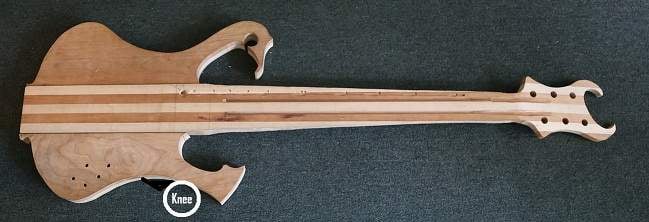
If you only play sitting down when you are at home, you could rig up something removable (instead of removing material - you add something that is not permanent) so it rests on your knee at a point more towards the headstock - and then remove it when you perform standing. Or make something that pivots out when you need it like Steinberger did.
I really don't play sitting down all that often. So its honestly not that big of a deal. I think it's more psychological to be honest. I wanted my bass to be balanced and I messed it up and I'm frustrated. I suppose I'm just throwing a bit of a hissy fit. It would be nice to fix it, but for a first build I guess I'll have to live and learn.


I do think that once you're finished shaping the neck and headstock that it will make a difference. Might as well keep going on your final path and see how much better/worse it gets. You have enough possible change left in your design that you can probably find some creative solutions. Another left field idea is to switch to headless tuners, and just use your headstock tuner holes as string anchor points. That would remove 90% of the tuner weight from the headstock, plus you have plenty of room behind the bridge location for headless tuners...
The balance point of a bass is usually close to the 12th fret. Basses that don't neck dive usually have a horn that reaches to the 12th fret. Leo Fender understood that perfectly. If a bass has a short horn or a strap button that puts your strap at the 15th fret, you need to test it for neck dive. ALso, if the upper part of the bass body is narrow compared to the bottom of the bass (certain Alembics), the neck will tend to point downward while you are sitting because there is not enough wood lifting the bass up off your knee. Once again, Fender nailed it.

Maybe I hold the bass funny, but despite Leo's best efforts, I have NEVER picked up a Jazz that didn't neck dive at least a little for seated playing. I can kill it by clamping down a little on the forearm relief, but it's always bugged me a little. Hipshots will cure that on a J, but if it's really out of balance, you have to add a lot of weight to the body to get anywhere. Your simplest option might be a nice grippy strap, maybe leather with a suede backside? What's the body shape? Any chance of relocating the strap posts?

- Jun 30, 2010
- 49,588
- 221,963
- Disclosures
- musician/artist/owner - Gildaxe
How often do you play sitting down? that's the only time neck dive would be affected by the position the bass wants to sit on the knee (standing it is the upper horn that affects neck dive).
If you only play sitting down when you are at home, you could rig up something removable (instead of removing material - you add something that is not permanent) so it rests on your knee at a point more towards the headstock - and then remove it when you perform standing. Or make something that pivots out when you need it like Steinberger did.
View attachment 918797
In my book that would be considered bad design. To be considered good design it needs to achieve a nearly 50% balance of function and aesthetics, and to be functionally 50% means it is actually functionally 100% (to reach design nirvana). So this (for me) means 1) it is ergonomic both standing and seated (as designed-including no neck dive), it needs to be comfortably light in weight (geared for a 2 hr + live performance), it needs to play really well (ease of playing), be stable over many gigs, sound great, and look great. "Looking" great is last on that list but by no means less important (same 50% = 100% ratio) in aesthetics - and so put the two together and that.., is good design.

Well of course it is! I didn't design it -- you quoted me, so just making sure you realize I simply offered the guy a possible workaround since he wasn't willing to give up his shapes that cause the problem.In my book that would be considered bad design.

With both sitting and standing, it partly depends on where exactly the player positions the bass.In my book that would be considered bad design. To be considered good design it needs to achieve a nearly 50% balance of function and aesthetics, and to be functionally 50% means it is actually functionally 100% (to reach design nirvana). So this (for me) means 1) it is ergonomic both standing and seated (as designed-including no neck dive), it needs to be comfortably light in weight (geared for a 2 hr + live performance), it needs to play really well (ease of playing), be stable over many gigs, sound great, and look great. "Looking" great is last on that list but by no means less important (same 50% = 100% ratio) in aesthetics - and so put the two together and that.., is good design.
Some basses balance just fine standing at some strap lengths, but not at others. I'm somewhat odd in that when sitting I typically rest the bass on my left knee, more like classical guitar position, I suppose.


