• TalkBass has been independent since 1998. Add your voice.
    Create a free account to reply to discussions, view embedded media, and browse with fewer display ads.
    Join freeLog in
    Want zero display ads or expanded classifieds tools? Compare plans.

Double Bass Need help identifying my bass

Howdy folks!

Just recently pulled my bass out of storage and have started bringing it (and me) back into working condition. Got some new Pirastro Obligatos on it, which play and sound great, and am slowly getting back into shape myself.

Anyhoo, I realized that I never really found out where my bass was from. The information I was told when I purchased was vague, I think he suspected it was a late Kay from just before they shut down, but as far as I can see, there is nothing written anywhere on the bass that could help me verify it. As such, I turn to you, oh internet wizards, to help in my endeavor.

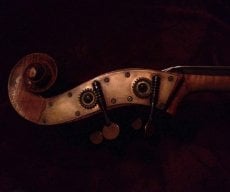
Here are some shots, let me know if there is anything that would help that isn't in the photos.

Link Removed
Link Removed
Link Removed
Link Removed
Link Removed
Link Removed

Thanks for looking! :D

 
That one's yours! Right there, in the corner, with the bow quiver. :)

Good looking instrument, sorry for the snark, couldn't resist. Someone will know.

:P

Late-period Kay or early Engelhardt, as evidenced by the outside linings, model M-1 or S-1.

Yup, and the Kluson tuners, scroll, f-holes. :)

Thank you internet wizards! That definitely will help answer the question "what do you play?" better than my previous "well, it might be a late kay, but I'm not really sure, but it could be..."
:hyper:
 
drurb, I figured those were a given...

shappen, I dug into my photobucket archive for photos I had saved of the '72 Engel S-1 I owned for a few months last year. Mine was very similar to appearance to your bass, possibly a little more blonde compared to the brown tint of your bass. Same nickel Kluson machines, same lines, same f-holes, same shiny nitro finish.

The label in my bass was about 2" by 3" and bright yellow. The serial and model numbers were not written or stamped inside the box, as was Kay's practice from soup to nuts. I'd guess yours is an early-'70s Engel whose label came unstuck and may still be floating somewhere inside the box.
 
That's a pretty bass!

The tuners and f-holes make it a Kay. The ebony fingerboard and inlaid purfling make it an S-8. The colour suggests its from 1955-1965-ish.
You might check the inner surface of the back with a flashlight; look through the bass f-hole for S-8 in red pencil and a number around 50,000.

I just picked up a '52 S-8 in pretty nice shape except for the broken neck and detached bass bar...:(

Good luck! ;)
 
There are examples of Kay basses that do not have a label, a tailpiece emblem or the word "Kay" embossed on the back of the pegbox, perhaps because they were sold through department stores. I recently sold one of these "unlabelled" Kay basses that was actually a 1949 M-1. These basses usually have the model and serial numbers stamped or written on the inside which will allow you to date the bass.

BTW your bridge is in the wrong spot :eek:

- Steve
 
There are examples of Kay basses that do not have a label, a tailpiece emblem or the word "Kay" embossed on the back of the pegbox, perhaps because they were sold through department stores. I recently sold one of these "unlabelled" Kay basses that was actually a 1949 M-1. These basses usually have the model and serial numbers stamped or written on the inside which will allow you to date the bass.

BTW your bridge is in the wrong spot :eek:

- Steve

Thanks Steve, i totally hadn't noticed the bridge, I may have accidentally let it ride up when I changed the strings on Tuesday. It should be about in the center of the F holes, correct?

Also, do you know where the SN is usually stamped?

EDIT: That also may explain why the intonation has seemed just slightly different than I was used to, which I had just chalked up to me not having played in while.
 
shappenfit said:
...It should be about in the center of the F holes, correct?

Also, do you know where the SN is usually stamped?

The center of the bridge feet should be aligned with the inner ticks on the f-holes. The serial number will be written or stamped on the back, usually opposite the E-side f-hole opening.
 
Kungfu-- I think the tuners, scroll, and f-holes are actually more definitive identifiers of a Kay/Engel than are outside linings, although those linings are sure part of the evidence. Many basses have outside linings but, for example, that scroll is pretty unique. :)

The serial number on Kays isn't stamped, its hand written, usually in red pencil.

From Invalid Link Removed:

Kay bass serial numbers can usually be found on a label by looking into the "f" hole on the "E" side of the instrument. Usually the serial number appeared twice. It was written in crayon, pencil or machine stamped at the beginning of the production line and then after the bass passed final inspection a tag with both the serial and model number was glued to the inside back.

The SN on the Kay I had for decades was machine stamped. I don't know when they started using machine stamping but it sure was used for the later ones. Here's a pic from Stower's site that shows a machine-stamped SN on a 1965 M-1:
kaytag3.jpg


Jake-- your site shows examples of Kay models "O-1." Are those C-1 models?

The 1942 M-1 I'm currently having fixed up has the SN written in black pencil right where one would expect the label to be.