• TalkBass has been independent since 1998. Add your voice.
    Create a free account to reply to discussions, view embedded media, and browse with fewer display ads.
    Join freeLog in
    Want zero display ads or expanded classifieds tools? Compare plans.

New Books! Friedland, Mooney

Dec 2, 2016
6,852
15,705
Ithaca Ny
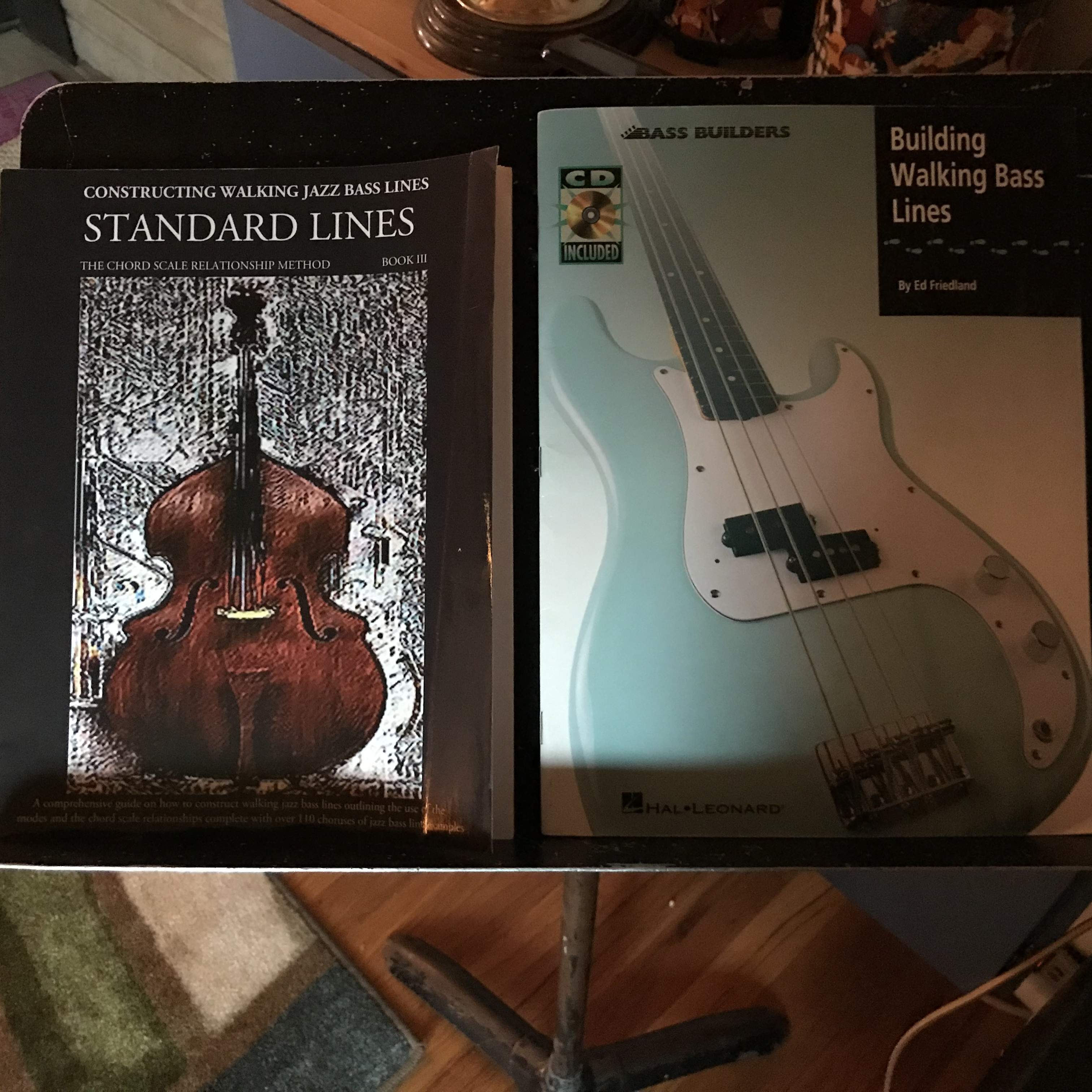
I’ve been on a quest to develop my walking bass lines. Picked up these 2 books to help.
8E96713C-913D-44D0-976A-53C756575A0B.jpeg


Building walking bass lines by Friedland: picked this one up on a whim. I’ve got his blues and reggae books, which I really like, so I’m excited to check this one out too.

Constructing walking bass lines (book 3- standards) by Mooney: this one I’ve been eyeing for a while. Seems to be more intermediate level (which is exactly what I’m looking for.) Developing beyond the “1-3-5-P” lines. Upon quick flip-through, seems to be a nice balance of theoretical instruction and example lines (full choruses of jazz standards). Excited to dig in!
 
My pleasure. Happy to write this up in case anyone else is curious about this book.

I (obviously) haven’t played through all the exercises yet. Not sure how “authentic” they will sound and feel. But looking over the lines, and the academic scope of the book, it looks really good.

The book has two basic sections. In The First, each lesson goes over a scale and corresponding arpeggio, and then gives you a practice example. Scales covered are things like Super Locrian, Whole Tone, Major Bebop etc. (see TOC pic below for full list.)

The second part is just more examples, without a corresponding scale lesson.

This definitely seems like a nice intermediate book. If someone wanted a beginners course, I think this would be too much. (The forward mentions “melodic minor over ii V I in book 2” so I think these books build on each other.)

The tunes are definitely spoof names, like “Winters coming” is Autumn Leaves, “Moonlight View” is Stella by Starlight. 24 tunes in all, examples are 4-5 choruses each

The Cons of this book would be:
1. No Audio content
2. Not knowing all the real tunes these are based on.
#1 doesn’t really bother me; but #2 kinda does. I plan on doing some sleuthing and hopefully I can identify them all.

Overall happy with my purchase, and think it hits the mark in terms of concepts I was looking for!

TOC
ACEA3527-A1F3-4469-B0D9-BFE51518CD10.jpeg


Example of a lesson
30FA917E-1B94-4F15-8CF9-11990C8F6146.jpeg
 
Best online resource are Chris Fitzgerald's video tutorials on YouTube.
I got a chance to check these out a little. They look fantastic, thanks for suggesting these!

The part one introduction video really resonated with me. Especially the bass line priorities part:
9A32B66D-A474-4BA9-B3AA-CA4267354676.jpeg


This has really been my personal bass philosophy as long as I can remember. I was recently chatting with my guitar player (we’re mostly rock and blues, but we do play some jazz standards.) and he was talking about all these other bass players who are really good, they’re “all over the place”. He says “I like what you do; you have good time and I know where you’re at.” So my point is other musicians really do notice this.

So like Chris mentions in the video, it really is a lifelong study. I’m into the “interesting note choices” phase of study- but this is a great reminder to keep priorities straight. :thumbsup:

And I instantly recognize the avatar as TBs own @Chris Fitzgerald - thanks for these Chris, looking forward to exploring them all! :)
 
  • Like
Reactions: Chris Fitzgerald
Hi, thanks for giving us some info on Mooney's book. There are audio files for it. If you click this [Invalid or Expired Link Removed] it'll take you to the page. It's a zero cost download but you have to put in your address info like it's a real, then click 'place order'.
 
Listen to and transcribe Ray Brown. The fun starts at 2:35.


Ray had perfect time. He never fumbled a line. I am guessing he was thinking a measure ahead, becasue a lot of his note choices required exctly the right hand position to play the phrase properly. Watch how he moves around the neck seamlessly. Note he doesnt start every measure with the root, but uses 3 and 5. Note different Turnarounds, lots of 1 6 2 5 . When Oscar throws in the Blues for Alice changes, Ray doesnt miss a beat.

Anway, enjoy the master. When I was growing up, we only had two jazz records and one was Ray with Barney Kessel. Subliminal influence.
 
Last edited:
  • Like
Reactions: CallMeAl
Listen to and transcribe Ray Brown. The fun starts at 2:35.


Ray had perfect time. He never fumbled a line. I am guessing he was thinking a measure ahead, becasue a lot of his note choices required exctly the right hand position to play the phrase properly. Watch how he moves around the neck seamlessly. Note he doesnt start every measure with the root, but uses 3 and 5. Note different Turnarounds, lots of 1 6 2 5 . When Oscar throws in the Blues for Alice changes, Ray doesnt miss a beat.

Anway, enjoy the master. When I was growing up, we only had two jazz records and one was Ray with Barney Kessel. Subliminal influence.

Thanks for the reply, the reminder and encouragement. :)

I know in my heart the best way to learn it is by ear. (I did heaps of trumpet solo transcription on college). I do most of my rock and blues bass by ear, but jazz eludes me. I seem to thrive on the mathematical side; learn the patterns, the formulas, then my ear follows. I always say I have a tin ear, but maybe I’m just being lazy. The other thing about my recent Jazz bass study is trying to become a better reader, which is why I’ve been leaning towards sheet music and books.

not making excuses here, just verbalizing my thought process. ;)
 
  • Like
Reactions: IamGroot