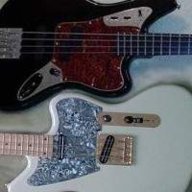
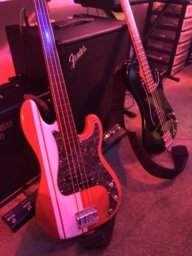
How can anyone believe that only one part of a bass is responsible for the sound?
No but less so than others, all parts and material contributes to the end result, but the first thing that strikes you are the pickups sound. The rest is secondary, like sustain, decay. The design of the instrument matters even more than material, read on...
If anyone thinks pickups are the only thing that makes a bass sound good or bad. . . . which part of the pickup do you think dead spots come from?
Neither pickups nor wood, or other hardware. It's design. Read the infamous interview with Gene Fields, the only way to remove dead spot was to remove the head, completely. First headless was born. But to the powers that be looked too alien to sell.
Fender Headless Bass
Neither wood, metal, or anything else helped. Some say that the SCALE of the strings removes dead spots, everything else being equal. Long and short scale?
Sure thing! Impacts the sustain more than any other thing. Longer strings: Longer sustain, period.
Oh BTW: Pickups if they're set too close to the strings, causing magnetic string pull, you'll bet your *** that you'll end up with several dead spots. Pickups can very well be the cause of the dead spots, if placed at the "un-sweet" spots or "sour" spots along any string. Two humbuckers used together in series or pararell (like using neck and bridge pikcup at the same time) can very well cause DEAD SPOTS in the amp, but not at the string, mechanically as such. It's a tad too nitpicky though.
I've yet to see any bass that causes larger output, and getting rid of noise and hum by
just changing body wood. Or neck wood. If you have a wood that is "very trebly" and sparkling high end, it doesn't get picked up if the pick up doesn't pick up that high frequency. And if you use flatwound strings as well on top of that. It doesn't get heard at all through any amp. It is actually said too, by such famous boutique builders such as Sheldon Dingwall, that the strings vibrations down to the body from the bridge - i e the point of which the strings resides on - are so minimal that it's really neglible. Especially on totally solid body basses. Chambered and half acoustic bodies are of a different breed, since the strings vibrations goes through the neck too. Wood and design mostly affects the decaying portion of the tone, note.
- - - - -
The only thing which I've heard a subtle difference of, is what is called "direct coupling". It's subtle and slight at best. It doesn't work with all basses guitars or pickups, but just some. It deals with that you have to use a squeeze technique to cram in the pickup into the cavity, so it is embraced and hugged with wood of the body from all it's sides. Even if it's potted and sealed. It's a once set, never swapped out technique. I e if you set it there it's impossible to remove the pickup later on. If one think that is worth the definition and increased sustain from pickups the by all means. The thing it that it keeps and holds the magnets of the pickup more still, and in a grip when faced with string vibration. To some, they screw the pickups down to the bottom to produce some direct coupling. It isn't enough. If I had my way, I would rather have the options to be able to adjust pickup height, pole pieces and change out and service the pickups.