Hello,
I have been trying to notate the bass part to Lumsk's "Allvis", linked below:
My question is related to the first 40 seconds of the song, from the guitar-only opening until the male voice stops singing. I feel the guitar part quite distinctly at a very fast and steady 17/8 (6/8 + 3/8 + 5/8 + 3/8), but the problem is that once the bass and the drums come in the time signature starts to shift, like this:
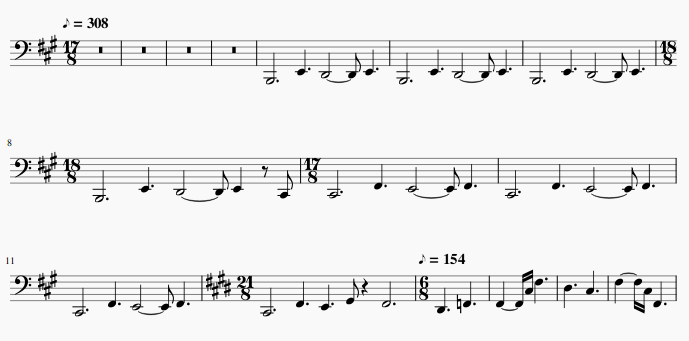
[Guitars only]
4 bars of 17/8
[Bass and drums enter]
3 bars of 17/8
1 bar of 18/8
3 bars of 17/8
1 bar of 21/8
[After 0:40 the song progresses for several bars at 6/8]
Just take for granted that rhythm-wise the above structure works - the audio playback of the above score lines up note-by-note with the original recording. My question is whether there wouldn't be simpler or more efficient ways to notate it.
I can think of several pros and cons regarding the use of 17/8:
I understand 17/8 could be written as 6/8 + 3/8 + 5/8 + 3/8 (or at times 4/8 or 7/8 where I have written 18/8 and 21/8 as above), but of course writing this four-bar sequence twelve times in a row would result in 48 bars, each single one of them in a different time signature, and this would look quite absurd on the page. Also, this mixed bag of time signatures would not outline the fact that the 18/8 and 21/7 bars are just variations of the 17/8 main rhythm (which appears in 10 out of 12 bars), which - if notated as 17/8 - results in two four-bar sequences with a variation on the fourth bar each time, which feels like a common enough musical sequence.
For the above reasons 17/8 would appear to be the a good solution, but in order for that to work the song has to be notated at a blazing fast [eighth note = 308 BPM] which clearly does not correspond to the actual feel of the song. Maybe it were possible to write [quarter note = 154] as I did when the song settles in 6/8, but since 17 is odd the quarter notes are useless to count because the last half of the last quarter note would have to be skipped each time. But adopting [eighth note = 308 BPM] for the 17/8 parts in turn results in either having to "change" (while actually not changing) the tempo from [eighth note = 308 BPM] to [quarter note = 154] just because 17 is odd, or having to notate the the entire song as [eighth note = 304 BPM] which feels just wrong.
I have thought this over and over and the impression I have - admittedly not knowing much about problems such as this - is that there is no easy way out and a compromise will have to be made either with regard to the tempo or to the representation of the time signature.
Any thoughts? Fell absolutely free to get into the details to your heart's content - I am really curious about this problem, and I believe getting to understand how to approach this sort of structure could be quite useful further on.
Thank you!
I have been trying to notate the bass part to Lumsk's "Allvis", linked below:
My question is related to the first 40 seconds of the song, from the guitar-only opening until the male voice stops singing. I feel the guitar part quite distinctly at a very fast and steady 17/8 (6/8 + 3/8 + 5/8 + 3/8), but the problem is that once the bass and the drums come in the time signature starts to shift, like this:
[Guitars only]
4 bars of 17/8
[Bass and drums enter]
3 bars of 17/8
1 bar of 18/8
3 bars of 17/8
1 bar of 21/8
[After 0:40 the song progresses for several bars at 6/8]
Just take for granted that rhythm-wise the above structure works - the audio playback of the above score lines up note-by-note with the original recording. My question is whether there wouldn't be simpler or more efficient ways to notate it.
I can think of several pros and cons regarding the use of 17/8:
I understand 17/8 could be written as 6/8 + 3/8 + 5/8 + 3/8 (or at times 4/8 or 7/8 where I have written 18/8 and 21/8 as above), but of course writing this four-bar sequence twelve times in a row would result in 48 bars, each single one of them in a different time signature, and this would look quite absurd on the page. Also, this mixed bag of time signatures would not outline the fact that the 18/8 and 21/7 bars are just variations of the 17/8 main rhythm (which appears in 10 out of 12 bars), which - if notated as 17/8 - results in two four-bar sequences with a variation on the fourth bar each time, which feels like a common enough musical sequence.
For the above reasons 17/8 would appear to be the a good solution, but in order for that to work the song has to be notated at a blazing fast [eighth note = 308 BPM] which clearly does not correspond to the actual feel of the song. Maybe it were possible to write [quarter note = 154] as I did when the song settles in 6/8, but since 17 is odd the quarter notes are useless to count because the last half of the last quarter note would have to be skipped each time. But adopting [eighth note = 308 BPM] for the 17/8 parts in turn results in either having to "change" (while actually not changing) the tempo from [eighth note = 308 BPM] to [quarter note = 154] just because 17 is odd, or having to notate the the entire song as [eighth note = 304 BPM] which feels just wrong.
I have thought this over and over and the impression I have - admittedly not knowing much about problems such as this - is that there is no easy way out and a compromise will have to be made either with regard to the tempo or to the representation of the time signature.
Any thoughts? Fell absolutely free to get into the details to your heart's content - I am really curious about this problem, and I believe getting to understand how to approach this sort of structure could be quite useful further on.
Thank you!