• TalkBass has been independent since 1998. Add your voice.
    Create a free account to reply to discussions, view embedded media, and browse with fewer display ads.
    Join freeLog in
    Want zero display ads or expanded classifieds tools? Compare plans.

Notation rules- Who is right? Auto Transcription or Me?

Apr 18, 2015
3,148
3,509
65
I've been working on my bass sight reading and selected Stevie Wonder's "For once in my Life". But as I'm reading through I come to measure 10-11 and stumble. As I'm looking at only the bass line in M11 there is an ascending chromatic line from E to G. But in M11 it reads "E-Gb-G". For whatever reason, it didn't register in my head and my brain goes into hesitancy mode. "Huh???", I thought- then had to cerebrally sort it out. It seems to me that a passing chromatic should have been written E-F#-G, which visually makes more sense.

So I went to the chord structure to see what was written. As you can see from the image below measure 11 does move from a (written inverted Gm7 to a D/5+ (which is essentially an inverted Bbaug with Gb in the bass of the guitar part. But that leaves the question...

...While the guitar chord does call for a Gb in the bass, should that be treated the same way in the bass line, as in practicality it appears to be a chromatic passing tone (see highlighted portions).

So who is right? The transcription, or my edited version?
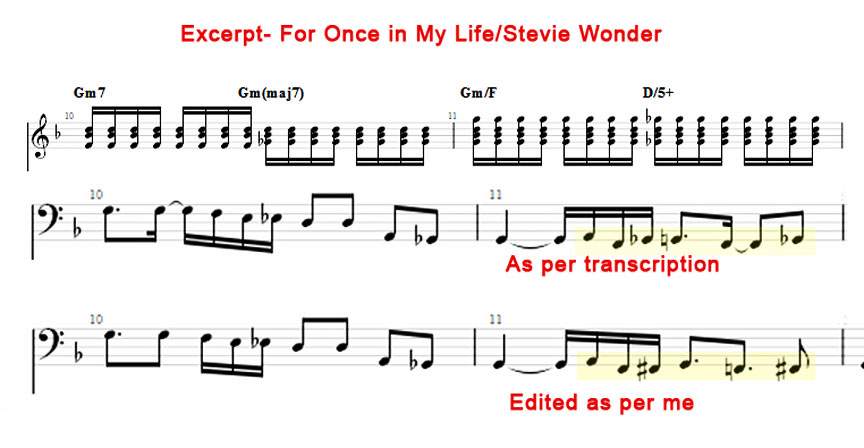
M10-11_multi-staff.jpg
 
I've been working on my bass sight reading and selected Stevie Wonder's "For once in my Life". But as I'm reading through I come to measure 10-11 and stumble. As I'm looking at only the bass line in M11 there is an ascending chromatic line from E to G. But in M11 it reads "E-Gb-G". For whatever reason, it didn't register in my head and my brain goes into hesitancy mode. "Huh???", I thought- then had to cerebrally sort it out. It seems to me that a passing chromatic should have been written E-F#-G, which visually makes more sense.

So I went to the chord structure to see what was written. As you can see from the image below measure 11 does move from a (written inverted Gm7 to a D/5+ (which is essentially an inverted Bbaug with Gb in the bass of the guitar part. But that leaves the question...

...While the guitar chord does call for a Gb in the bass, should that be treated the same way in the bass line, as in practicality it appears to be a chromatic passing tone (see highlighted portions).

So who is right? The transcription, or my edited version? View attachment 3465960

Neither. Stand by.
 
I'd do this:

upload_2019-7-4_17-22-54.png


I'd use an F# on the upbeat of 4 in measure 1 because the chord is a Gm(Maj7). The Maj7 of G is F#, not Gb. (Also note that Jamerson plays a D major triad over the Gm(Maj7) here. Pretty cool.)

I'd use an F# in the second beat of the second measure for the reasons you've noted.

I'd use an F# on the upbeat of 4 in measure 2 because regardless of whether you characterize that as a Daug/F# or a Bbaug/F#, it has an F# not a Gb. (I'd also note that D/5+ is a nonstandard chord spelling and inconsistent with the notated chord.)

Finally, watch the beaming. It's correct in the original but incorrect in your edit. Tie the sixteenth note in beat 1 of the first measure to sixteenth note at hte beginning of beat 2 rather than using an 8th note there. The original (and my edit) makes it easy to see each beat:

upload_2019-7-4_17-31-45.png
 
I'd do this:

View attachment 3466254

I'd use an F# on the upbeat of 4 in measure 1 because the chord is a Gm(Maj7). The Maj7 of G is F#, not Gb. (Also note that Jamerson plays a D major triad over the Gm(Maj7) here. Pretty cool.)

I'd use an F# in the second beat of the second measure for the reasons you've noted.

I'd use an F# on the upbeat of 4 in measure 2 because regardless of whether you characterize that as a Daug/F# or a Bbaug/F#, it has an F# not a Gb. (I'd also note that D/5+ is a nonstandard chord spelling and inconsistent with the notated chord.)

Finally, watch the beaming. It's correct in the original but incorrect in your edit. Tie the sixteenth note in beat 1 of the first measure to sixteenth note at hte beginning of beat 2 rather than using an 8th note there. The original (and my edit) makes it easy to see each beat:

View attachment 3466261

Excellent reply! I got the transcription was from Guitar Pro 7 that got the file from Ultimate Guitar Tabs. I like getting material from there because in GP most of the parts are transcribed and, as you can seen, there is other reference material to look at.

I agree entirely. I was just wondering as there was some sense based on the way the chords were structured in the rhythm guitar, but seemed to make little sense in terms of chromaticism and passing tones. I don't know why I didn't think of subdividing the individual beats like that. SO much easier (visually) to keep time with the offsets caused by the ties. What a great tip. I don't know why I didn't think of it myself. Thank you so much!