
These type threads are not designed to work well with wood. It's way too easy to strip out the wood, as has happened in my case. I don't understand why this is engineered like this. To their credit, NS Design has offered to repair my bass for free, though I made it clear I'm not the original owner. I would have to pay shipping, which would be around $200 from where I'm at. They would fix it by waxing the bolt threads and putting epoxy in the hole, then inserting the waxed bolt into it. The epoxy would then form new threads using the bolt as a pattern. I am currently waiting for a machinist friend to stop by to make a recommendation. I'm appalled that your bass, worth nearly 3 times what mine is, is constructed in this way.I checked my radius and it is indeed constructed as you described. The threads run directly into the body wood, no metal threaded bushings (see picture). I have the top of the line European CR5 Radius model, which sells for about €2750. I must say that I am a bit disappointed by this poor design and did not expect this in this price range.
View attachment 4680561

Enjoy the benefits of a premium membership!
Upgrade Account
-
TalkBass has been independent since 1998. Add your voice.
Create a free account to reply to discussions, view embedded media, and browse with fewer display ads.
Join free Log in
Want zero display ads or expanded classifieds tools? Compare plans.
You are using an out of date browser. It may not display this or other websites correctly.
You should upgrade or use an alternative browser.
You should upgrade or use an alternative browser.
NS Design Club
- Thread starter Danny O Danny
- Start date
More options
Who Replied?
I checked my radius and it is indeed constructed as you described. The threads run directly into the body wood, no metal threaded bushings (see picture). I have the top of the line European CR5 Radius model, which sells for about €2750. I must say that I am a bit disappointed by this poor design and did not expect this in this price range.
View attachment 4680561
I would go through the (minor) trouble of installing a threaded insert, myself. That's the only real solution to this.These type threads are not designed to work well with wood. It's way too easy to strip out the wood, as has happened in my case. I don't understand why this is engineered like this. To their credit, NS Design has offered to repair my bass for free, though I made it clear I'm not the original owner. I would have to pay shipping, which would be around $200 from where I'm at. They would fix it by waxing the bolt threads and putting epoxy in the hole, then inserting the waxed bolt into it. The epoxy would then form new threads using the bolt as a pattern. I am currently waiting for a machinist friend to stop by to make a recommendation. I'm appalled that your bass, worth nearly 3 times what mine is, is constructed in this way.

That's indeed a disappointment, specially at this price level. If your machinist has the right tools metal bushings shall be used. As the NS design manufacturer plant is located in Czechia the shipping costs are much less from my location but I would also ask to use metal bushings instead wood threads. I hope I don't need that.I'm appalled that your bass, worth nearly 3 times what mine is, is constructed in this way.
The flip side to all this is that the wood down the entire length of the hole is threaded. It would seem unlikely that with so long a length of thread that this would strip out, but I can move the bolt in and out of mine easily, so it's stripped all the way down. There is really very little pressure on those bolts. I would think that, as long as you loosened all the strings when you wanted to raise the bridge, it would never be a problem. But who among us does that? We expect the bolts to be secure, so we just raise the bridge if we need to.
Altough build in an european plant all screws and bolts are imperial sizes on the Radius. Should be easy to find them in the US. But may be yours use metric sizes as it's build in asia.I tried a couple hardware stores in the area with no luck finding appropriate metal bushings. Maybe if I can establish the size & thread pattern, I can find something on Amazon.
For me this clearly a design fault. I wouldn't even accept this on a 700€ bass, definitely not on a 2750€ bass. Metal threaded bushings are just cent value pieces and are easy mounted so why use this crap ? Fortunately I never raised and only lowered the bridge yet, which might be the reason why I didn't see any damage yet.The flip side to all this is that the wood down the entire length of the hole is threaded. It would seem unlikely that with so long a length of thread that this would strip out, but I can move the bolt in and out of mine easily, so it's stripped all the way down. There is really very little pressure on those bolts. I would think that, as long as you loosened all the strings when you wanted to raise the bridge, it would never be a problem. But who among us does that? We expect the bolts to be secure, so we just raise the bridge if we need to.

Thank you. This is an excellent recommendation as they have threading inserts in stainless steel or brass for hardwood and in many sizes. All I need to do is establish the size. If I take it to a bigger hardware store, maybe they can help me with size and thread count. If they had appropriate bushings, I could buy a couple, one for each side. If not, I'd know the size I needed and could order from here.
It does seem like it's a setup for failure, but at least once you know it's there, you can loosen the strings to raise the bridge, as that's when the most pressure would occur. I'd loosen them moving it up or down, just to be safe. Street price on the WAV4 was over $1,000 when they were available new. While some consider this a "starter bass", my idea of a starter bass is more like a Squier Affinity for $300 or a Squier Classic Vibe for $600. To me, a bass with a price tag of over $1,000 comes with expectations of excellence in engineering and build quality. My hat is off to NS Design for their offer of a free repair, but if the bass had been designed properly, repair wouldn't be needed. I love Ned's designs. Over the years, I've owned 4 Steinberger basses, and I still own 2 of them. But this design was a mistake. I, too, am disappointed. Perhaps on future builds, they'll correct this.For me this clearly a design fault. I wouldn't even accept this on a 700€ bass, definitely not on a 2750€ bass. Metal threaded bushings are just cent value pieces and are easy mounted so why use this crap ? Fortunately I never raised and only lowered the bridge yet, which might be the reason why I didn't see any damage yet.
Good news...I found brass insert nuts designed for use in wood at Home Depot. The bolt is a slightly unusual size--5/16" x 18--but they had 4 of the inserts available, so I bought a couple, one for each side. Not sure if I'll get to install these this week or if I'll have to wait until next, but these should solve the problem. For those of you who have CR or NXTa basses and are thinking of upgrading this issue, I recommend you first check to make sure yours doesn't already have inserts--who knows how this might have changed from year to year?--then take a bolt with you to a hardware store and have it measured. Not all NS basses might have the same size, especially since the WAV was made in Indonesia and the CR and NXTa in Czech Republic. And the sizes might even differ on the same model from year to year. Thanks for your help and support.
I can confirm at least that the Radius' built in Czech Republic uses imperial size bolts. I will wait to update mine until the 1st problems show up but it's good to know that there is an easy fix available. European users might want to consider contacting NS Design Customer Service 1st to have their Radius fixed in Czech Republic manufacturing plant. For myself I'd rather have it fixed from my favourite bass builder Rüdiger Ziesemann from Bass Line who is just 30min away from my home.Good news...I found brass insert nuts designed for use in wood at Home Depot. The bolt is a slightly unusual size--5/16" x 18--but they had 4 of the inserts available, so I bought a couple, one for each side. Not sure if I'll get to install these this week or if I'll have to wait until next, but these should solve the problem. For those of you who have CR or NXTa basses and are thinking of upgrading this issue, I recommend you first check to make sure yours doesn't already have inserts--who knows how this might have changed from year to year?--then take a bolt with you to a hardware store and have it measured. Not all NS basses might have the same size, especially since the WAV was made in Indonesia and the CR and NXTa in Czech Republic. And the sizes might even differ on the same model from year to year. Thanks for your help and support.
Keep us informed how the fix went (pictures !).

While I don't have an NS-branded bass, I do have an NXT-5 cello and an NXT-5a fretted violin.
Since they are all sort of related, I also have a Washburn Bantam headless bass and a Hohner G3T guitar.
I used to have an NS/Stick by Stick Enterprises, but traded that years ago for another Grand Stick.


Since they are all sort of related, I also have a Washburn Bantam headless bass and a Hohner G3T guitar.
I used to have an NS/Stick by Stick Enterprises, but traded that years ago for another Grand Stick.
Well, darn. I forgot to snap pics while I was working, and I'm already home from my studio, which doubles as my shop. Installing the inserts was not as easy as I thought. The WAV4 bass guitar body is made out of meranti, which is apparently a rather brittle and crumbly wood. The stripped out side went smoothly. I enlarged the hole and threaded the wood-cutting threads of the insert into the hole. The other side, which I almost wish I'd left alone, had a chunk of wood that crumbled out of the hole a little way in when I drilled it. I didn't think it would be a problem, but it was. The insert kept wanting to slip into that area when I was threading it into the hole. As a result, the insert went in a little crooked, so when I went to drop the bridge onto the studs, they were crooked and the bridge wouldn't slip onto them. I worked and worked and finally got them straight. However, in doing so, I damaged one of the teats that the bridge slides onto, the place where the hex key slips into. I was able to do a very temporary repair using super glue and get the bass put back together, but I've contacted NS Design in the hope that they have some of those studs in stock, or at least can get me one. If you have a bass other than the WAV series, you would probably have a better time of it, since the WAV is the only one made out of meranti. If you want to do this to your WAV, just be extra careful when enlarging the hole. I got mine done with only a little frustration, so you can do it, too. Thanks again to all of you who provided advice and encouragement.I can confirm at least that the Radius' built in Czech Republic uses imperial size bolts. I will wait to update mine until the 1st problems show up but it's good to know that there is an easy fix available. European users might want to consider contacting NS Design Customer Service 1st to have their Radius fixed in Czech Republic manufacturing plant. For myself I'd rather have it fixed from my favourite bass builder Rüdiger Ziesemann from Bass Line who is just 30min away from my home.
Keep us informed how the fix went (pictures !).
I am an electronics engineer but a lousy craftsman. Sounds like I should leave that to NS or a skilled luthier in case it should be necessary someday. Thanks.Well, darn. I forgot to snap pics while I was working, and I'm already home from my studio, which doubles as my shop. Installing the inserts was not as easy as I thought. The WAV4 bass guitar body is made out of meranti, which is apparently a rather brittle and crumbly wood. The stripped out side went smoothly. I enlarged the hole and threaded the wood-cutting threads of the insert into the hole. The other side, which I almost wish I'd left alone, had a chunk of wood that crumbled out of the hole a little way in when I drilled it. I didn't think it would be a problem, but it was. The insert kept wanting to slip into that area when I was threading it into the hole. As a result, the insert went in a little crooked, so when I went to drop the bridge onto the studs, they were crooked and the bridge wouldn't slip onto them. I worked and worked and finally got them straight. However, in doing so, I damaged one of the teats that the bridge slides onto, the place where the hex key slips into. I was able to do a very temporary repair using super glue and get the bass put back together, but I've contacted NS Design in the hope that they have some of those studs in stock, or at least can get me one. If you have a bass other than the WAV series, you would probably have a better time of it, since the WAV is the only one made out of meranti. If you want to do this to your WAV, just be extra careful when enlarging the hole. I got mine done with only a little frustration, so you can do it, too. Thanks again to all of you who provided advice and encouragement.
I am neither an electronics engineer nor a skilled craftsman, but I have to do for myself. I live out in the boonies, so the closest luthier to me is 120 miles away. He has a great reputation, but also a reputation for being very expensive. (Maybe he gives senior discounts if you ask, like McDonalds??) My preferred luthier, who is a true craftsman, lives 350 miles away since I moved about 5 years ago. So these days, it's either I do it or it doesn't get done. With necessity being the Mother of Invention, I've learned a lot over the past 5 years when it comes to instrument repair. Good news, though: Greg at NS Design came through for me on the bridge posts for the WAV4. Hopefully, they'll be here by the middle of next week. Changing them out shouldn't take 5 minutes.I am an electronics engineer but a lousy craftsman. Sounds like I should leave that to NS or a skilled luthier in case it should be necessary someday. Thanks.
Last edited:
BTW, for those of you with a desire for a slightly less expensive NS Design bass guitar, Greg at NS Design tells me they hope to start making the WAV series basses again in the future, using a different manufacturer. That would be nice. Mine plays like a dream, and though I prefer the sound of it now with the Lace Alumitone pickup over the sound of it with the EMG passive, sound is a subjective thing, and you might feel otherwise. Just remember: When raising the bridge, take the tension off the strings first! This problem I'm having is best avoided rather than repaired. Kudos to NS Design's customer service for their help in this situation.
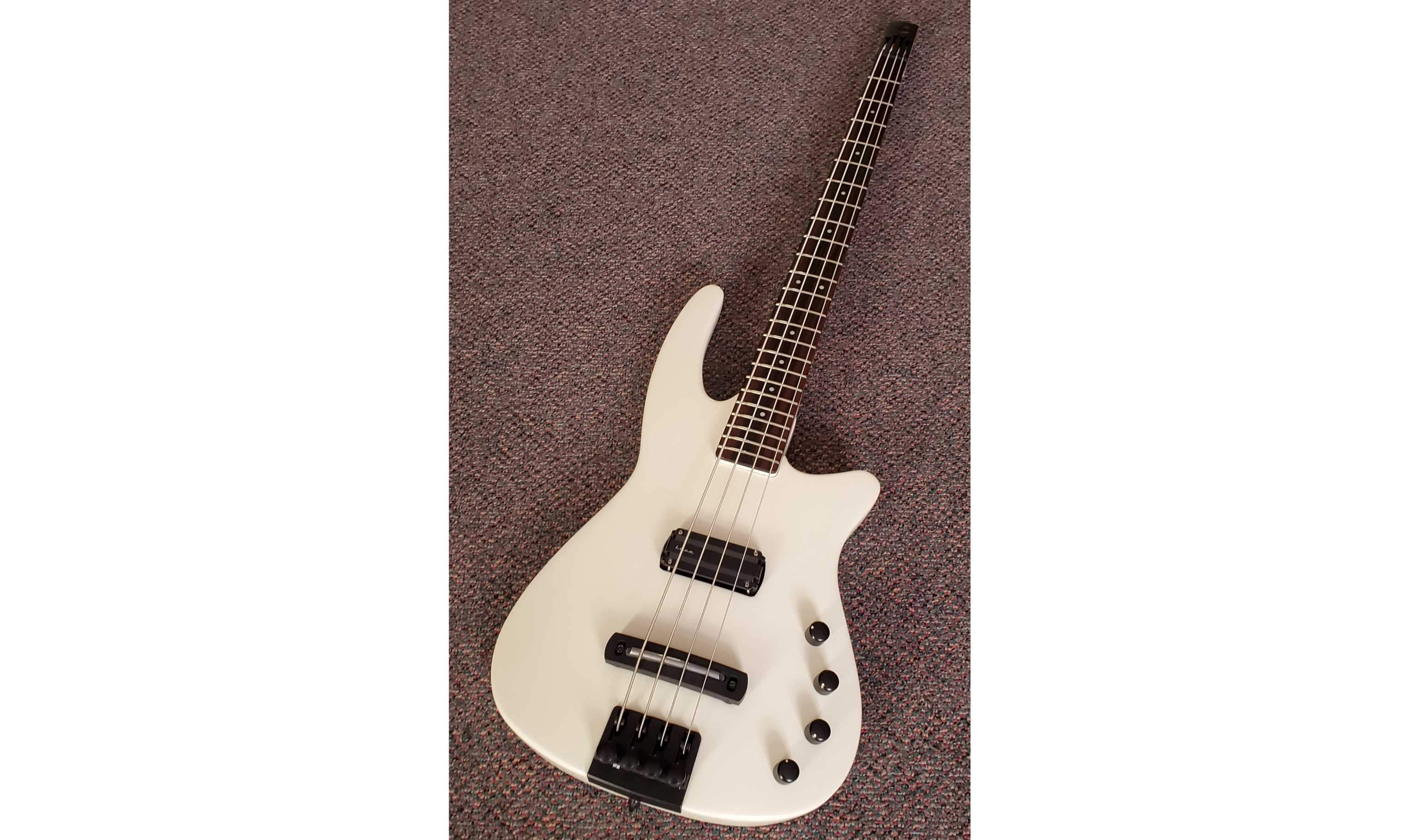
Pics of my metallic white WAV4 with its Lace Alumitone magnetic pickup. With the original EMG passive magnetic pickup, the bass's lows and highs--boomy and brittle--overpowered the mids. With this pickup, I have a very good balance across the spectrum.

I agree with you about the unpleasantness of the stock passive emg pickup. I tried a dimarzio model j and it was a big improvement but ultimately the p bass tone is not what I want from this bass. Now I put the stock pickup back in but wired it in parallel instead of series, which is how it came from the factory. It has a more open sound that I really like.
One trait I’ve noticed is that it is hard to tame the brightness on this thing. The tone seems work only the last bit of travel. When I had it open for rewriting the pickup I noticed that there are no capacitors on the tone pots. Any wiring gurus know why that is?


One trait I’ve noticed is that it is hard to tame the brightness on this thing. The tone seems work only the last bit of travel. When I had it open for rewriting the pickup I noticed that there are no capacitors on the tone pots. Any wiring gurus know why that is?
Last edited:
I also noticed no caps on the tone control. I don't know why that is. Maybe it has something to do with the preamp? Or if you'd like, I can venture another wild guessI agree with you about the unpleasantness of the stock passive emg pickup. I tried a dimarzio model j and it was a big improvement but ultimately the p bass tone is not what I want from this bass. Now I put the stock pickup back in but wired it in parallel instead of series, which is how it came from the factory. It has a more open sound that I really like.
One trait I’ve noticed is that it is hard to tame the brightness on this thing. The tone seems work only the last bit of travel. When I had it open for rewriting the pickup I noticed that there are no capacitors on the tone pots. Any wiring gurus know why that is?
 .
. The original magnetic pickup, to my ears, sounded like a mudbucker...all lows. The piezo has plenty of highs, but they're kinda brittle-sounding. Mine was lacking smoother highs and severely lacking articulate mids. Installing the Lace helped that because it is smooth across the spectrum, so I can roll the brittleness off the piezo to tame it without losing all my highs. I also put a set of TI flats on it. Now it's a rich, articulate sounding bass with very little finger noise.


