

Enjoy the benefits of a premium membership!
Upgrade Account
-
TalkBass has been independent since 1998. Add your voice.
Create a free account to reply to discussions, view embedded media, and browse with fewer display ads.
Join free Log in
Want zero display ads or expanded classifieds tools? Compare plans.
You are using an out of date browser. It may not display this or other websites correctly.
You should upgrade or use an alternative browser.
You should upgrade or use an alternative browser.
Official Ampeg Portaflex Club
- Thread starter JimmyM
- Start date
More options
Who Replied?

That’s why I hate selling anything. It always costs more to rebuy it later.
How true, I miss my 1966 Fender Jazz
and a B-15ND I once owned. Shoulda kept both and left the G&L 1000 at Griffin Music for someone else.



I've a quick question for you experts regarding the PF-50T:
Mine arrived with a microphonic tube. It is the 12AU7. When I turn up the gain and master and softly tap the tubes with a toothpick, the 12AU7 makes an audible sound.
This makes the whole surface of the amp microphonic and this is a bother when playing live and using the transformer line out.
The thing is that I called my shop and told them about it, and they sent me a replacement 12AU7.
I replaced it and nothing happened. I tried replacing the other preamp tubes as well, but it did not help.
The possibilities seem slim that my amp arrives with a microphonic tube and they send me a microphonic replacement.
Can I use any other tube in that slot ? I have 12AX7's lying around, as well as 12DW7. Just for testing purposes, will any of these do?
Mine arrived with a microphonic tube. It is the 12AU7. When I turn up the gain and master and softly tap the tubes with a toothpick, the 12AU7 makes an audible sound.
This makes the whole surface of the amp microphonic and this is a bother when playing live and using the transformer line out.
The thing is that I called my shop and told them about it, and they sent me a replacement 12AU7.
I replaced it and nothing happened. I tried replacing the other preamp tubes as well, but it did not help.
The possibilities seem slim that my amp arrives with a microphonic tube and they send me a microphonic replacement.
Can I use any other tube in that slot ? I have 12AX7's lying around, as well as 12DW7. Just for testing purposes, will any of these do?
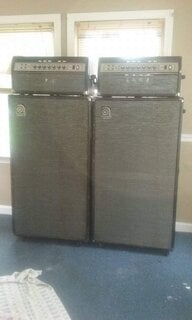
In 1964, list price for a new Chevy Impala, four door with inline six engine was $2700. In comparison, a B-15NL was pretty expensive.
Although 54 years later, the amp can still be in service with not a lot of maintenance. My ‘63 is better than new. The car would cost a lot more to keep on the road today. My Impala will never last that long.
I had a 64 Biscayne 4 door with 6 cylinder in 1972, bought it cheap, had just gotten married (my first time) it had hood locks and racing stripes and a dent in every corner, it was the most embarrassing car I've ever owned.
 It ran good though even though I tortured the poor thing constantly.
A microphonic tube will make a sound through the amp when you ping it. Examples of microphonic tubes are in the video below. A small amount of ping noise carried through a musical instrument amp may be alright.
There are other possibilities that can cause a microphonic sound such as a bad component, even a loose PCB. Start with the tube though. Also check that the tube socket is connecting tightly with the tube pins. If it’s loose, you might hear a crackle. If the tube slides in or out too easily, there is an issue. There should be some friction.
Yes it is possible that your replacement 12AU7 is microphonic. It won’t hurt to test that position with a spare 12AX7 or 12DW7.
There are other possibilities that can cause a microphonic sound such as a bad component, even a loose PCB. Start with the tube though. Also check that the tube socket is connecting tightly with the tube pins. If it’s loose, you might hear a crackle. If the tube slides in or out too easily, there is an issue. There should be some friction.
Yes it is possible that your replacement 12AU7 is microphonic. It won’t hurt to test that position with a spare 12AX7 or 12DW7.
I had a 64 Biscayne 4 door with 6 cylinder in 1972, bought it cheap, had just gotten married (my first time) it had hood locks and racing stripes and a dent in every corner, it was the most embarrassing car I've ever owned.
A friend had a Biscayne. It was a good family car. You could really run the cars of that era into the ground. They would just keep on working.
I drove my Nova with a straight six for 25 years and a lot of miles and never had to even change a gasket. Never changed the transmission fluid. In the end it was pretty worn out.
A microphonic tube will make a sound through the amp when you ping it. Examples of microphonic tubes are in the video below. A small amount of ping noise carried through a musical instrument amp may be alright.
There are other possibilities that can cause a microphonic sound such as a bad component, even a loose PCB. Start with the tube though. Also check that the tube socket is connecting tightly with the tube pins. If it’s loose, you might hear a crackle. If the tube slides in or out too easily, there is an issue. There should be some friction.
Yes it is possible that your replacement 12AU7 is microphonic. It won’t hurt to test that position with a spare 12AX7 or 12DW7.
Thank you. I will test with a 12AX7 and see.
Yes it is possible that your replacement 12AU7 is microphonic. It won’t hurt to test that position with a spare 12AX7 or 12DW7.
I did just that right after I got home. The 12AU7 came out and I put in a JJ 12AX7. I switched the amp on and let it warm up for a couple of minutes, then I flicked the standby switch. My first impression was that It did not work, because the expected hum was not coming the cab. When I connected a bass, It played fine. I tapped everything with a toothpick for good measure, but all tubes are dead silent now. I could not test it properly, but the amp sounded fine to my ears, even with the wrong tube.
Which brings me to my next question: What does the V3 12AU7 tube in the PF50T do?
And what does it do differently than a 12AX7?
Can I keep that configuration?
I did just that right after I got home. The 12AU7 came out and I put in a JJ 12AX7. I switched the amp on and let it warm up for a couple of minutes, then I flicked the standby switch. My first impression was that It did not work, because the expected hum was not coming the cab. When I connected a bass, It played fine. I tapped everything with a toothpick for good measure, but all tubes are dead silent now. I could not test it properly, but the amp sounded fine to my ears, even with the wrong tube.
Which brings me to my next question: What does the V3 12AU7 tube in the PF50T do?
And what does it do differently than a 12AX7?
Can I keep that configuration?
The 12AU7, is part of the power amp; half is a gain stage after the master volume, half is the phase inverter. The 12AU7 has less gain than a 12AX7 but it can drive more current which makes it a good choice for a phase inverter. The amp will perform differently with the 12AX7, you might notice it more when the amp is cranked and you want distortion.
Yes, you can keep the 12AX7 in place if you prefer the sound. It will not hurt the amp.
I would look for a good 12AU7 and operate it as designed.
A friend had a Biscayne. It was a good family car. You could really run the cars of that era into the ground. They would just keep on working.
I drove my Nova with a straight six for 25 years and a lot of miles and never had to even change a gasket. Never changed the transmission fluid. In the end it was pretty worn out.
Ah, the Chevy Nova. I drove them around Conner Chevrolet when I worked their afterschool. The early ones were 4 cylinder’s I believe. General Motors concieved those cars as competition for foriegn imports that were flooding the U.S. car market.
Ric

Not to get off topic here, but I get to pick up my PF-50T with the noise mod one day next week. My repair guy's had it and my Hammersmith done for a while, but he's stalling on the SVT. Not going to bust his chops, though. He had a quintuple bypass last fall and a long history with a bad back, so I'm surprised he even took it, and he's done great work for years, so he gets a pass 
Even if there’s no change in the hum level, it won’t hurt the amp. Having a modded amp is a badge of courage.
Maybe he likes keeping the SVT in the shop, it makes an interesting talking point. Now if he’s charging people to have their pictures taken with the amp, that wouldn’t be right.
Maybe he likes keeping the SVT in the shop, it makes an interesting talking point. Now if he’s charging people to have their pictures taken with the amp, that wouldn’t be right.
I made him sign an NDA. He violates it and I send in the legal team.Even if there’s no change in the hum level, it won’t hurt the amp. Having a modded amp is a badge of courage.
Maybe he likes keeping the SVT in the shop, it makes an interesting talking point. Now if he’s charging people to have their pictures taken with the amp, that wouldn’t be right.
A microphonic tube will make a sound through the amp when you ping it. Examples of microphonic tubes are in the video below. A small amount of ping noise carried through a musical instrument amp may be alright.
This is a very useful device, to bad thay didn't put this feature into the tube testers they used to have at the drug store. Would have been very useful. Red base 6SL7's seem to
be ideal for a B-15N Preamp section. Mine has a lot of hum going on these days, but
the outlets in my study are problematic anyway.
Ric

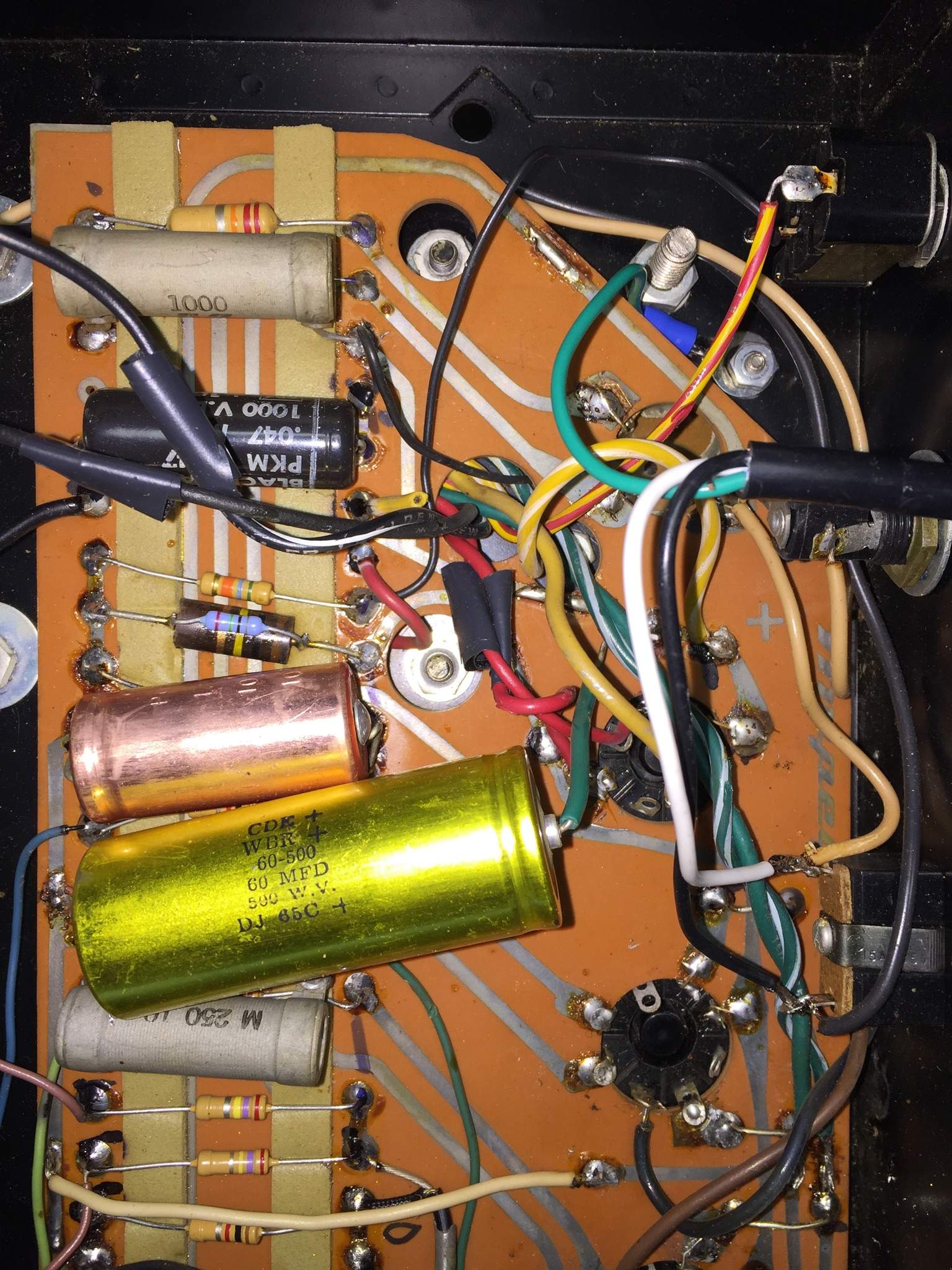
Calling on the Portaflex Club for a technical question. My 70s B15N was gone over a few years ago by a tech in PA (when I lived in the Philadelphia area). He changed a couple of caps and did the 3 prong plug conversion. I am getting ready to recap the electrolytic caps (purchased from Fliptop.net) but before I jump in, was curious about the yellow wire that has been cut. I am not a home now but did read some voltage on the wire (don’t recall the value). It is the yellow wire that’s cut and sits close to the black .047 cap. Might this have been the lead for the polarity switch? Also assume since it’s hot, I should place a wire nut on it.
Another “dumb” question. Any tricks to remove the 3x40 mF multi can without taking out the board it looks that in order to remove the board, I would have to unconnect all the tube leads? I just can’t see the twist prongs for the multicap can. Or maybe if I undo the can screws & bolts and remove the leads from the board, I will get lucky
Also have no idea why the blue resistor is bridged over the old resistor. Anyone here venture a guess?
PS Jimmy, can I’m be added to the club - I could post pics of the amp once I complete the work I’ve had this one for about 10 years - sold my 60’s Blue Tolex to a friend who was dying to have it for his studio.
PS sorry if this is a redundant post. Was trying to add from the iPad and it failed and may have added another post else where.
Another “dumb” question. Any tricks to remove the 3x40 mF multi can without taking out the board it looks that in order to remove the board, I would have to unconnect all the tube leads? I just can’t see the twist prongs for the multicap can. Or maybe if I undo the can screws & bolts and remove the leads from the board, I will get lucky
Also have no idea why the blue resistor is bridged over the old resistor. Anyone here venture a guess?
PS Jimmy, can I’m be added to the club - I could post pics of the amp once I complete the work I’ve had this one for about 10 years - sold my 60’s Blue Tolex to a friend who was dying to have it for his studio.
PS sorry if this is a redundant post. Was trying to add from the iPad and it failed and may have added another post else where.
This is a very useful device, to bad thay didn't put this feature into the tube testers they used to have at the drug store. Would have been very useful. Red base 6SL7's seem to
be ideal for a B-15N Preamp section. Mine has a lot of hum going on these days, but
the outlets in my study are problematic anyway.
Ric
Those tubes are quite nice. The hum could be a tube issue or perhaps your amp needs to be serviced.
Like you say, the noise can be from an external influence. In the past, dimmers and fluorescent lamps were the primary concerns. These days, switching power supplies for LED lighting and computers can be noise contributers. You can first try the amp in another room that is on a different circuit.
#651 daltontomlinson
Can't help you with tech questions. Beans is the go-to guy for that. But I'm sure you'll get it sorted.
Can't help you with tech questions. Beans is the go-to guy for that. But I'm sure you'll get it sorted.
Those tubes are quite nice. The hum could be a tube issue or perhaps your amp needs to be serviced.
Like you say, the noise can be from an external influence. In the past, dimmers and fluorescent lamps were the primary concerns. These days, switching power supplies for LED lighting and computers can be noise contributers. You can first try the amp in another room that is on a different circuit.
Good suggestions, I tried the outlet change first, but no difference in the hum, so it’s on to the technician.
.... I am getting ready to recap the electrolytic caps (purchased from Fliptop.net) but before I jump in, was curious about the yellow wire that has been cut. I am not a home now but did read some voltage on the wire (don’t recall the value). It is the yellow wire that’s cut and sits close to the black .047 cap. Might this have been the lead for the polarity switch? Also assume since it’s hot, I should place a wire nut on it.
....Any tricks to remove the 3x40 mF multi can without taking out the board it looks that in order to remove the board, I would have to unconnect all the tube leads? I just can’t see the twist prongs for the multicap can. Or maybe if I undo the can screws & bolts and remove the leads from the board, I will get lucky
Also have no idea why the blue resistor is bridged over the old resistor. Anyone here venture a guess?
The black 0.047uF capacitor is the so called death cap. Normally it is removed when the three conductor power cable is added. The yellow wire normally goes through the hole and under the board. It is part of the polarity circuit. Some tech will disable the polarity circuit by clipping wires so that they don't have to solder on the board. It's faster and avoids potentially damaging the PCB by applying too much heat. Rather than covering it with a nut, I would either trim the yellow wire at the solder joint, or unsolder it.
You should not have to remove the board to change the cap can. It is important to completely desolder the can's tabs. The trick is to cut the tabs as close to the capacitor body as you can. You don't want to stress the solder joint and damage the trace on the circuit board. Once the tabs are cut, the can will be released. It takes a lot less heat to remove the remaining metal from the PCB solder points. Don't use more heat then necessary. I find that it helps to apply some solder flux paste first, heat, remove the tab. Clean the area well with solder wick covered in paste.
No idea why the two resistors are connected in parallel. It should be replaced with the proper resistor of the correct wattage. Trace the circuit and find where it connects, then identify it on the schematic to determine what value it should be.
I don't like the black electrical tape on the red wires. I'd remove it and find out what is going on there. They need to be better isolated if the covering is damaged. I would use heat shrink tubing if you can.
Latest posts
-
-
 Greetings, and help me value my basses, please.
- Latest: MochaFiend
-
-

-
