• TalkBass has been independent since 1998. Add your voice.
    Create a free account to reply to discussions, view embedded media, and browse with fewer display ads.
    Join freeLog in
    Want zero display ads or expanded classifieds tools? Compare plans.

Official Ampeg Portaflex Club

Thanks cor all your help David. Taking bets on whether my tolex is actually navy blue. It's so nasty I think it might just be black with filth.

Mike, I would try cleaning an area with mild soap, warm water, and a soft brush, away from any seams. The glue softens easily with water and if it gets into the seams, they can peel back.

The first thing that I usually do is clean everything. For one thing it helps with old amp odor, but it also gives me some time to assess everything while I'm working. Cleaning takes some time. After the vinyl and cabinet, I move on to the chassis, then the electronics.

There is always the possibility that someone painted your amp. After trying the soap and water, you can try cleaning a small test spot with 99% isopropyl alcohol (pharmacy) and Q-tips.
 
  • Like
Reactions: MMMike
Sigh. Just ran to guitar center. Now I have a spare rectifier tube... .argg. No change. Really thought that would do it. Might have to take this somewhere as it's kind of consuming me. Is it possible I wired the transformer backwards?
 
If you are discouraged, having a tech look at it at this point would probably be a good idea.

The power transformer black, red, green, and yellow pairs can be connected either way. The death cap on the primary side should have been removed or replaced with a new type Y safety cap when the three conductor power cord was installed. With the cap, the polarity switch will continue to work. Most people simply choose to remove it.

Given all that you have done and if all is well with the transformer installation, my best guess is that there is a bad solder joint, a bad capacitor, bad resistor, or a bad pot. Since the tone controls on channel 1 are not functioning, it indicates that this is a good place to start looking.

A tech would first inspect the connections carefully, then look at the circuits. Test the pots. A scope and signal generator can be used to take readings along the signal pathway.
 
  • Like
Reactions: Bass 45
If you are discouraged, having a tech look at it at this point would probably be a good idea.

The power transformer black, red, green, and yellow pairs can be connected either way. The death cap on the primary side should have been removed or replaced with a new type Y safety cap when the three conductor power cord was installed. With the cap, the polarity switch will continue to work. Most people simply choose to remove it.

Given all that you have done and if all is well with the transformer installation, my best guess is that there is a bad solder joint, a bad capacitor, bad resistor, or a bad pot. Since the tone controls on channel 1 are not functioning, it indicates that this is a good place to start looking.

A tech would first inspect the connections carefully, then look at the circuits. Test the pots. A scope and signal generator can be used to take readings along the signal pathway.
Tone pots are all functional now.
 
I was going through some paperwork I have here and came across a page of notes that Jess had written showing things he thought should be included in a B15N reissue. I thought some people may find them interesting, especially since they can be compared against what became the B15R.

B15R.jpg
 
Close to the released B15R

I think that it was important to keep many aspects as they were rather than morph the B-15 into something else. I think that Loud did an excellent job on the first Heritage reissue and paid tribute to the B-15 which was the intent.
 
Last edited:
  • Like
Reactions: JimmyM
I was going through some paperwork I have here and came across a page of notes that Jess had written showing things he thought should be included in a B15N reissue. I thought some people may find them interesting, especially since they can be compared against what became the B15R.

View attachment 821579

Mark,

Thanks for posting that!!! I appreciate those implementations that Jess made.
 
LOL...nobody's THAT pure!

Good old Jess, but as it turns out, some folks ARE that pure :D

It mostly just looks like a spec. That it was hand written by Jesse makes it really cool. I only wish that he had mentioned something about keeping the weight down, like maybe under 100 lbs.

For my gig last night, we were wearing white shirts and black pants. My wife ironed a shirt for me. Smokin'.
I got to the venue, unloaded the B-15R and set up. Then I went to put on my tie in the bathroom, I looked in the mirror, and my newly ironed shirt was badly wrinkled. My wife would have been miffed if she saw that. I straightened up as well as I could, and having a tie helped. That, and also being parked in the back of a big band behind 15 horns.

The tone was great, and I got some complements at the break, so I forgot about the shirt for a little. But then I got the big head, and made a few minor fumbles in the second set. Anyway, it was a great night for the B-15R that evolved from Jesse's list.
 
No they aren't.

What did you do to get channel 1 tone working?

I think it started working again after I replaced the hum pot. I also found dirt/fuzz between the chassis and the tone pots so I'm sure cleaning that out helped as well. I didn't move the hum pot ground maybe I will try that or try moving the power cord ground. I almost want to learn how to use a signal generator and oscope to chase the noise. I realize I could just start removing and testing resistors but that would be so much less intrusive than desodering & resodering a million things. I think my meter has a capacitor checker. What do you think the chances of getting a new cap that is bad are...doh, I guess I should have checked them before installing, didn't think of that.
 
There are some ground connections from components to the pot case in some amps, so a bad contact on the tone pot would have affected how it worked. Good progress there.

Your meter's capacitance tester will test capacitance but it won't be able to test if the cap is leaking. That's what needs to be done. A special setup is needed to do this, a voltage is applied and you measure how long it holds the charge. If it is leaking too much, it won't hold it as long as it should. A telltale sign of a leaking cap in the tone circuit is a static sound when you adjust the pot. This can also be due to a scratchy pot so it would first need to be cleaned internally by applying a little deoxit inside to eliminate that possibility.

The power cord safety ground is best attached to one of the power transformer mounting bolts. A ring terminal should be used. Nothing else should attach to that point. If this is what you've done, moving it will not help.

It is always good practice to test components before installing them. The chances of getting a bad component or one that is mislabeled are pretty slim. More often, the incorrect value is installed during manual assembly.

If you changed the hum pot, you should hear a difference in the hum as you rotate the pot. Set it for minimal hum. But you later said that it is a high frequency noise and not a low frequency hum. If this is the case, moving the ground will not help.

There is something called a listening device that you can build. This can help you trace through a circuit without a scope. You connect a signal from a bass or a music player and listen for noise along the signal path. It can help narrow down problems. Construction details and a video are here: Troubleshooting your Amp – Billm Audio
 
  • Like
Reactions: MMMike and vmabus
After I fix my pellet stove tonight I will build that. Speaking of which if you need any help with pellet stoves let me know, I'm your guy.
So I should be able to hear where the hum is created by stepping through the circuit. Just what I need.
You are great. Thanks for the emotional support, lol. I can usually fix a pellet stove in a hour or two so this has been a humbling (yet enlightening) experience.
 
No end of the need to fix things. Better to repair the stove now than wait till things are really cold.

The listening device can help. It fails when the noise is in the power supply and it affects other stages.

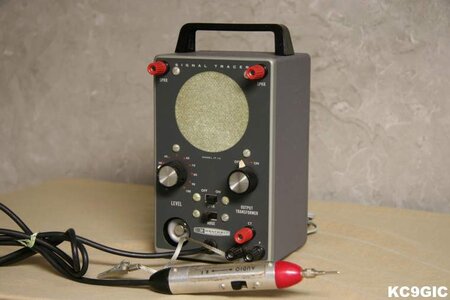
Here is a more elaborate version. A step up is an instrument called a signal tracer. I have a couple of old ones made by EICO and Heathkit that I bought at hamfests. They often sell for under $20.
 

Attachments

  • stethoscope weber.jpg
    stethoscope weber.jpg
    38.4 KB · Views: 64
  • Eico 147A signal tracer.jpg
    Eico 147A signal tracer.jpg
    23.7 KB · Views: 64
  • heathkitit12lg.jpg
    heathkitit12lg.jpg
    39 KB · Views: 63
  • Like
Reactions: MMMike


Signal tracers are pretty simple so one shouldn't cost a lot.

I'm not sure if this is a continuity tracer, something that beeps, or if it amplifies the signal and allows you to listen. Both types are sold. You need the latter in order to listen for noise.

EDIT: I recall seeing one of these used on This Old House. A signal is injected at one end, you probe at the other end and it beeps when there is continuity.
 
Last edited:
As an Amazon Associate, TalkBass may receive commissions from qualifying purchases made via links on this site.
  • Like
Reactions: vmabus
I was going through some paperwork I have here and came across a page of notes that Jess had written showing things he thought should be included in a B15N reissue. I thought some people may find them interesting, especially since they can be compared against what became the B15R.

View attachment 821579

Maybe David can add this to the Wiki.
 
  • Like
Reactions: beans-on-toast