In Chuck Traeger's The Setup and Repair of the Double Bass, concerning bridges, Chuck writes "if it is more than ten years old it should be replaced because the wood has dried out and become hard and brittle, and will not vibrate as well as a younger, more flexible piece of wood." (p 23). How many luthiers would agree with this?

Enjoy the benefits of a premium membership!
Upgrade Account
-
TalkBass has been independent since 1998. Add your voice.
Create a free account to reply to discussions, view embedded media, and browse with fewer display ads.
Join free Log in
Want zero display ads or expanded classifieds tools? Compare plans.
You are using an out of date browser. It may not display this or other websites correctly.
You should upgrade or use an alternative browser.
You should upgrade or use an alternative browser.
Double Bass Old Bridge
- Thread starter jkschultz48
- Start date
More options
Who Replied?
How many luthiers would agree with this?
"Better" is a difficult criterion here. A harder bridge will transmit more vibration and absorb less, that's just physics. Wood will absorb higher frequencies first, so a given player may prefer a younger bridge for a more mellow tone or to suit a particular instrument.
- Aug 1, 2005
- 3,546
- 1,421
- Disclosures
- Private Inventor - Bass Capos
Didn't he also say to replace the bass bar every ten years? Will a 20 year old bridge have less moisture content than a well seasoned new one? What about the rest of the bass? I'm not a luthier, but I find this idea is hard to support.


I don't think too many luthiers agree with Mr. Traeger's thinking here. Hopefully some will chime in...
Yes, he did say that. All I can say is that Chuck has worked with many bassists over the years and probably bases this idea on the accumulated experience--although I wonder about the logic. I was hoping for more responses to help push me one way or the other.Didn't he also say to replace the bass bar every ten years? Will a 20 year old bridge have less moisture content than a well seasoned new one? What about the rest of the bass? I'm not a luthier, but I find this idea is hard to support.

There are bridges still in use that are very old indeed. If it ain't broke, don't fix it.
That being said, if you suspect that there is something amiss, it is entirely reversible: if the new bridge doesn't work miracles, you can always put the old one back.
Usually, I find that some small adjustment, and (possibly) new strings, makes all the difference that was needed. Once it was literally a half-millimeter shift of the treble bridge foot (on a viola, to be sure, but...). Sometimes small things matter.
That being said, if you suspect that there is something amiss, it is entirely reversible: if the new bridge doesn't work miracles, you can always put the old one back.
Usually, I find that some small adjustment, and (possibly) new strings, makes all the difference that was needed. Once it was literally a half-millimeter shift of the treble bridge foot (on a viola, to be sure, but...). Sometimes small things matter.

I'm still rockin' the bridge that came on the bass I bought 40 years ago. The bass sounds better than ever.
Chet, yes, it seems that if it ain't broken the luthier (or mechanic) don't know what to fix! I bought this bass just a year ago. It is about 120 yrs old and sounded wonderful. But it needed a top lift to fix cracks and bass board. That work got done and I have played it with joy for about 8 months. When I say JOY, I mean string response and tone across strings way up the finger board. BUT, the finger board is an old school model with 1 3/8s string spacing on the bridge with deep notches. So, I'm going to have the finger board remodeled to a rounder shape and, basically, it will require a new bridge.There are bridges still in use that are very old indeed. If it ain't broke, don't fix it.
That being said, if you suspect that there is something amiss, it is entirely reversible: if the new bridge doesn't work miracles, you can always put the old one back.
Usually, I find that some small adjustment, and (possibly) new strings, makes all the difference that was needed. Once it was literally a half-millimeter shift of the treble bridge foot (on a viola, to be sure, but...). Sometimes small things matter.


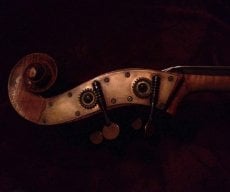
@jkschultz48 Couldn't the existing bridge, assuming it's not warped or anything, just be re-cut/re-shaped to match the shape of the new fingerboard? It looks to have plenty of wood to spare between the decorative heart shape and where the strings pass over it.
My original question was about Chuck Traeger's advice to change out old bridges after 10 years. Seems like no one likes the idea, so I guess I have an answer.
I could use the old bridge. I played with this bridge for about 8 months preparing for performances and the bass sounded pretty good for orchestra use--good volume and enough brightness for the director to hear clearly over the cellos. My aim now is to optimize the sound AND make this bass a little easier to play. The reasons for getting a new bridge have been (1) no one knows how old this bridge is (definitely >10 years), (2) I want to try a bridge without adjusters (top is very stable even out here on the frozen prairie), and (3) I plan to have the finger board remodeled to take out the crown between the E and A strings and make it more round and move the strings closer together with the notches away from the edge. The photo below shows how I have been experimenting on my own. Leaving the A string stationary, I moved the other strings in to get a 1 1/8 spacing. But the G, D, and A are practically on the same plane so in thumb position it is almost impossible to hit only one string (with a bow of course). I trimmed the G side down a bit but this makes very little difference. This guy gets a break for a few months so he's going to stay with the luthier to have the finger board and bridge surgery. I'll keep the old bridge so I can go back to it if deemed necessary. Thanks for your comments.
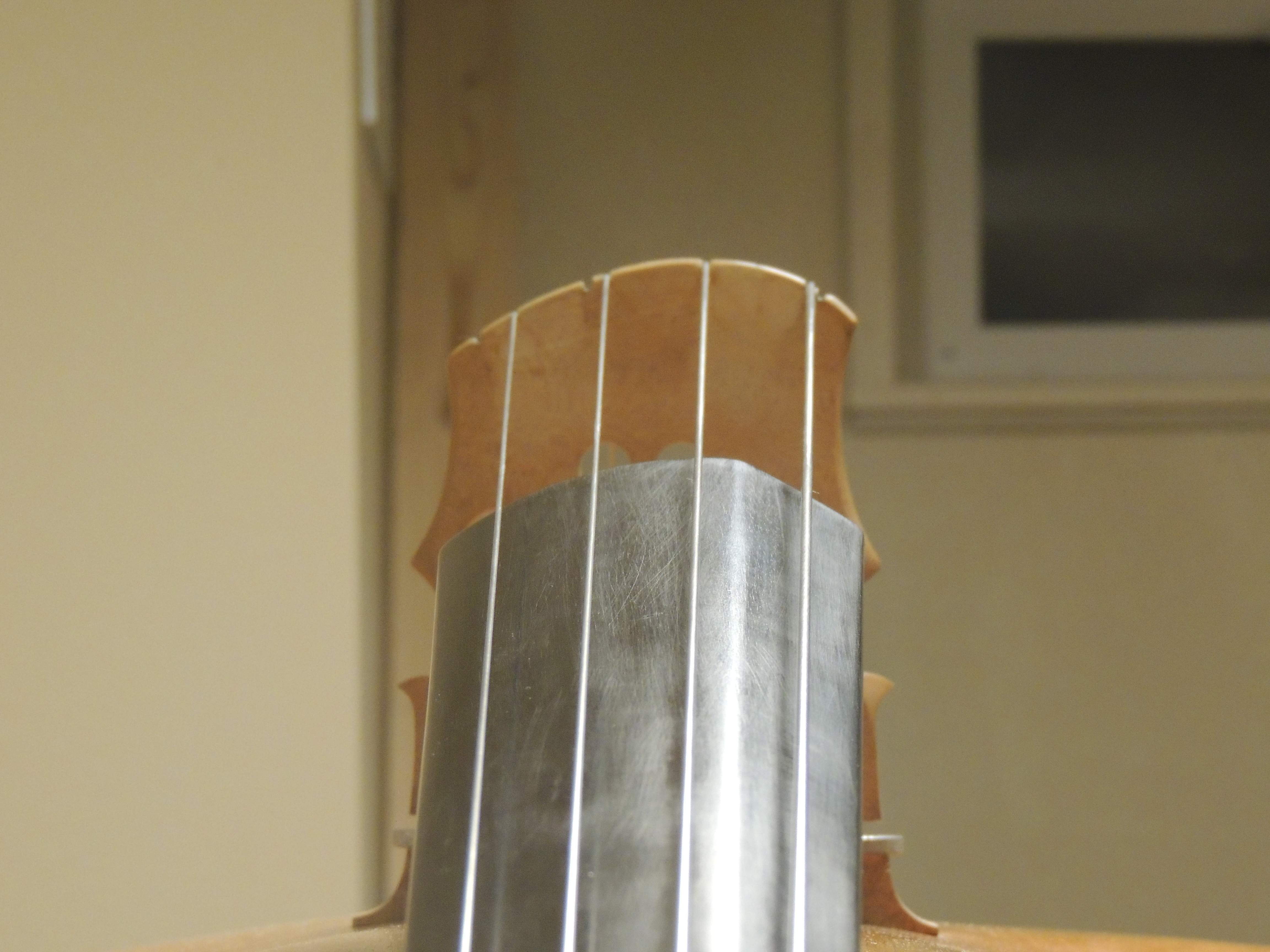
I could use the old bridge. I played with this bridge for about 8 months preparing for performances and the bass sounded pretty good for orchestra use--good volume and enough brightness for the director to hear clearly over the cellos. My aim now is to optimize the sound AND make this bass a little easier to play. The reasons for getting a new bridge have been (1) no one knows how old this bridge is (definitely >10 years), (2) I want to try a bridge without adjusters (top is very stable even out here on the frozen prairie), and (3) I plan to have the finger board remodeled to take out the crown between the E and A strings and make it more round and move the strings closer together with the notches away from the edge. The photo below shows how I have been experimenting on my own. Leaving the A string stationary, I moved the other strings in to get a 1 1/8 spacing. But the G, D, and A are practically on the same plane so in thumb position it is almost impossible to hit only one string (with a bow of course). I trimmed the G side down a bit but this makes very little difference. This guy gets a break for a few months so he's going to stay with the luthier to have the finger board and bridge surgery. I'll keep the old bridge so I can go back to it if deemed necessary. Thanks for your comments.
As long as you don't want your action higher than you have now, there is no need for a new bridge. If you want the D higher for easier bowing you might need one unless you lower G and/or A.
Reshaping the fingerboard either lowers the fingerboard (resulting a higher action if this happens under a string) or keeps it as it is ( if the change is only between strings).
But a new fingerboard (different angle or thicker) in many cases needs a new bridge.
If you make the spacing between the strings smaller the overall angle of bowing gets smaller (because of the bouts). Just keep an eye at the G string that you get enough clearance towards the bout. I made my high C on my five string a little bit too low and sometimes touch the bout with the bow (but probably also because I'm not very experienced with the bow). On the other hand I have a rather larger bowing angle on each string for a five string.
On the E side you usually will not have problems touching the bout with the bow because the action is much higher on the E than on the G.
Reshaping the fingerboard either lowers the fingerboard (resulting a higher action if this happens under a string) or keeps it as it is ( if the change is only between strings).
But a new fingerboard (different angle or thicker) in many cases needs a new bridge.
If you make the spacing between the strings smaller the overall angle of bowing gets smaller (because of the bouts). Just keep an eye at the G string that you get enough clearance towards the bout. I made my high C on my five string a little bit too low and sometimes touch the bout with the bow (but probably also because I'm not very experienced with the bow). On the other hand I have a rather larger bowing angle on each string for a five string.
On the E side you usually will not have problems touching the bout with the bow because the action is much higher on the E than on the G.


