• TalkBass has been independent since 1998. Add your voice.
    Create a free account to reply to discussions, view embedded media, and browse with fewer display ads.
    Join freeLog in
    Want zero display ads or expanded classifieds tools? Compare plans.

Old peavey century 120

Hey South Paw--I only know enough to be dangerous. The little I know was picked up from a little guidance from Flieglers amp book, jumping in and what I gleaned from the interwebs. I have no problem cleaning, replacing bad parts, etc... but I leave the sensitive stuff to the pros since I don't have a bench full of testing equipment to trouble shoot.
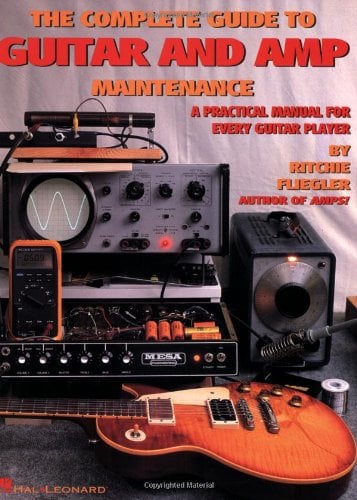
51r7GfRGVPL.jpg
 
  • Like
Reactions: SOUTH PAW
QUOTE="bigtone23, post: 19753245, member: 271263"]Hey South Paw--I only know enough to be dangerous. The little I know was picked up from a little guidance from Flieglers amp book, jumping in and what I gleaned from the interwebs. I have no problem cleaning, replacing bad parts, etc... but I leave the sensitive stuff to the pros since I don't have a bench full of testing equipment to trouble shoot.


I'm currently at the dangerous stage myself, but plan to follow the same path to usefulness. Smoke and solder burns are ahead. :woot: And, hopefully, a functioning Peavey Century 120 amp.

Thanks for the direction and pic of the amp guidebook.
 
  • Like
Reactions: bigtone23
That book is a good one to cover the basics -- you can also just Google or Wiki resistors and capacitors. Most of the other components are more stable over time and less likely to need replacement.

The old Century is a great sounding amp -- very musical, if a little "scooped".
It almost seems (dare I say) tubey to me; the overdrive circuit shifts the tone a little, so I try to run it just below audible clipping and goose the input gain so that the amp overdrives dynamically. It's clean when I play normally, and snarls a bit when I lay into it.

I'll also share the rest of my conversation with Bobby Baldwin (@BbbyBld) about this amp:
There were two Centuries.

The early one had a discrete preamp that ran off of a single +50V supply.

I built a really simple preamp with discrete transistors and was blown away at how fast and present the response was. It occurred to me that each opamp stage probably has close to 10 transistors inside in the audio path, and a modern preamp can easily use a dozen opamp stages. Each transistor adds a little delay and a little distortion.

The later Century (C1980) used the 200H module, the preamp used opamps and they ran off of +/-15V.


The power module [in the older Century] is one of the original Peavey solid state power amps by the way.

Hartley Peavey contracted a company out of Alabama to design it. That company was Orrtronics, and their claim to fame was manufacturing recording tape.

It is a very early, primitive design.
It was used in various products up to about 1980, even though Peavey had far more advanced designs during that time designed by Jack Sondermyer, the father of modern solid state power amp technology.

The capacitively coupled output is part of the "crudeness" of this design, so I'd recommend modifying that part.
Basically, capacitors pass higher frequencies with ease, but lower frequencies have a harder time passing through. This means that your power amp puts out a little less in the low frequency range than it does at 1K.

The other thing that happens is that when you start to clip the power amp with low frequencies, instead of a pleasant growl, you get a nasty buzz sound. The way to fix that is to use a larger capacitor, but...

The other thing is that capacitors can be inductive, especially electrolytic caps, because the plates are rolled into a coil. This means that your power amp also puts out a little less in the upper audio range because the inductance starts to factor in a little. Inductors pass lower frequencies freely, but tend to block higher frequencies. Just using a larger capacitor can increase the inductance because the plates can be longer, thus more inductance.

Ultimately, the output response of your power amp is sort of a bell curve.

This capacitor is also subject to high ripple current (rapid charging and discharging) because there is pure, high AC current passing through it all the time. This can dramatically shorten the life of a capacitor.

The way to get around all of this is to use multiple capacitors in parallel, one of them being a film capacitor so there is no high frequency degradation.
The inductance will go down because inductors in parallel divide. The ripple current will also divide so you won't be stressing a single cap.

So, if you end up beefing up the output coupling cap. it will add some low end.

There may be a little bit of crossover distortion, but that is normal for these modules, and it improves once it heats up, which is also typical of many passively cooled SS power amps.
If you've had to replace the original output transistors, you may want to add a 0.1uF cap. across the speaker output jacks.
It would help to clean up the output signal when using the modern output transistors by dampening out instability.

[After completing these mods, I commented on how loud the Century is for a humble 100-watt amp. Bobby replied as follows:]

Modern power amps are biased class B, but also have a whole lot of gain and lots of negative feedback to get rid of crossover distortion, which in turn gives them a high damping factor. Your amp does not have a lot of gain or feedback, and has a low damping factor. That's where I think the loudness comes from.


So...that's everything I know about the amp -- and the experience shaped my opinion that low parts count/low complexity is a good recipe for tone.

It made me a sucker for fast transient attack...and although I still love tube amps, it showed me that they are not the only way to get that kind of musicality from an amp.
 
Thanks groovaholic, for sharing all the history on the Century amps. Very interesting how it was a primitive design that gives it it's unique character and makes it easy/affordable to work on. Even better that it can be easily improved.

The fact that it goes back that far, reminds me of when I bought it used in 1980, and I remember thinking this thing is ancient. Now I'm beginning to fit that description. ;)
 
A few days I found my Peavey Century 200H (extended range) in the attic after not using it for a long time.
And of course it works just fine, no problems!

So I thought let's check talkbass.com for more information on this amp and so I came across this thread.

Interested in the mod with the cap's I decided to open up the amp to see what version I have:

PVC3.jpg


PVC2.jpg


PVC1.jpg


So it is the version with the opamps in the preamp (B version?), and what I see is that there are two cap's of 1000mF.

My question is, would the mod with extra cap's work on this version?
 
A few days I found my Peavey Century 200H (extended range) in the attic after not using it for a long time.
And of course it works just fine, no problems!

So I thought let's check talkbass.com for more information on this amp and so I came across this thread.

Interested in the mod with the cap's I decided to open up the amp to see what version I have:

View attachment 2745853

View attachment 2745854

View attachment 2745855


So it is the version with the opamps in the preamp (B version?), and what I see is that there are two cap's of 1000mF.

My question is, would the mod with extra cap's work on this version?
Hmm...without looking at a schematic for that power module, I don't know for sure.
The preamp board definitely looks different; I would think that it's what Bobby B referred to as the "B" version.

The power board is more similar, but still with some clear differences.

My recommendation would be to get a schematic, and see if those 1000 uF caps are connected to the speaker jack.
Failing that, you could use the continuity checker on a multimeter to see if they are connected.

If so, and you still have a Radio Shack nearby, you might just buy a couple 1000 uF caps and use alligator clips to parallel them with the existing caps (paying CLOSE attention to polarity) to see if "the capacitor hack" would yield worthwhile results. It'd set you back less than $5 in parts...
 
  • Like
Reactions: TonH
Thanks for your reply!
Maybe I contact Peavey Customer Services for a schematic of this version.
Meanwhile I can do the trick with the alligator clips. As you say, the parts are cheap :)!

Don't do "that trick" if you don't know what version it is...
 
I'm pretty sure they are not. ("only" about 99% sure ;) )
100% right!!!

I found the schematics voor the 200H modules A and B version on this website/forum, searching for pictures:
Peavey XR-400 Amp section burned circuit indentify


And here are the pdf-files:

Invalid Link Removed

Invalid Link Removed

Those 1000mF cap's are from/in the power supply for the opamps in the preamp.


Strange that both the A version as the B version are directly coupled in these schematics.
 
Last edited:
I believe the original 120 power amp was single ended and used the output coupling cap. The 200 series and up (likely designed by Jack Sondermeyer) were bipolar, direct coupled.
 
Too bad that cap mod doesn't apply to your amp. I do think people play with op amps and tweak some component values in the Saturation and tone stack to get them a bit more toneful.
Despite it working fine, a good electrolytic cap job can still help a lot. I have an old 83 Bandit that is the same era as your 200H Century. Still on all original parts and working fine, so I letting it go just a little longer.
 
Too bad that cap mod doesn't apply to your amp. I do think people play with op amps and tweak some component values in the Saturation and tone stack to get them a bit more toneful.
Despite it working fine, a good electrolytic cap job can still help a lot. I have an old 83 Bandit that is the same era as your 200H Century. Still on all original parts and working fine, so I letting it go just a little longer.

Yes, it's a pitty. On the other hand I am glad I found the correct schematics for my amp. Usefull when the amp needs a service.

I tried the amp with a DIY cab (115l/ 4 ft3) with a Eminence Kappa 15A speaker and it sounds great.
With the saturation on position 3 it creates something extra, very usefull for some songs we play.
 

Latest posts