
Enjoy the benefits of a premium membership!
Upgrade Account
-
TalkBass has been independent since 1998. Add your voice.
Create a free account to reply to discussions, view embedded media, and browse with fewer display ads.
Join free Log in
Want zero display ads or expanded classifieds tools? Compare plans.
You are using an out of date browser. It may not display this or other websites correctly.
You should upgrade or use an alternative browser.
You should upgrade or use an alternative browser.
Orange Isobaric
- Thread starter ghiggin1079
- Start date
More options
Who Replied?

I believe their main liability was how heavy they were for the amount of sound you could get out of one.

They are out there, a "regular" 2x12 will have more output.
It fit that odd, more than a 1x12, less than a 2x12 niche.
It fit that odd, more than a 1x12, less than a 2x12 niche.

I think Fuchs might be doing something similar, but with lighter speakers...
Fuchs Audio Technology FAT-410X: 4x10 Bass Cab
Fuchs Audio Technology FAT-410X: 4x10 Bass Cab

Not quite. The Fuchs is more like a conventional 4x10 but with pairs aimed in opposite directions.I think Fuchs might be doing something similar, but with lighter speakers...
Fuchs Audio Technology FAT-410X: 4x10 Bass Cab
An isobaric has pairs of speakers nested in an enclosure so you can only see the outer-facing ones. The space between them is completely sealed, and it's the space behind the hidden speaker that acts as the bass chamber (sealed, ported, reflex, whatever)
via our friends at Wikipedia.
Last edited:
I misinterpreted Fuchs' product decription, then. It makes sense, then, that the FatCab 410 reverses the phase on one pair of drivers (one pair pulls while the other pushes, and vice versa) to prevent standing wave interference.Not quite. The Fuchs is more like a conventional 4x10 but with pairs aimed in opposite directions.
An isobaric has pairs of speakers nested in an enclosure so you can only see one.
View attachment 7217698
via our friends at Wikipedia.

Drivers with stouter motors and more robust voice coils made this design concept unnecessary.

From a marketing standpoint, it was a solution looking for a problem. Sonically, I didn't think they sounded that great. They seemed to lean more towards old-school sounding, but were heavy and expensive.

Some people like them and some people don't. Some people think they are loud enough and some people don't. Only you can decide if they sound good and are loud enough for your needs.
If I understand correctly, the main advantage of an isobaric is the internal volume of the chamber a given driver requires for a specified LF cutoff is cut in half. This does not mean the size of the cabinet is cut in half, but an isobaric design will be smaller than a conventional design. Power handling doubles, which may be claimed as an advantage but it's really not
Let assume you have a conventional 110 rated for 150W with a sensitivity of 94dB 1W/1m.
Let's compare it to a 210 isobaric using the same drivers tuned for the same LF response. The isobaric will be smaller but also heavier. Since the isobaric uses two drivers, power handling will be doubled to 300W, but the sensitivity will be reduced to 91dB 1W/1m. Impedance will either be doubled or cut in half, depending on how the drivers are wired.
SPL of the conventional 110 at 150W will be 115.8dB
SPL of the isobaric 210 at 300W will be 115.8.
Essentially the isobaric can take 3dB more power, but the sensitivity is 3dB lower--so max SPL is the same for both.
Advantages: smaller box, slightly lower distortion.
Disadvantages: Lower efficiency, requires double the power for the same volume, heavier, more complicated to build, more expensive.
Back in the day, drivers required a huge cab to play low. So it could make sense to use an isobaric design in order to get the desired LF response in a smaller cab. Modern drivers can be designed to perform well in much smaller cabs. So if you need a small cab, it's arguably better to choose an appropriate driver, rather than resorting to an isobaric design.
If I understand correctly, the main advantage of an isobaric is the internal volume of the chamber a given driver requires for a specified LF cutoff is cut in half. This does not mean the size of the cabinet is cut in half, but an isobaric design will be smaller than a conventional design. Power handling doubles, which may be claimed as an advantage but it's really not
Let assume you have a conventional 110 rated for 150W with a sensitivity of 94dB 1W/1m.
Let's compare it to a 210 isobaric using the same drivers tuned for the same LF response. The isobaric will be smaller but also heavier. Since the isobaric uses two drivers, power handling will be doubled to 300W, but the sensitivity will be reduced to 91dB 1W/1m. Impedance will either be doubled or cut in half, depending on how the drivers are wired.
SPL of the conventional 110 at 150W will be 115.8dB
SPL of the isobaric 210 at 300W will be 115.8.
Essentially the isobaric can take 3dB more power, but the sensitivity is 3dB lower--so max SPL is the same for both.
Advantages: smaller box, slightly lower distortion.
Disadvantages: Lower efficiency, requires double the power for the same volume, heavier, more complicated to build, more expensive.
Back in the day, drivers required a huge cab to play low. So it could make sense to use an isobaric design in order to get the desired LF response in a smaller cab. Modern drivers can be designed to perform well in much smaller cabs. So if you need a small cab, it's arguably better to choose an appropriate driver, rather than resorting to an isobaric design.
I'm a big fan of Orange amplification. I play both guitar and bass, and I use Orange amps for both. My experience demoing these isobaric cabs was that they sounded fantastic, and worth owning as long as you had a place to put them and leave them there. Otherwise, all the benefits were cancelled out by the back pain you'd experience.

As Wasnex explained, there was a time when the smaller box size permitted by isobaric design might have been useful. With the drivers/tech available now it's just a marketing gimmick.

An isobaric cab gives the driver(s) you listen to a "larger" cabinet to work with, the internal driver(s) relieves some of the back pressure - it has some advantages in lowering distortion at lower frequencies which make it a better hi fi cabinet, but which don't really help with a musical instrument speaker, where we actually like some distortion, even on "clean" sounds.From a marketing standpoint, it was a solution looking for a problem. Sonically, I didn't think they sounded that great. They seemed to lean more towards old-school sounding, but were heavy and expensive.
An isobaric cab gives the driver(s) you listen to a "larger" cabinet to work with, the internal driver(s) relieves some of the back pressure - it has some advantages in lowering distortion at lower frequencies which make it a better hi fi cabinet, but which don't really help with a musical instrument speaker, where we actually like some distortion, even on "clean" sounds.
I understand that, which is why I referred to Orange's marketing of the product. It didn't solve a problem, it didn't improve anything, it was pretty much out of touch with where the market was going (heavy weight, muddy), and had limited appeal.
The few times I tried them in a band setting, they seemed to do nothing well. They weren't articulate, they had a weird low-midrange bump to them and they also didn't work well for me in an open-air concert setting. It was more Orange's application to bass guitar that didn't seem to get anything right. At the time it seemed everything else (including Orange's non-iso cabs) sounded better!
I was curious because I have seen isobarics in hi-fi applications and in a couple of custom PA sub applications.
Isobaric designs where the speakers were placed cone to cone / face to face would reduce even order distortion produced by the drivers.
The speakers were wired out of phase so they would still move in the same direction at the same time as canceling the speaker produced
distortion products.
There were some speaker designs not isobaric but direct loaded with one speaker mounted backwards and wired out of phase to help lower disortion.
Peavey and TAD are a couple I can think of quick.
The speakers were wired out of phase so they would still move in the same direction at the same time as canceling the speaker produced
distortion products.
There were some speaker designs not isobaric but direct loaded with one speaker mounted backwards and wired out of phase to help lower disortion.
Peavey and TAD are a couple I can think of quick.
Last edited:
There were some speaker designs not isobaric but direct loaded with one speaker mounted backwards and wired out of phase to help lower disortion.
Peavey and TAD are a couple I can think of quick.
EAW FR250Z
IF it's not clear, this is not isobaric. I believe they call it "push pull," which IMHO is a bit misleading. The polarity is reversed on one drive so the cones of both move in the same direction.

I have an SP210 and an SP212 cabinet.
Heavy and not super loud, but they sound really cool (if you like that sound).
Heavy and not super loud, but they sound really cool (if you like that sound).

There was this thing.Isobaric designs where the speakers were placed cone to cone / face to face would reduce even order distortion produced by the drivers.
The speakers were wired out of phase so they would still move in the same direction at the same time as canceling the speaker produced
distortion products.
There were some speaker designs not isobaric but direct loaded with one speaker mounted backwards and wired out of phase to help lower disortion.
Peavey and TAD are a couple I can think of quick.
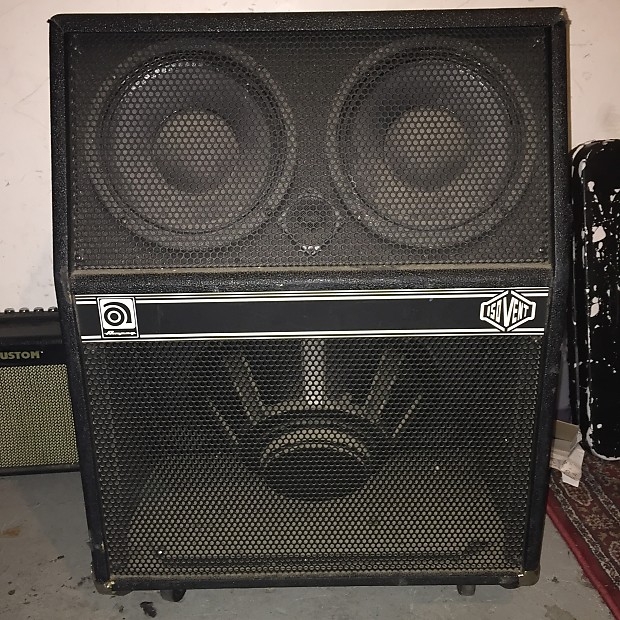
The Ampeg Isovent SVT50 Pro…

EAW FR250Z
View attachment 7217906
IF it's not clear, this is not isobaric. I believe they call it "push pull," which IMHO is a bit misleading. The polarity is reversed on one drive so the cones of both move in the same direction.
I used to have a set of old EV subs that work like this. Although, you can rewire them so the drivers move either in or out of phase with each other. I can't remember why you'd want to do one or the other - I never did the rewiring, the setup group handled that, but it had to do with throw and I think you had to also reach in and slide a wooden baffle or plate around if you changed the wiring. Different concept, for sure.
Isn't that a photo from the guy who showed up here for a couple weeks trying to make that thing "sound better?" That was a hilarious exchange.

I believe this is the thread being referenced: >>> Isovent
Is the Orange version still being offered?
Is the Orange version still being offered?


