• TalkBass has been independent since 1998. Add your voice.
    Create a free account to reply to discussions, view embedded media, and browse with fewer display ads.
    Join freeLog in
    Want zero display ads or expanded classifieds tools? Compare plans.

Double Bass Ouch - So: How Bad Is It?

I think you won't get a smooth surface on the ribs with the breaks in it by pressing the block back to them. And with the kind of tool you mentioned (just bigger, of course), you won't get pressure to the whole block area. Taking that together it won't hold well.
Of course, the repair might be a whole lot cheaper than taking the top off, but for a bass with a carved top and back I don't think you want to go that way.
If it would have been a cheap ply, you might try that for yourself and if it doesn't hold, try your own bass surgery at some later time with it and get something else for playing now.
But being the bass it is with carved top and back and you like playing it, talk to the luthier and get something else for transport.
The bass buggie with a medium thick rubber foam mat is much better than a single bass wheel as a replacement for the endpin. You can even build something like a bass buggie yourself and mount air inflated wheels instead of the medium hard rubber wheels of the bass buggie. Might get a bit bulky, but will be easy on your nerves and bass. But don't forget the rubber foam mat here too. It's what takes the shock waves when you take your bass up and down the curb, so go slowly there and help when it goes down to avoid too much shock.
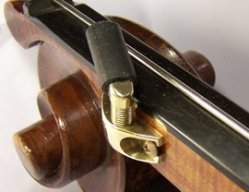
 
I actually like your basic idea, but forget about that wing fastener. I'd prepare two big blocks with holes in the centers, one block must fit inside the F hole. Set a nut tightly into the hole of that block, and have a length of threaded rod, nut, and washer on hand to pull the blocks together. Make the hole in the outside block large enough so the rod passes through freely, and if necessary shape that block a bit to match the bottom rib curve. cover the surfaces of the blocks with cello tape so they don't stick. The hard part will be getting hide glue in there, as you have very little working time. If you first steam the surfaces to be joined, and prepare thin glue in a squeeze bottle with a fairly large nozzle, I think this could be done. Of course you won't have adhesion to the top and back, so the joint will still be weak, but I think it might be worth a try. You could later open up the plates just enough to get some glue in there too.
4527t25p1-f01al.png
 
Last edited:
  • Like
Reactions: Matthew Tucker
Cntrzjones, firstly please do not take any numbers I mentioned earlier as pertaining to the value of you bass. I know too little of your bass, and certainly have no idea on it's value, either in good health or in it's current state.

Secondly, I always welcome & applaud creative thinking in looking for a solution, but I don't think this is a suitable solution. My biggest gripe with these approaches (and Rob mentioned this too) is that the block never gets attached properly to the top & back, and those are the most important joints. And then, all this sounds quite a bit more complicated than taking the top off, and will still leave you with poor (very partial) joints, at best. And likely oodles of glue at places it shouldn't be. So I think you can do a much better job in a much easier way, along the lines KFS outlined.

I don't know what glue Musima used for this instrument, but it was likely hide glue, and then taking the top off isn't such a big deal. And that will allow a proper repair, and even reinforcement if required (probably not necessary). Putting the top back on can seem a bit daunting, and requires many clamps, but you can work section by section, so even that isn't all that difficult. But you need a place to work, tools & materials, and be handy. Yet, to my mind, if you can do the keyhole surgery as described above, you could also do it properly, and at least then it is a repair.

So if you want to do it yourself, by all means, but then I recommend to do it properly. Otherwise, see what instruments are available (within your budget), play some, get a quote from your luthier (a Spanish luthier might be considerably cheaper than one in Westfalen), and then decide.
 
Update (with the hope that you still have any productive sympathy with my calamity):

The usual and estimated luthier is on a 3 weeks trip; so I did show the whole thing to a colleague of hers, contracted by a prestigious & high-priced house in the city.

To my surprise he was very sympathetic and estimated 500€ max for the repair, saying that it can be done with only opening and lifting the bottom part of the top and refitting/glueing the tail block with some 'special tools'. He was also admitting that this would not be the best and proper way of doing that repair, but, taking in account the worth of the instrument an okay thing to do. And he also promised that it would hold for the rest of my playing time.

Boy, I still feel like a bump and really wish to own a 8grands piece of hardware and having the funds to do all this the way it should be done ... But it's not the case. I love to play beautiful music though, to the best I can ...

So what do you think? Should I give it a go? Or is this for asking for even more trouble?
 
Last edited:
I'd prepare two big blocks with holes in the centers, one block must fit inside the F hole. Set a nut tightly into the hole of that block, and have a length of threaded rod, nut, and washer on hand to pull the blocks together. Make the hole in the outside block large enough so the rod passes through freely, and if necessary shape that block a bit to match the bottom rib curve.

U Might Be A Genius.
I like this - a reversal of the force that caused the implosion. Just like in the old days (back when cars had "frames"), they had "jigs" that could accurately pull the frame back to normal, using hydraulics.
Nice.
Edit: I think it's called a "caul", y'all. (The outer "block" shaped to the area around the damaged area.)
(like this, only smaller?)
IMG_001.jpg
 
Last edited:
U Might Be A Genius.
I like this - a reversal of the force that caused the implosion. Just like in the old days (back when cars had "frames"), they had "jigs" that could accurately pull the frame back to normal, using hydraulics.
Nice.
Don,
Thanks. I've always known I was a genius. At least since I was three. But, it's been a futile struggle convincing even a single other person in this world of this fact. I like your "jigs" reference. One colleague described me as a "jig maker". It's not inaccurate. Most of the things I now make require that the part be held at a specific angle and position during the machining process. Ergo, making the holder (jig) can involve more planning and calculation than the actual machining of the part itself.
 
Don,
Thanks. I've always known I was a genius. At least since I was three. But, it's been a futile struggle convincing even a single other person of this fact. I like your "jigs" reference. One colleague described me as a "jig maker". It's not inaccurate. Most of the things I now make require that the part is held at a specific angle and position during the machining process. Ergo, making the holder (jig) can involve more planning and calculation than the actual machining of the part itself.

Nice "Twisted" quote!
YES - From my earlier experiences as a (Molto Apprentice) Machinist, I know that attempting to machine anything that is not securely held is like playing Russian Roulette, with a full magazine!
The Bridgeport Vertical Milling Machine that I used was formidable and NOT to be taken casually. (I still have all 10 fingers and both eyes.)
Thanks, robobass.
 
Nice "Twisted" quote!
YES - From my earlier experiences as a (Molto Apprentice) Machinist, I know that attempting to machine anything that is not securely held is like playing Russian Roulette, with a full magazine!
The Bridgeport Vertical Milling Machine that I used was formidable and NOT to be taken casually. (I still have all 10 fingers and both eyes.)
Thanks, robobass.

Don,
I also worked with a Bridgeport vertical mill for many years, and still have all my important parts intact. I had one event which really had an impact though. I had a drill break off and embed itself in the right lens of my eyeglasses. It poked through a few MM, right in the center, but not quite deep enough to touch flesh. I had no health insurance at the time, and came incredibly close to losing an eye. This stuff really makes you think.
 
Last edited:
Don,
I also worked with a Bridgeport vertical mill for many years, and still have all my important parts intact. I had one event which really had an impact though. I had a drill break off and embed itself in the right lens of my eyeglasses. It poked through a few MM, right in the center, but not quite deep enough to tough flesh. I had no health insurance at the time, and came incredibly close to losing an eye. This stuff really makes you think.

I have nothing funny to say, for once.
Yikes.
HEY! Let's be careful out there.
 
Right, once again.

OP I think you should have the luthier fix it. €500 max seems sensible, and for that you won't find an alternative instrument with same quality & feel (not even including the value @current state). Unless you want to enter luthiery at the deep end, which I would advice against.
 
6 weeks later: case is closed. I finally resembled the necessary guts together and did it myself, lucky me with wholehearted incredible support from the luthier (in the first round of glueing a little piece of metal came between the joint, it had to be taken out for the second round).

Costs:
- two metal plates I had made by the local 'herrero': 10€
- 250gr. hide glue: 6.45€
- new cable for the endpin & soundpost setting: 50€
- burned synapses during procedure: invaluable

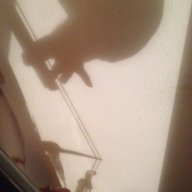
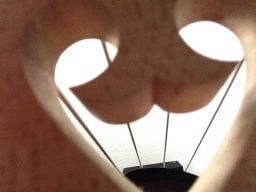
Description: the bigger plate goes inside while the bass lies on its back, navigated by the two cables, is then fished with the screw and brought to the tail block, the second plate is screwed in place from the outside and before executing pressure the hot glue is filled in with the flexible tube, this is fast; then everything is closed with pressure for an overnight dry. I then let it alone for 3 weeks (xmas holidays), yesterday it all came together and it still holds today ...

Now the only things left are to recover the callusses and get a new vehicle for transportation ...
Ah and: it is a good thing to rest playing db from time to time. Made me come back to guitar (and gained a new and better understanding of the use of chromatics) as well as a different focus on the bassists compliance.http://[URL=http://s1094.photobucket.com/user/ctrlzjones/media/IMG_1191.jpg.html][ATTACH=full]2569133[/ATTACH]

[ATTACH=full]2569134[/ATTACH]'][URL=http://s1094.photobucket.com/user/ctrlzjones/media/IMG_1191.jpg.html][IMG]http://i1094.photobucket.com/albums/i449/ctrlzjones/IMG_1191.jpg[/URL][/URL]

IMG_1185.jpg
 

Attachments

  • IMG_1191.jpg
    IMG_1191.jpg
    157.8 KB · Views: 3
  • IMG_1191.jpg
    IMG_1191.jpg
    157.8 KB · Views: 4
  • Like
Reactions: Chris Fitzgerald