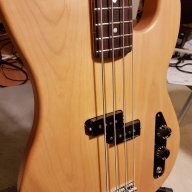
Man, I would not try to recolor that bass. It is very unlikley you will be pleased with the result. Try to purchase a used body if you must. You may be able to sell the original if you want. (personally I would just play it as is.)

TalkBass has been independent since 1998. Add your voice.
Create a free account to reply to discussions, view embedded media, and browse with fewer display ads.
Join free Log in
Want zero display ads or expanded classifieds tools? Compare plans.


This is quite lovely. Thank you @J Wilson. I'll definitely follow your guide if I can just muster the courage to begin. It's a fragile thing, you know- a first bass and all.Pauly, I'd remove the neck and all the hardware from the body. Then, there's two ways to do this (you pick) if you want a solid color (not stained or transparent).
1) Leave the clear finish in place. Sand the gloss to an overall dull finish. Wipe down with mineral spirits. Then shoot with a primer (paint always sticks to primer better than the original surface), then your color coat(s), and a clear (either satin or gloss) to finish. You can wet sand the color and clear if you're so driven. You can use rattle cans, but warm them in hot water from the tap for five minutes before you shoot (and PLEASE do not put pressurized cans in boiling water, just use straight hot water from the tap). This would be my choice.
2) Either sand or take it to a furniture refinisher and have it chemically stripped (and it's worth doing that, DIY on this can be a REAL handful). Then get the wood smooth, prime, color, and top coat clear.
You can spend the money at StewMac, etc., but for me there's lots of hobby hot-rod model colors or even Krylon. And with the right prep and execution, you can get some good results for a low spend. I once did a car model with Testors paint for a true Candy Apple Red: yellow primer, metallic gold, then see thru red on top of the gold. Nice.
Good Luck !
????
Why is there a club then?
Rattle Can Refinish Club
Why is there a company that specializes in rattle can paint for guitars?
ReRanch Guitar Refinishing


+1 on the guitar reranch. They are generous sized cans of real nitro lacquer colour matched to Fender colours for reasonable prices. They won't ship outside the US, otherwise I'd have about 20 cans of the stuff. Whether you can spray nitro over that finish is not something I know. You might have to lay down some shellac based primer like white BIN's first ( probably should anyway).Because it works.
The prep is 80% of the labor, minimally.
If you are just painting, you are better off not stripping it but sealing it first, then prime, then paint, clearcoat if necessary. No sealing of the wood means the grain will pop through in an uneven way.
You will also learn to final wet sand with 2000 grit paper, and some of the smaller number/heavier grits.
Read a little on the subject. You'll be fine.

What a great set of diy instructions. After reading this I now feel like painting something...I have painted a motorcycle or two with spray cans. Here are my tips:
1. Make sure the surface you are painting is clean of all dust, and will remain that way. Make a little booth if you have to.
2. Lots of light coats is much, much, better than a few heavy ones. You may get excited and want to lay it on thick. DO NOT GIVE IN TO THIS URGE.
3. After a couple light coats, wet sand with 2000 grit. Spray a few more coats, sand again. Rinse and repeat until the coating is even thickness and color.
4. Sand again with 2000 wet. Then buff the sanding marks out. This takes A LOT of time and elbow grease without a buffer.
5. If using a clear coat, repeat these steps with clear.
It is tedious, but you can do it. Get a piece of wood to test on, old chair seat or something. Just be sure to be patient. If you mess up you can always sand it down and start again.

I agree completely, now that I think about it. I'll bet you could trade for a pro-finished body. If getting your hands dirty is your thang, though, it can be done with a bit of knowledge, patience, and understanding that you might have to start over.You'll probably turn a nice body into a an exercise in hindsight is 20/20 regret.Maybe you can trade that nice natural body for a color you like with no work involved.Getting an great finish the first time out is a lot easier than it sounds,unless you like flat back.
'This' was referring to the Boa's post, not sure why it didn't show the quote.^this, to a 'tee', is exactly how I painted the only bass body I ever tried my hand at. For the booth I used my laundry room and a couple tarps with a HEPA filter to make it positive pressure (no potential airborne stuff to worry about). It was an old Hondo P that my roommate got for like a stick of gum. I made a diamondplate pickguard for it, painted it flat black, and had a hot-rodder buddy pinstripe it. I gave it to said roommate after I put a 1/4-lb'er and new electronics in it because (at the time) I was totally anti-P bass. I wish I had it now, silly as it was.

My prime questions are:
-Do I need to sand off the glossy top?
-Is a VM body fairly sturdy?
-How long would said process take?
-Is a spray paint coating sufficient?
-Any other information to be given from the experts here?

 VM is a great platform to express yourself and do it at a reasonable price. I've toyed with the idea of painting mine as well so this thread is perfect for me to glean information from the talented TB luthiers.