I transcribed the article
Enter the Dead Zone
We Chronicle the return of the long-lost 1974 Alembic bass, known as ‘Osiris’ aka ‘Mission Control’ by Deadheads, and ‘The Osage’ or ‘The Omega’ by Alembic faithful, once belonging to Phil Lesh of the Grateful Dead
Words: Joel Mclver, Jason Scheuner Photography: Lisa S Johnson, James Katz, Dave Stotts, Ed Perlstein/Getty
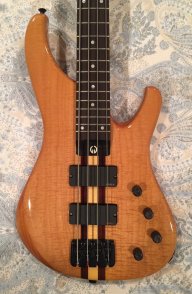
Just about any Deadhead is familiar with the Phil Lesh bass known as ‘Mission Control’. What is hazy are many of the details, as thsi bass seemed to simply disappear over 40 years ago. This astounding custom Alembic bass, with serial umber 74 00008, was played by Lesh on stage with the Grateful Dead from [June 16, 1974](
Grateful Dead Live at Des Moines State Fair Grandstand on 1974-06-16 : Free Borrow & Streaming : Internet Archive) until July 1, 1979 and was hand-built at Alembic by luthier Rick Turner. Only te eighth instrument built by Alembic, Turner started it in 1972 and completed it in mid 1974. ‘Osiris’, ala ‘Mission Control’, ‘Osage Orange’ or ‘The Ornega’, was built not just for, but as part of, the band’s historic Wall of Sound.
The significance of the Wall of Sound, another brainchild of Alembic co-founder Owsley ‘Bear’ Stanley III, cannot be overstated. This grand audio experiment spawned the modern PA system, and set a standard still unmatched today. However that is only part of the story of this bass and its builders at Alembic. This instrument adn a handful of its contemporaries set the stage for the modern ‘boutique’ instrument. Consider the construction of this bass, beyond its exotic inlays and electronics. When this instrument was built, you could count on two hands the number of instruments built this way. It featured laminated neck-thru construction, coupled with sandwiched, exotic tone wood wings known as ‘The Hippie Sandwich’. These techniques, pioneered by the builders at Alembic, have paved the way for countless luthiers and instruments that now use these elements as the standard for today’s boutique instrument. Jerry Garcia’s Wolf guitar, built by Luthier DOug Irwin in 1972-1973, featured the smae type of construction, and was also used with the Wall of Sound. Irwin also came from the Alembic tree of luthiers.
Used by Lesh at over 250 Grateful Dead shows in that five-year period, the Mission Control bass became iconic in its own right, with Rolling Stone magazine featuring the instrument in an Alembic article in September 1973. It was also featured in its own scene in The Grateful Dead Movie the following year. It was used at the hiatus comeback show at the Great American Music Hall in 1975, and the Day on The Green show in 1976, as well as the May 8, 1977 gig at Cornell University - possibly their best-known performance.
Osiris even visited the Great Pyramid in Egypt, where it as played during the lunar eclipse, in September 1978; it also closed down the famous Winterland Ballroom not once, but twice, in 1974 and 1978. The bass was also used to track Mars Hotel (1974), Blues for Allah (1975), Terrapin Station (1977), and the Shakedown Street 1978 studio albums, as well as countless live releases.
Its specifications are extravagant, with red and green LED dot markers in the neck - quite a rarity back then. In fact, they were only the third set ever installed, after David Crosby’s set in 1970 and a set in Alembic 72 01 for Jack Casady in 1972 - all three sets still work. Turner carved the top adn back from Hawaiian koa wood, which is prized for tis tone, and formed the wings from mahogany core and maple walnut veneers.
The ebony fretboard is ----ed in 11 different ------- ecord, these are--
- Mother of pearl lightning bolts striking lapis lazuli
- An avalon serpent eating its own tail
- a mother of pearl crescent moon
- an abalone lizard
- an abalone darkstar
- mother of pearl and abalone stars
- an abalone bat
- an abalone infinity symbol
- a mother of pearl and abalone Saturn
- Abalone kissing fish, as Lesh is a Pisces
- More mother of pearl lighting bolts striking lapis lazuli
The headstock is overlaid with Brazilian rosewood on both sides, and the inlays are made of mother of pearl, abalone, brass, opal, lapis lazuli,and even hashish.
Rick Turner crafted the neck-thru portion from seven laminates of three different types of lumber - walnut, maple, and Osage orange wood, a Midwestern US tree that is hard as a rock. Luthiers regard it as a fabulous building material for necks. The mother of pearl fingerboard inlays are a series of mystical symbols. The design on the headstock incorporates the Alembic logo and the Dead’s ‘Steal Your Face’ skull and lightning bolt, both designed by Owsley ‘Bear’ Stanley III . In the light, the ‘Hand of Man’ portion of the Alembic logo sends a beam of light or energy into the ‘Steal Your Face’ skull portion - a remarkable display of Turner’s handiwork. The cloud portion of the logo representing the Universe even has a natural phantom skull hiding deep within the mother of pearl.
Two abalone and mother of pear stars are inlaid on the lower half of the bass, each surrouinded by five knobs controlling various tone settings and filters. There is a fantastic mother of pearl and avalon ‘Osiris’ inlawy on the back of the headstock, revealing where this bass gets one of its names. There were also 10 small push-button switches under ivory discs, which Turner says were mostly for the ability to send each string to four separate stacks of nine 15” speaker cabinets, each powered by a stack of McIntosh amps in the Wall of Sound.
The original groundbreaking electronics were made by Lesh’s colleague George Mundy, as an early version of the [Alembic Super Filter]([Invalid or Expired Link Removed]), designed by Ron Wickersham, and have now been upgraded to the current SF-2 version for less noise and weight. Each knob still does exactly what it did in 1974. Mundy was tracked down for consultation, and gave his blessing on the updates.
Rick Turner tells us: “George got deeply into; he really put a lot into that instrument. I think his side of that bass probably cost like $30, 000 [ around $200,000 in 2021] back then. You could buy a house with what Phil paid for that bass. Les Paul once came to a Grateful Dead show to check out the electronics - the crew thought his name was on the guest list as a joke until he showed up. We popped the back off the bass and showed him the insides, He loved it.”
There are low impedance-wide aperture neck and bridge pickups, as well as a thin ‘quad’ pickup placed between the bridge and bridge pickup for maximum string separation, each with dedicated outputs. During the restoration, Jason Scheuner, the bass’s current owner, tracked down the original neck and bridge pickups over 40 years after they were removed from the bass, while accurate replicas of the quad unit, hum cancelling coils and batwing tailpiece have been built and installed by Turner in 2020. The Red LED indicator lights hav been restored next to the ivoroid buttons by Turner as well.
As a final touch, Turner also provided an era-correct Alembic ‘U-Channel’ bridge that came off one of Stanley Clarke’s personal basses from 1973-75. The aim has been to undo som radical modifications which the bass underwent in
1970 by an overzealous roadie, before it was misplaced for over 40 years, and to make ti as close to the original as possible, as well as to create a detailed timeline of the history of Mission Control.
After the roade had removed the original pickups and electronics, he returned the bass and associated items to Equipment Room #4 at the Dead’s studio in San Rafael. Following frontman Jerry Garcia’s dead in 1995, the bass was moved to a storage locker, which was subsequently defaulted and bought by a salvage company in 2014. They sold it to Gruhn Guitars in Nashville, who performed the structural repairs, installed the new Alemibc Super Fitler, and then sold it to Scheuner in December 2019, who completed the restoration with Turner in 2020.
Given its provenance, and the spectacular restorations that have gone into it, what does the future hold for the Mission Control bass? As Scheuner says, “the last couple of details to wrap up ar eto combine the two five-pin outputs currently ont he bass to a 50 year-old NOS LEMO 3 connector proved by George Mundy, and to return the plate where the five-pin output for the Quad pickup currently resides to a historically accurate brass and koa plate, housing the fine adjust for the pickup volumes. Nobody really owns a treasure like this- my family is just its custodian for a while. As long as it remains in the hands of a Deadhead, I’l be happy.”
Just before this issue of Bass Player went to print, there was a development. Doug Irwin, the builder of Jerry Garcia’s most famou guitars - The Wolf, Tiger and Rosebud- reached out to Scheuner with a never-before seen phot of the bass from 1975 with a gorgeous koa and abalone triple pickup ring.
Iriwn explained that he had built the ring for Phil Lesh, and that he had put it on the bass in1975. It was subsequently replaced with a brass ring in 1976, but Scheuner and Irwin agreed that Osiris would best with a duplicate of the koa and abalone ring.
As Irwin still had the same piece of koa and the same bag of shell which he had used to make the original in 1975, a historically accurate duplicate was made and installed. This is a fitting final touch for what we feel is one of history’s most beautiful and significant bass guitars.