• TalkBass has been independent since 1998. Add your voice.
    Create a free account to reply to discussions, view embedded media, and browse with fewer display ads.
    Join freeLog in
    Want zero display ads or expanded classifieds tools? Compare plans.

PJ that works

I have never, ever seen VVT pots do anything like what you are describing. Ever. I don't know how many VVT setups I have played either, but it's a big number.

Surely you see the advantage of blending the levels of the two signals--it's an imperfect process but it's a choice you do not have with switching alone. The Roscoe Beck bass uses an in-line resistor as another means of mixing the pickups but without multiple volume controls.

 
I have never, ever seen VVT pots do anything like what you are describing. Ever. I don't know how many VVT setups I have played either, but it's a big number.

Surely you see the advantage of blending the levels of the two signals--it's an imperfect process but it's a choice you do not have with switching alone. The Roscoe Beck bass uses an in-line resistor as another means of mixing the pickups but without multiple volume controls.

The Roscoe Beck isn't a PJ.
 
I'm loving my Schecter Model-T....

Great Bass! I have always loved DeLeo's P/J tone. Once again, Bongo has made it clear why I shouldn't love my P/J basses :scowl:
And I just don't care...they are my favorite configuration, and I CAN get any tone I need out of them, VVT or otherwise. I prefer them "full-on" for most songs, but the P is there for the bluesier stuff, and the J is there if I wanna tear off into some Rush. :bassist: VIVA LA P/J!
 
You missed the point. I was using it as an example of bass that has (limited) pickup blending, but only one volume control.

I was having trouble finding the context of your statement, but I did get the point. I'm not trying to argue, but I can't see how with all of your experience using passive VVT setups, that you have never once noticed the disparity in that particular type of volume control. It's true that it isn't the case on some instruments such as the Beck, but isnt the single coil option still basically a humbucker, with the silenced top coil acting as a "dummy" to quiet the hum of the coil closer to the bridge?
 
I was having trouble finding the context of your statement, but I did get the point. I'm not trying to argue, but I can't see how with all of your experience using passive VVT setups, that you have never once noticed the disparity in that particular type of volume control. It's true that it isn't the case on some instruments such as the Beck, but isnt the single coil option still basically a humbucker, with the silenced top coil acting as a "dummy" to quiet the hum of the coil closer to the bridge?

No, the Beck does not use dummy coils. It's true single in the middle position. It's also not VVT... that's why I mentioned it. I think you have definitely missed what I was saying.

I have never played a VVT where decreasing the volume caused a permanent tone change even if the volume was brought back up to full. However, every two pickup bass I have ever played does do the thing where two pickups at full volume are quieter than either pickup soloed or when one pickup is turned down.
 
No, the Beck does not use dummy coils. It's true single in the middle position. It's also not VVT... that's why I mentioned it. I think you have definitely missed what I was saying.

I have never played a VVT where decreasing the volume caused a permanent tone change even if the volume was brought back up to full. However, every two pickup bass I have ever played does do the thing where two pickups at full volume are quieter than either pickup soloed or when one pickup is turned down.

So the single coil hums in the middle position? Keep in mind we aren't discussing dual single coil equipped basses, but P/J combinations. I agree that there is no discernible difference when one volume is lowered on a SS setup, but IME there is certainly a noticeable tonal change on a PJ setup with a traditionally VVT config.
 
Was never really happy with the VVT setup on my Jazz Special. it was a major pain to try and make major tone changes plus still keep a consistent volume level. VVT wiring plus PJ pups just weren't a practical proposition for live work, in my experience, unless I was willing to find one tone I liked and stick with it. Big tone changes on the fly, in the middle of a tune - forget it. I eventually ended up rewiring that bass to VBT and dumping the switch entirely

MUCH better :)

Never had a Jazz available to do a proper A/B comparison using exactly the same rig, but the VBT setup on my Jazz Special fits my needs (and tonal goals) very well

Just my 2¢ worth.......
 
A P/J will work if you use a REAL Jazz pickup and a REAL Precision set and SWITCH between them and not try to mix them.

Agree here -
Wanted a PJ with a real P mode. So did a PJ with 3 way switch (P, P/J, J) with one vol and one tone. Won't get the 'full' J mode but you can switch into the real P mode anytime. They are a DiMarz PJ set, adjusted by height to taste for the mixed mode. No blend needed.

6790981251_150bdb7abf_z.jpg


Build story at http://www.talkbass.com/forum/f8/warmoth-p-j-my-birthday-826305/
 
So the single coil hums in the middle position? Keep in mind we aren't discussing dual single coil equipped basses, but P/J combinations. I agree that there is no discernible difference when one volume is lowered on a SS setup, but IME there is certainly a noticeable tonal change on a PJ setup with a traditionally VVT config.

The RB singles don't hum in the middle position because they're RWRP just like a Jazz Bass. Solo one and it hums, or mix a single and a humbucker and it hums.

Okay, it's confusing because Bongolation seemed to be suggesting the described problem is something all VVTs have which they definitely do not. But you're saying it's just a PJ thing. I don't get why on earth that would be but I have very little experience in that area (messing with VVT controls on a PJ) so I will defer to your prior knowledge. On a Jazz or a Ric the described VVT issues (Rics are VVTT, but still) do not happen.
 
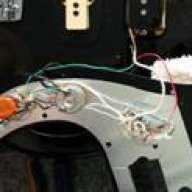
Are there any PJ's out there with a 4-Way switch:
- P-only
- PJ serial
- PJ parallel
- J only

If so, I'd be very interested in the wiring diagram...

Thanks!

Dingwall has that, although I don't have a wiring diagram available for that particular approach...sorry. However, there are numerous examples on the web of point-to-point wiring that can accomplish this (for both rotary and blade switches). Pretty straightforward, once you've thought it through. Good luck!
 
Okay, it's confusing because Bongolation seemed to be suggesting the described problem is something all VVTs have which they definitely do not. But you're saying it's just a PJ thing. I don't get why on earth that would be but I have very little experience in that area (messing with VVT controls on a PJ) so I will defer to your prior knowledge. On a Jazz or a Ric the described VVT issues (Rics are VVTT, but still) do not happen.

The thread took a left turn at Albuquerque and appears to have ended up at Pismo Beach. I believe that Bongo's original point was that, for those seeking "traditional" passive P tone in a PJ configuration, there will be compromises unless a selector switch is used that has a position that runs the P without the J in the circuit (in contrast to a VVT or VBT setup). As several posts have pointed out (including thiocyclist), these other setups produce perfectly valid and usable tones, as do active versions. And for many players, the compromise in the classic P tone isn't all that significant for them when using these alternatives. I believe that Bongo's correct in his assertion (isolate the P for a pure traditional tone)--which was really just an FYI to the OP to take into consideration when selecting a bass, since the OP seemed to be looking for classic tone--and others are correct in theirs (other setups work great in their own way).

As for VVT "dropouts," I've experienced them, but have no bass with that setup now...just selector switches or blend controls. But that's a tangential (albeit legitimate) topic for a different thread.

And as for the OP's question, I've read a number of posts on TB saying that the Tony Franklin has a great classic P tone with a decently growly J that is hot enough to play nicely with the P when they're run together. Others tout the Reggie Hamilton, which is a fantastic bass, but that may not appeal to a P purist, since it's more of a J in P's clothing.
 
Nordstrand P with Nordstrand Big Split. Passive. 3-way selector and V/V/T. Works great in my Fender MIA P5. If I were to do it again, I would not bother with the second volume. Live, there is not enough variation in tone by mixing volumes to matter IMO. Maybe in the studio it would be useful. I like the idea of a 5 or 6 way switch with varying degrees of blend.
 
Nordstrand P with Nordstrand Big Split. Passive. 3-way selector and V/V/T. Works great in my Fender MIA P5. If I were to do it again, I would not bother with the second volume. Live, there is not enough variation in tone by mixing volumes to matter IMO. Maybe in the studio it would be useful. I like the idea of a 5 or 6 way switch with varying degrees of blend.

I did that just recently. It's very practical live, and I wasn't using the full mixing potential anyway. There were just a few sounds I kept falling back to, so a 5 way switch is more than enough. There's a 6 way switch designed for a Les Paul that wil replace a pot. It allowes me to switch p/pj/j and have two different blended options. It's kind of like having a small gear shift on my bass.