What is playing along and what is playing across the strings? Playing 'A B C' on all G string,playing 'A' on D and 'B C' on G string.Which is which?

Enjoy the benefits of a premium membership!
Upgrade Account
-
TalkBass has been independent since 1998. Add your voice.
Create a free account to reply to discussions, view embedded media, and browse with fewer display ads.
Join free Log in
Want zero display ads or expanded classifieds tools? Compare plans.
You are using an out of date browser. It may not display this or other websites correctly.
You should upgrade or use an alternative browser.
You should upgrade or use an alternative browser.
Double Bass playing along vs. across the strings
- Thread starter Stefan Boeters
- Start date
More options
Who Replied?Originally posted by altugbas
What is playing along and what is playing across the strings? Playing 'A B C' on all G string,playing 'A' on D and 'B C' on G string.Which is which?
Playing along the string would be playing a scale, for example, straight up a string, or as much on one string as possible, where playing across is staying in one "hand position" as much as possible and playing nearby notes on nearby strings rather than shifting around.
Well, here's another data point: I've found that the move up the G string on the opening of the Marcello Sonata 1 seems longer (!) on bg than urb. I think part of it is the difference in position and possibly also the difference in sound, but while I can play this just fine on urb, it falls apart on bg. If I were to refinger it for more across than along playing, it would probably become more tenable on bg.
They're different instruments with different techniques.
And yes, I'll do some stuff across on urb, but it's much less common/appropriate under those circumstances.
-dh
They're different instruments with different techniques.
And yes, I'll do some stuff across on urb, but it's much less common/appropriate under those circumstances.
-dh
I would like to voice my support for the most legato-ish (if that's what you're going for) fingering approach. When I was/am doing the Bach cello suites, I at times found that going across sounded extremely choppy and clipped in certain parts, and that going along the string sounded stacato at certain parts as well. I tend to favor a combination of the two, as some times certain phrases scream GO ACROSS, while others might scream GO ALONG. You pick the ones that sounds the bestest. ^_^

Ron Carter put out an instructional book many, many years ago, and he advocated the across method.
Both methods seem to have their pros and cons - when applied in different contexts, one may be better than the other. So why not become proficient at playing along and across the strings?
If you have more options for creating a sound that is notated on paper or heard in your head, then isn't it easier to create the sound?
If you have more options for creating a sound that is notated on paper or heard in your head, then isn't it easier to create the sound?

Originally posted by Chris Fitzgerald
Why does my tongue always start bleeding whenever I read this thread?
Don't bite your tongue, say something!
Give me a minute to change into some asbestos drawers first.....
Ahh, much better. Okay - admittedly, I'm not an orchestral player, and I'm also coming from a jazz piano background, BUT....I don't see what the whole aversion to across the string playing is all about. For certain types of passages - arpeggios spanning more than an octave, for instance - playing across the strings seems to be a total no brainer, especially when you have to move quickly. I'm not sure what I'm missing here, and I don't want to start WWIII, but this whole "don't play across the strings if you can possibly help it" vibe doesn't make any sense to me.
Yet. Do I get points for saying "yet"?
Ahh, much better. Okay - admittedly, I'm not an orchestral player, and I'm also coming from a jazz piano background, BUT....I don't see what the whole aversion to across the string playing is all about. For certain types of passages - arpeggios spanning more than an octave, for instance - playing across the strings seems to be a total no brainer, especially when you have to move quickly. I'm not sure what I'm missing here, and I don't want to start WWIII, but this whole "don't play across the strings if you can possibly help it" vibe doesn't make any sense to me.
Yet. Do I get points for saying "yet"?
I think kpo touched on an excellent point, that being that the across/along debate must take the bowstroke into account as well as the shifts. Sometimes the phrasing and bowing lends itself to an across the string fingering, or vice versa. Sometimes either may be a desired effect and used interchangably. I don't think there's a set rule for either, really.
I think also there's some things that I've just learned a certain way, and have a difficult time approaching them otherwise. Mozart's 40th is an excellent example. For the licks in both the 1st and 4th movements, I always shift up and down the G string, even if it means doing so at a frenetic pace simply because they just don't sound right to me any other way.
I think also there's some things that I've just learned a certain way, and have a difficult time approaching them otherwise. Mozart's 40th is an excellent example. For the licks in both the 1st and 4th movements, I always shift up and down the G string, even if it means doing so at a frenetic pace simply because they just don't sound right to me any other way.
Originally posted by Chris Fitzgerald
this whole "don't play across the strings if you can possibly help it" vibe doesn't make any sense to me.
I just reread the entire thread. I don't sense any "don't play across at all cost" vibe. What I got was "select the fingerings best for the music."
That said, in the last couple of months I've done some reevaluating of things due to being chronically dissatisfied with everything about my playing, particularly in jazz. I just wasn't getting some ideas from my head to my hand; especially when tyring to play arco. As a result I've been going across a little more often than I used to. Despite the extra string crossings, it seems like it's making improvising w/the bow a little easier.
Originally posted by David Kaczorowski
I just reread the entire thread. I don't sense any "don't play across at all cost" vibe. What I got was "select the fingerings best for the music."
You're right. I'm doing what my wife calls "Projecting" onto this thread. I hear a lot of "don't play across the strings" from a lot of DB sources, and I must have gotten this particular thread confused with another source (I had read it when it first came out, and then forgotten about it until it was dug up just recently). My fault...
Clearly, what's best for the music is the best fingering, but like Ed says, what's best for one person might not be best for the next. In addition to my regular lessons, I take lessons whenever possible from guys coming in town to play jazz concerts. I've had the experience of having lessons from some "heavies" who shall remain nameless just a couple of weeks apart, where one guy will rip me up and down for playing across, then the next guy compliments my "pianistic" approach to harmony and line building and says that the previous guy needs to chill out and realize that different conceptual approaches require different physical approaches. The guys who are against across the strings playing have come off as really negative, pedantic, and bitter, and I guess I was attributing some of that to this thread. Next time an old thread gets dug up, I'll refresh my memory first.
Originally posted by Chris Fitzgerald
I've had the experience of having lessons from some "heavies" who shall remain nameless just a couple of weeks apart, where one guy will rip me up and down for playing across, then the next guy compliments my "pianistic" approach to harmony and line building and says that the previous guy needs to chill out and realize that different conceptual approaches require different physical approaches. The guys who are against across the strings playing have come off as really negative, pedantic, and bitter.
Maybe one day I'll understand what "pianistic approach" means. I've heard that before and remain clueless.
When those cats rip you for playing across, what do they say? What's their reason?
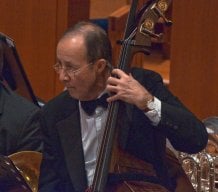
Thinking on some phrases I've had to work out, what I want to minimize is 'reversals' of either the left hand position or the bow angle. I.e., in crossing, an ascending or descending phrase may require both up and down shifts. I'd rather do all my shifts in one direction (getting back to Ed's teacher's concept of the "elegant" solution). It just feels smoother. Same thing with bow angles. I prefer to make all my string crossings in one direction. But sometimes a crossing fingering pattern requires the bow to reverse, i.e., the line is descending, but it requires an upward bow crossing in the middle of things. This can be messy when the reversal involves an interior string (A or D).I don't know if I'm making this clear. It's just another factor I consider when analyzing how to play a line.
Originally posted by David Kaczorowski
Maybe one day I'll understand what "pianistic approach" means. I've heard that before and remain clueless.
I'm not completely sure what people mean by that either, but I have a few ideas which I'd be happy to share (later, when I'm not on my way out the door) if you want. Of course, they could be completely wrong, but...
When those cats rip you for playing across, what do they say? What's their reason?
Mainly the complaint has been that I'm trying to play lines that are not at all "idiomatic" for the bass, which IMO is a really stupid reason not to play something. I remember one time when I asked one of the "nameless bunch" how I could best finger a passage like (go to the piano and play a basic horn type bop line which included arpeggiating 1-3-5-7-9 and then became linear)...and the answer was, "why would you want to try to play a line like that on the bass?". I answered, "well, because it sounds so good on the piano". His reply was, "yes it does. But you're not playing the PIANO now, are you?" then he goes off on a big rant about how if I'm hearing lines like that, I need to reprogram what I'm hearing because I'll only end up playing across the strings playing those types of lines, yadda yadda and they don't fit the bass yadda yadda, and if I play across that much my intonation will be sh*t yadda yadda....
Ok, I was venting a bit. But you get the idea. My point is that to me, music is music, and you should play what you're hearing. And if you're hearing something that's hard to pull off on your instrument, then you just need to practice and develop a technique that works for you to let you get the music in your head out of your instrument.
DOH! I'm late! See ya later...
Happy to say that's not my problem.Originally posted by Chris Fitzgerald
and the answer was, "why would you want to try to play a line like that on the bass?". I answered, "well, because it sounds so good on the piano". His reply was, "yes it does. But you're not playing the PIANO now, are you?" then he goes off on a big rant about how if I'm hearing lines like that, I need to reprogram what I'm hearing because I'll only end up playing across the strings playing those types of lines, yadda yadda
Michael Moore wanted to let me know of his low opinion of something I had played. He said: "You sounded like a bass player."
I must say it does a body good to hear that a couple more highly respected teachers have open minds about soloing. My own teacher isn't a jazzer, so he never really gets to hear me improvise....therefore, most of my "jazz input" comes from folks on their way through town. Sometimes (like when they are grouchy primadonna jack*sses) that's a good thing. At other times - like when I get a really good, helpful lesson from someone who understands what I'm trying to do - it's enough to make me crazy when they leave. Not that you guys don't already know it, but you're lucky to have such great teachers. Someday......

Correct me if I am wrong, but isn't the tone of the string in question also a factor? I mean, and this may have already been said, that sometimes I opt for a more difficult fingering because the notes sound more appropriate for the line. Its actually very similar on "toy" bass - I'll opt for higher areas of the lower strings for a thumpin' booooooty grabber, but go down lower on the high strings for a little more punch and brightness...I guess what I am saying is this translates into different fingerings not based upon what is easiest or what my theory is of across vs, along, but rather based on what I hear the part as. Maybe that's what some of you are saying, the coffee's not done yet ;-)
Ok. As usual, you do a search on something at TB and you will find that it has been addressed at some point by someone. Perhaps this thread is a hairball that was better left alone rather than coughed up on the kitchen floor of tb land. But as a young and impressionable lad, I had to ask.
Here's the deal, I have somehow been conned, convinced or otherwise manipulated into actually putting on the black, breaking out the bow and attempting to be an Orchestra bass player for this holiday season. The stuff we are doing is a bit of pops, traditional Christmas music and some classical excerpts from Handel's Messiah and others.
My teacher, an SO player, is up to his ears with the same kind of thing on a larger scale, so I'm not working with him right now. I'm on my own.
So, being such a noob to this sort of thing, I have been woodsheding to the point that my children head outdoors as soon as they see me within 20 feet of my bass. And, as I work through this stuff, this very issue of along the strings verses across them is coming up over and over.
At first, I had an experienced player I know mark up the sheets with the fingerings. He did it in the traditional Simandlish kind of way.
When I started playing through it, I thought I sounded like cheese. My intonation was poor and I struggled keeping time well.
Over the past couple of weeks, I have re-marked more and more of the passages to be played across the strings with less shifting. I have found that I have much BETTER intonation and by playing in 4,5 and even 6th with closed strings, the overall arco tone, although not as loud, is MUCH sweeter.
This does make for more crossing with the bow. But, for some reason, crossing hasn't really been that tough to get used to.
I guess the real question is, "Am I setting myself up to hit a wall by taking this approach?"
I know my teacher will freak when I talk to him about it. But at this point for this season, I need to play in tune and in time, and I'll worry about the consequences later.
Here's the deal, I have somehow been conned, convinced or otherwise manipulated into actually putting on the black, breaking out the bow and attempting to be an Orchestra bass player for this holiday season. The stuff we are doing is a bit of pops, traditional Christmas music and some classical excerpts from Handel's Messiah and others.
My teacher, an SO player, is up to his ears with the same kind of thing on a larger scale, so I'm not working with him right now. I'm on my own.
So, being such a noob to this sort of thing, I have been woodsheding to the point that my children head outdoors as soon as they see me within 20 feet of my bass. And, as I work through this stuff, this very issue of along the strings verses across them is coming up over and over.
At first, I had an experienced player I know mark up the sheets with the fingerings. He did it in the traditional Simandlish kind of way.
When I started playing through it, I thought I sounded like cheese. My intonation was poor and I struggled keeping time well.
Over the past couple of weeks, I have re-marked more and more of the passages to be played across the strings with less shifting. I have found that I have much BETTER intonation and by playing in 4,5 and even 6th with closed strings, the overall arco tone, although not as loud, is MUCH sweeter.
This does make for more crossing with the bow. But, for some reason, crossing hasn't really been that tough to get used to.
I guess the real question is, "Am I setting myself up to hit a wall by taking this approach?"
I know my teacher will freak when I talk to him about it. But at this point for this season, I need to play in tune and in time, and I'll worry about the consequences later.

I'll throw some more wood into this fire...I don't knock the Simandl approach, however others of the czech school, such as Hertl, took a more moderate attitude. It's important to remember the state of bass in Simandl's time:set up and string quality wasn't as exacting as our era. Can imagine if Simandl had steel strings that speak as well as what we have available, as opposed to inconsistent gut that often didn't sound that good. Rather than keep our heads buried in the sand, let's explore new directions in the eterenal quest to master the beast...
I'll get off my soapbox now...
I'll get off my soapbox now...


