• TalkBass has been independent since 1998. Add your voice.
    Create a free account to reply to discussions, view embedded media, and browse with fewer display ads.
    Join freeLog in
    Want zero display ads or expanded classifieds tools? Compare plans.

Potentiometers for a P/J Project…

Malak the Mad

Over the River and through the Looking Glass
Supporting Member
Oct 20, 2012
14,078
19,549
The Archduchy of DuPont
Greetings All!

I'm in a bit of a bind and I was hoping I could pick the brains of those who either know electronics better than I do (which doesn't take much) or have experience with P/J configurations. I put together a P/J parts bass and am trying to find an acceptable volume/tone control. To be more specific, I'm trying to figure out which values I should look for in regards to pots, tone control and which capacitor would work best on it.

Here's the specs;
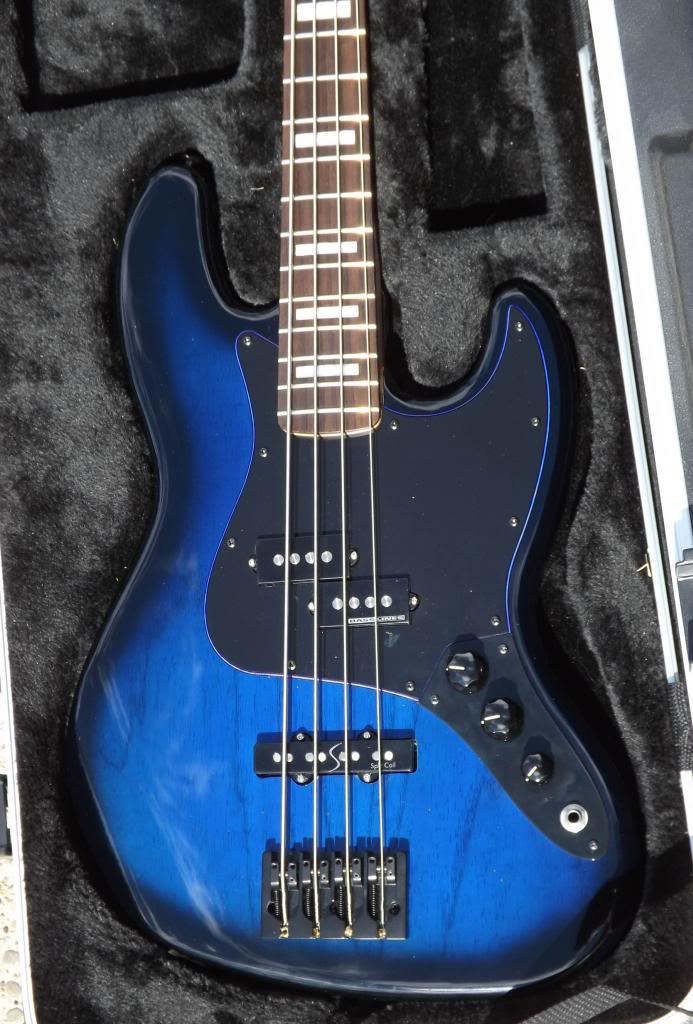
  • Seymour Duncan SPB-3 "Quarter Pounders" in the neck position.
  • Fender Super 55 Split-Coil Jazz in the bridge position.
ProjektBlue03_zps7d4a1dfe.jpg


I first tried a V/B/T with a Stellartone Tonestyler. It wasn't bad by any stretch, but I found I like the independent volume control better. Then I tried a V/V/T configuration with a TBX Circuit I had lying around. I figured, "Eh, let's give it a shot." It, too, is not bad at all, but it sounds like it's missing something that my commercially built P/J's have. To elaborate, I already have a Fender Aerodyne and I really dig it, but for this project I wanted the deeper sound of the Quarter Pounders with a bit more "grit/growl" added in with a strong Jazz bridge pickup. My sonic tastes tend to run towards the more aggressive end of the spectrum, but not at the expense of the deeper fundamentals.

To be clear, I'm not in the market for different pickups nor an active pre-amp. I simply want to get the absolute most I can out of the pickups I already have without having to go active or make another blend circuit.

Many thanks for your time! :thumbsup:
 
For V/V/T setups, I prefer linear taper volumes, and an audio taper tone. If you use a no-load tone pot, you'll effectively take the tone pot out of the circuit when it's on "10." That might give you a little more bright top end. I prefer 250K-ohm all the way around, but some prefer 500K. 500 tends to be just a smidge brighter.

With P/J basses, though, I actually prefer to skip the V/V/T setup, and I go with master volume, master tone, and a selector switch. I play a P/J on just the P pickup 75% of the time, and the other 25%, I add the J pickup at full volume. I find I don't ever need to dial down the J pickup volume -- it's just not that usable to me. The V/T + switch setup gets me the sounds I like, very quickly, without much fiddling. YMMV.
 
Last edited:
between the overwound QPs and the split-coil J, as well as the stated preference for the more aggressive end of the tone spectrum, i vote 500k pots all around; linears for the volumes, audio for the tone.

try a traditional .047μF cap, and if that gets too dark when you roll the tone down, swap it out for a .022μF to leave more mids in.
 
Many thanks for the replies and advice. Y'all rock! :thumbsup: And please keep it coming. I have a week or more before I drop off my bass to my local guitar tech.

At this point, the majority says linear taper for volume and audio taper-tone. This groks with what my tech recommends, so I'll likely stick with that. So far, I'm leaning towards this…
  • V1 - 500k linear pot
  • V2 - 500k linear pot
  • T - 500k audio pot + .047 cap
…but that's not set in stone just yet.

I already have an Oil-&-Paper .047 cap on the TBX circuit, so I'll probably reuse that if it can be taken off intact.

I'm leery of a two or three position switch. I want to keep the ability to vary which pickup is at the forefront, as opposed to an "all or nothing" circuit.

I should elaborate further; When I'm noodling around with my straight-up Jazz bass, I'm usually keeping the neck at 100% and the bridge anywhere from 50% to 100%. Once in a while, just to mix things up, I'll drop the neck to 50% to 75% and let the bridge ride at a full 100%. I rarely drop the tone below 50%…a little too muddy for my tastes.
 
Last edited:
Is it possible that the Quarter Pounder is overwhelming the output of the Super 55 so much that the bridge pickup can't make much of a dent in the overall sound? If so, would a different pot (something other than the existing 500k) allow for a more balanced output between the two?
 
Last edited:
Higher value pots will "load" the circuit less and give you a slightly higher resonant peak; lower value pots will be slightly more even in the spectrum. I actually use 500 kohm audio taper pots on the volume controls and bridge the outside lugs with a 1 meg resistor to get a hybrid 333 kohm pot that I find works very well for an even audio sweep.

I prefer a .033 tone cap in the circuit to retain more mids when tone knob is rolled off, because I don't really use the "dub" tone; rather, I use the tone control to tame the zing of a new set of strings until they settle in.

Another item I do is to put a .01 inline capacitor between the hot lead of the bridge pickup and the wiper lug of its volume pot in traditional V-V-T wiring to tame the comb filtering and impedance drop that occurs when both pickups are full on.
 
Last edited:
What made you choose a value of .01ud vs. .1, .05 etc
The Rickenbacker schematic for the 4002. Instead of the "classic" pickups we associate with 4001/3's, the 4002 has end-to-end humbuckers in the P/J positions, and the inline cap value is .01. Since that is different from the 4001/3 basses with the .0047, I reasoned that Rickenbacker had done the research to see what sounded best for the changed location, so that's why I tried the .01 inline on my J-bridge pickup. Once I got it wired in, like on the 4002, I liked the tone. I later experimented with the .0047 and the Fender .0068, and each of those capacitors cut off too much low end and gain for a pickup that close to the bridge. YMMV.
 
Is it possible that the Quarter Pounder is overwhelming the output of the Super 55 so much that the bridge pickup can't make much of a dent in the overall sound? If so, would a different pot (something other than the existing 500k) allow for a more balanced output between the two?
i wouldn't think so; the pots don't really affect that, and in some ways the lower-wound pickup actually dominates when they're together in parallel.

remember, two pickups in parallel don't so much "mix" like hearing two sound sources, but rather they combine electrically to create a third distinct sound. mostly the J pickup scoops out mids and adds some treble to the P pickup as it's brought in.
 
Higher value pots will "load" the circuit less and give you a slightly higher resonant peak; lower value pots will be slightly more even in the spectrum. I actually use 500 kohm audio taper pots on the volume controls and bridge the outside lugs with a 1 meg resistor to get a hybrid 333 kohm pot that I find works very well for an even audio sweep.

I prefer a .033 tone cap in the circuit to retain more mids when tone knob is rolled off, because I don't really use the "dub" tone; rather, I use the tone control to tame the zing of a new set of strings until they settle in.

Another item I do is to put a .01 inline capacitor between the hot lead of the bridge pickup and the wiper lug of its volume pot in traditional V-V-T wiring to tame the comb filtering and impedance drop that occurs when both pickups are full on.

Umm…wow. :confused: That's, err…pretty technical stuff. o_O

Like I said before, it doesn't take much electrical/electronic know-how to baffle me. Although I may love gadgets and have figured out many throughout my life without even glancing at the instructions, when it comes to what's actually inside said gadget, well…let's just say that, if I were to look beyond the gross anatomy of my computer (RAM cards, hard drive, etc…) I'd half expect to see alchemy or Keebler-Elf magic at work. :sorry:

I really, really appreciate the suggestions. It looks incredibly well researched and thorough, but most of it, starting with the first mention of "lugs", is lost on me. Sorry for my ignorance, but could you possibly give me a little more layman's terminology? Or perhaps I can save you the trouble by reiterating the point that I just want something simple, but effective. Something that lets both pickups "have their say" in the sonic palette instead of one massively overpowering the other into practical nonexistence.

Seriously, I super-appreciate it, but this is a bit beyond my pay-grade. :bawl:
 
useful stuff here ...

So I thought the audio tapers were preferred for volume ? Seems like when I had linear volume pots
all the change came in the last small fraction of the sweep ?

I like the idea of a 3-toggle switch for a PJ as well ... for the same reason ... primarily using the P pup.

Are there 3 way toggles that fit in the space of a precision bass tone or jack area route ?
 
  • Like
Reactions: LoveThatBass
useful stuff here ...

So I thought the audio tapers were preferred for volume ? Seems like when I had linear volume pots
all the change came in the last small fraction of the sweep ?

I like the idea of a 3-toggle switch for a PJ as well ... for the same reason ... primarily using the P pup.

Are there 3 way toggles that fit in the space of a precision bass tone or jack area route ?


On a V/V/T setup (like on a Jazz), I find linears easier to dial in the blend I'm looking for between the neck and bridge pickups. There's probably a very technical reason for this, but all I know is it works better for me.

On a Master Volume/Master Tone setup (like on a Precision), either taper works fine for me, I don't notice a huge difference either way.

On a P/J bass, I vastly prefer Master Volume/Master Tone + selector switch. I play the P pickup by itself much of the time, and occasionally bring the J pickup into the mix at 100% volume. I used to fiddle around with dialing back the volume of the J pickup, but over time, found I used that option less and less. The switch is fast, and gets me where I want to go with minimal fussing. As always, YMMV. Some people really prefer having the V/V/T setup on a P/J.
 
As far as I know, Audio Tapers pots are the same thing as Linear pots. Type "A". And type "B" are log pots, non-linear. There is a confusion of terms here?

Audio = logarithmic, or non-linear, A
Linear = linear, B

(though I understand there are some inconsistencies with the A & B designation, depending on where the pots are manufactured)
 
  • Like
Reactions: LoveThatBass

Latest posts