
I see the difference between recomposition and transcription as rather hazy. The works BWV 995 and BWV 1006a are pretty much always called transcriptions even though they both include aspects of what might be termed 'recomposition'. At what point does a transcription become recomposition? Recomposition implies a more extensive renovation of a work but even works that have been heavily renovated like the Sinfonia to Cantata 29 which is based on the Preludio to the 3rd Violin Partita are still called transcriptions. I hesitate to call my versions transcriptions. I think of them of arrangements since I am mostly just changing the instrumentation. There are only a handful of places in the half-dozen or so works I have been working on that require any changes and another handful of places where I double a note with the note an octave lower or higher. For example, the begginning and ending of Partita No. 2 in D minor fo Solo Violin. Although it is possible to play the unison D's, I find it is more dramatic to bookmark that piece with the unisons *and* an octave doubling. In the Allemande of the 6th Suite, I double a low C with a note an octave higher since the low C on the bass doesn't seem to work as well on its own.Originally posted by David Kaczorowski
I read the article you pointed to in your other post, and I see two problems with how your using it to support your position. First, what Bach did with those pieces cited is really more recomposition than transcription.
Secondly, the purpose of the recomposition was, one, to make the piece more idiomatic for the instrument, and two, to update the work to reflect his own development as a composer.
I think that making the piece more idiomatic for the instrument is exactly what I was doing by transposing a voice that was meant to be on an open string down an octave to a point where it can be played on an open string. Bach's use of open string pedals is all over the Solo Cello and Violin works. In many cases, it is possible to play them on at two different strings but in other cases, you can't. One then has to make a decision to respect the exact notation or respect the intent. I don't think there is any question as to whether these notes were meant to be played on open strings or not.
When I come across situations like this, I agonize over how to deal with it. I would love to play it exactly as written but in some cases I would have to resort to retuning, just living with voices that cross at the unison using the same fretted note, or playing the notes high enough on the fretboard such that I can stretch the unison. In some cases, transposing a voice down an octave is a better solution. There are other examples where I have tried every option.
When I first learned this piece about 6 years ago, I did it with my high-C tuned to an A. Since the only place in the first suite that this helped me any was in that one passage, I decided to tune normally and play that note an octave lower.
What score do you work from? The double-bass editions I have seen do depart from the original in many movements.I've been studying the third suite on db for about two years. The question of changing the register of something has never come up.
Try the sixth suite sometime. How would you play the triplets with the fretted A alternating with an open A? I still don't know whether I should try play the open A an octave lower on an open string or just pluck it differently to give the illusion of a different voice. I've even tried doing the 7th-12th fret stretch but that doesn't work well either.
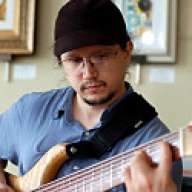
Some say that it was written for a Viola Pomposa which is said to have been invented by Bach. Others say that it was written for a 5-string Violoncello Piccolo. I don't think that anybody knows for sure. All the recordings I have use a standard 4-string Cello or 5-string Violoncello Piccolo ( pictured below ).As a footnote: you mention the sixth suite, did you know that was written for a 5-stringed cello of Bach's own invention?
One last word in my defense. Check out measures 40-43 in the Fugue in G minor for Lute BWV 1000 ( this is a difficult score to find its original version. guitar versions might not have this change ). You can see that in measures 40 and 41, the pedal D is played as normal but is then dropped an octave in measures 42 and 43. In the original version for violin, this note stays at the same pitch for the duration. I presume that this change was made to facilitate playing it more idiomatically on the Lute. Although it has been argued that this transcription was not done by Bach, it was certainly done with someone who knew what they were doing.
Check out my Bach Works Catalog at: http://www.jsbach.net/catalog/index.html which has hyperlinks between works that were transcriptions of other works.
Dave





