• TalkBass has been independent since 1998. Add your voice.
    Create a free account to reply to discussions, view embedded media, and browse with fewer display ads.
    Join freeLog in
    Want zero display ads or expanded classifieds tools? Compare plans.

PROOF! That fingerboard wood makes a difference.

This is why there can never be a definitive answer one way or another. Wood is an organic substance that is anything but consistent.

But why not? If Computational Physics is able to model heat transfer (for example), then why could it not be used to model sound energy through various materials?

The more accurate the modeling, the more complex the algorithms and physics involved (as well as computation time).

How a body blank from one end of an 8' plank can be different from the other end is something that is not really understood.

It isn't? Mass, density, and rigidity would be the primary suspects. Any others? These vary throughout the body blank (obviously).

It could prove difficult to employ highly realistic models but given that information, do you think could some/any reliable conclusions be drawn about that blank? For example, do you think it is possible that the body's resonant frequencies could be identified using this modeling (suppose the variables above are measured and provided to the model)?

As an aside,this is why I'd be really loathe to order a custom shop instrument as even with the best intentions and skill, the final sound quality is a bit of a lottery.

Agreed.
 
Last edited:
I haven't read all the responses in this thread, so apologies if someone else has already asked this:

Why would the fingerboard have any impact on tone on a fretted instrument?

I'm not saying it doesn't. But I want to hear why other folks think it should.
 
Why would the fingerboard have any impact on tone on a fretted instrument?

142.gif
 
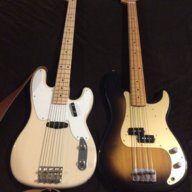
The basses in the OP sound different enough that I suspect an electronics variance.

We need a test that is the same body, pickups, strings, and tuners with 2 or more necks.
In the bottom of the two videos only the neck was changed with everything else including strings kept the same. I believe that video is unique for the extreme measures taken to keep the variables down to the neck only.
 
If one granny Smith apple has some squishy spots and one gala apple doesn't, what does that tell us about how often we can expect granny Smith apples to have squishy spots?
Yes one sample may not be representative enough to establish a rule ... thus for sure ... but there is more than one person stating that dense, oily tropical woods tend facilitate the propagation of low frequency waves and/or to exert a higher damping on a vibrating object attached to them ... thus may have an effect on the sound which to is there ... I've got four good basses (others are crappy) 2 jazz and 2 precisions ... both Precision have got s maple board and they donning sound exactly as a vintage 60s instrument with a rosewood board .. I don't believe that this is only due to the different electronics .. one jazz has got a maple fretboard the other a rosewood ... the maple one , on which I installed at least three sets of different pickups , has got definitely a snappier sound and it is much more distinguishable in the mix when slapped, for example, with respect to thd other ... thus us only my experience however
 
Why does everybody argue that unless whatever it is changes a bass guitar into a tuba it really makes no difference? Hey I gig. I have maple and Rosewood fingerboards and for sure nobody is going to walk up during a break and seriously advise me that I really should have brought the bass with the maple fretboard rather than the rosewood one because the tone needs to be a little brighter! Ok, maybe they say, "Ew! Flats! Put some nice rounds on that Fender!" But I can't even remember that ever happening! But that is not the whole issue. When I play the bass even with the rest of the band the way it feels and responds and tickles my fancy depends on subtle things like fingerboard wood. Yeah it isn't enough difference to matter to anyone else, but if I'm happy then things just go better. That's all.
That right there is the REAL point! If you feel you are playing your best,you will actually play better. i.e. regarding things like playing music, the perception of the artist really becomes reality - except when drug induced.