• TalkBass has been independent since 1998. Add your voice.
    Create a free account to reply to discussions, view embedded media, and browse with fewer display ads.
    Join freeLog in
    Want zero display ads or expanded classifieds tools? Compare plans.

Proper balanced tension strings in Europe? (brands and/or shops)

Me neither, they're a nuisance.


Find it funny, because it's IN HOUSE to you, so to speak, with inside Austria. No shipping, not vat tax, and I thought that domestic prices were fair enough for you guys.

Well, they don't sell them directly as far as I can tell and the cheapest prices are just from normal german stores. 50€ for a set of roundwounds, 60€-80€ for flats (5 string sets). And the roundwounds have a terribly low tension B string, which is weird because the flats seem perfect.
 
  • Like
Reactions: Honch
Another issue is that nobody carries short or medium scale single strings for my shortscale bass.
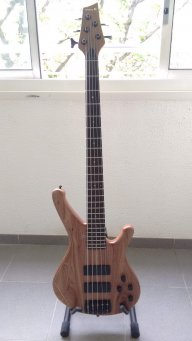
Ask Newtone about this too. Take measures of the D'addario strings CORE diameter and hand it over to Newtone. He will make different inner core diameter, which is the only thing you have to alter in order to get close to equal tension. I had E A strings on hex core and D G strings on round core, and the tension was equalled out a bit, but I skipped the equal tension strings altogheter and equaled tension out with ALL kinds of strings by buying this bass instead:

B-1005SE-MS.jpg


There's no denying that I'd rather want the tension to be equalled this way instead, cause I don't have to think ever which strings I am buying.
 
Hi Honch, we've been through this elsewhere several times already, so i direct Nohrellas to our previous discussions (see my post history) for the details.
I won't let you mislead someone with your nonsense that contradicts physics and all string manufacturers.
you can decide how thick or thin the inner core should be, in order to equal tension.
Tension (as opposed to flexibility or 'perceived tension') is determined by string mass (unit weight) only. With string mass held constant core size has no effect on tension (but it does alter the flexibility which alters the 'perceived tension').
Round cores have slightly LESS tension than hex core, if all else equal, total gauge, inner core to wrap ratio and so on.
True, if you are (wrongly but commonly) using 'tension' to refer to flexibility or perceived tension, but the scientific linear pull tension is only determined by string mass.
The definition of a 'balanced tension set' as sold by D'Addario or Kalium is 'equal scientific tensions', as in linear pull tension in lbs, therefore only string mass matters.
in order for you to gain some kind of equal tension, he knows what to do, and that is altering the inner core only in diameter although the outer gauge is the same.
Nonsense, he does not consider this 'what to do', this is just your arrogance in assuming he shares your weird beliefs.
Yes core size is important in terms of feel and flexibility, but irrelevant in terms of 'equal scientific tensions'.
He will make different inner core diameter, which is the only thing you have to alter in order to get close to equal tension
Nonsense. You need to alter string masses to create equal tensions. As long as the necessary string masses are created core size has no effect on tension.
I skipped the equal tension strings altogheter and equaled tension out with ALL kinds of strings by buying this bass instead:
A fanned fret bass does not make any bass set equal tensions, with very very few bass sets it does yes, but only if they have an exact and steady rise in tension from low to high on a non-fanned bass.
There's no denying that I'd rather want the tension to be equalled this way instead, cause I don't have to think ever which strings I am buying.
Also complete nonsense.

It's about time you admit you are wrong and accept what most here, and science, and string manufacturers will tell you. I've already linked you to the D'Addario .pdf that explains what determines tension, and any scientific resource will back that up. I learnt how to derive the string equation when i was 17 in school physics lessons, T = (UW * (2 * L * F) ^ 2) / 386.4, with scale L and pitch F constant tension T is determined by unit weight UW only.

Nohrellas, if Newtone do not know the 'unit weight' (string mass) for each of their gauges the best you can do is just buy the gauges that are known to be close to equal tensions: 40 55 75 100 135.
 
Hi Honch, we've been through this elsewhere several times already, so i direct Nohrellas to our previous discussions (see my post history) for the details.
I won't let you mislead someone with your nonsense that contradicts physics and all string manufacturers.

Tension (as opposed to flexibility or 'perceived tension') is determined by string mass (unit weight) only. With string mass held constant core size has no effect on tension (but it does alter the flexibility which alters the 'perceived tension').

True, if you are (wrongly but commonly) using 'tension' to refer to flexibility or perceived tension, but the scientific linear pull tension is only determined by string mass.
The definition of a 'balanced tension set' as sold by D'Addario or Kalium is 'equal scientific tensions', as in linear pull tension in lbs, therefore only string mass matters.

Nonsense, he does not consider this 'what to do', this is just your arrogance in assuming he shares your weird beliefs.
Yes core size is important in terms of feel and flexibility, but irrelevant in terms of 'equal scientific tensions'.

Nonsense. You need to alter string masses to create equal tensions. As long as the necessary string masses are created core size has no effect on tension.

A fanned fret bass does not make any bass set equal tensions, with very very few bass sets it does yes, but only if they have an exact and steady rise in tension from low to high on a non-fanned bass.

Also complete nonsense.

It's about time you admit you are wrong and accept what most here, and science, and string manufacturers will tell you. I've already linked you to the D'Addario .pdf that explains what determines tension, and any scientific resource will back that up. I learnt how to derive the string equation when i was 17 in school physics lessons, T = (UW * (2 * L * F) ^ 2) / 386.4, with scale L and pitch F constant tension T is determined by unit weight UW only.

Nohrellas, if Newtone do not know the 'unit weight' (string mass) for each of their gauges the best you can do is just buy the gauges that are known to be close to equal tensions: 40 55 75 100 135.

Woah, no clue what happened between you guys but okay. I'm not taking anyones word here as gospel, don't worry, and I know how string tension is calculated (in general).

In regards to roundcore vs hexcore tension, roundcore also seem to have lower tension in general ("scientific" tension) since the hex core bites into the first wrap of wire making them slightly more dense in that regard (less airgaps = more mass for the same gauge of string). You can compare the hexcore to the roundcore boomers from GHS, they have the tension calculations on their website.

I've also talked with Neil from Newtone strings over email and all that he said is that they do not have any specific experience with balanced tension strings. He advised me to use the same (or similar) gauges that I used with my daddario strings as the relative tension to each other should be fairly similar (the overall tension might be different due to materials/winding styles/core types, etc.).

Judging by Daddario strings and also GHS strings I compared all their hex core strings and also the round core boomers (since the proper calculations are done already by those companies). Yes, 040 055 075 100 135 should in all cases be fairly balanced or progressive tension which I'm fine with. I'm also pretty sure that it will work out since the standard gauges from newtone are 040 060 080 100, which is a common standard among many string manufacturers, and all of them have higher tension A and D strings. So just stepping those down a notch and going for a hefty low B should work in any case even if it's not perfectly balanced.

I ordered "Diamond" nickel plated steel roundcore strings with my desired gauges with standard winding in case anyone is curious. And yes, I'm aware that I need to be careful when installing them, bending the end 90° before cutting them so the core doesn't slip.
 
@Nohrellas you can ask Newtone while you're at it. They will reply. Instead of starting the flame between us two again, you could do a fair assessment of any person who stated/states this in another thread:

but core diameter has no effect on actual tension

... and think for yourself a bit who you should really trust. It's all I have to say, and this mudslinging between him and me, isn't something I started in this thread. It's like it's a PM fight brought up in public. You should not trust anyone, but the folks at Newtone, you should neither trust him (ixlramp,) or me in that case. You can - for example - just put the question forward to Newtone if hex core has more tension than round core strings or not. It's a yes or no question. There's not something like "real", "true","actual" or "scientific" or "perceived" tension. Or "false" tension. There's just tension. Period. If I would be him, I would block any messages from mine, so he wouldn't be as annoyed. I haven't blocked him, because I didn't think he would be that adamant on going on a crusade, like in "I take this too personal" and get OCD'd over it.

- - - - - -

That form of argumentation logical fallacy comes from anyone trying to find an ad hoc implementation to hammer down their own Weltanschauung (I know your mother tounge is German) as a matter of fact and science, only if they have they own preferential right of interpretation (like people who don't believe in global warming, and such yadayada). You know, righteousness. It works like this:

There's something in logical argumentation called "no true scotsman". You can look that one up in any Wikipedia, or real book, if you don't believe in internet garbage can information. But it's basically about this that you say, if something has happened that involves a scot, then you'd be appalled and think that no scotsman would do such a thing, but when faced with evidence that it was a scotsman, rather than admit that you're wrong you'll go instead "yes, but no TRUE scotsman would do this". And this is the point. Change out the word scotsman, to christian, muslim, Swede, Austrian, American, afro-american, or anything, and especially in this case, change it out to the word TENSION. All of a sudden, you must apply the word "true" or "actual" or "real" attached to the word tension to hammer your thing down. It's called changing the definition of the subject subjectively to avoid any guilt. It's used all the time in politics, rethorics, and polemics. An example of such a dialog that can occur:

- You can admit that everyone is children to their parents, right?
- Yes of course
- But according to Geneva convention, and UN directives, childrens work are prohibited throughout the world, right?
- Yes.
- But then no one should have to work, right?
- huh ?

In the middle of argument you change the definition of children. Without telling anyone, and it's granted that everyone knows what you mean, and you take a shot at it. Another one is this, which is more likely that happens with @ixlramp :

"Imagine Hamish McDonald, a Scotsman, sitting down with his Glasgow Morning Herald and seeing an article about how the "Brighton Sex Maniac Strikes Again". Hamish is shocked and declares that "No Scotsman would do such a thing." The next day he sits down to read his Glasgow Morning Herald again; and, this time, finds an article about an Aberdeen man whose brutal actions make the Brighton sex maniac seem almost gentlemanly. This fact shows that Hamish was wrong in his opinion, but is he going to admit this? Not likely. This time he says: "No true Scotsman would do such a thing."

No true Scotsman - Wikipedia

It's just about by changing the definition in an ad hoc fashion to exclude the counterexample.
Now, change out the word, Scotsman, to TENSION in this case and go figure. You have to attach the word "true" or "real" or "actual" or "linear" to some other word, just to avoid public embarassment.

Since you have a swift mail conversation with Newtone, why don't you ask him a simple question like that, if hex core has more tension, than round core, or if core diameter affects tension? It's a yes or no answer, and nothing "it depends" or "real" or "actual" tension or "linear" tension. It's tension. There's just tension, it's not any false, real, actual, or even perceived, or whatever. Tension. There may only be lower tension, normal tension, or high tension and everything in between.

It's very easy to do this, instead of trusting neither me nor ixlramp. It's just a few clicks away. I recommend that you should not trust neither me nor ixlramp. Put your faith in mr Silberman at Newtone, professor String and a couple more string manufacturers out there, instead.

And of course, I think you should be wary of any person that has forgotten what he wrote in past history, and can't remember if he stated this or that at all, and when someone else finds it he modifies the subject to suit his needs, in order to not be officially ridiculed. Like these ones (from another thread):

what you mean is that 'only the core is under tension' which is of course correct.

The windings are under almost zero tension because they are spirals and so stretch very easily, like a spring does. The core takes almost all of the tension

I never meant anything else. Never said anything else.
 
Last edited:
Just ask Newtone two simple questions, and come back here with the un-edited quote reply from him:

1. Does hex core has more tension than round core if all else equal? Only if ever so slightly?
2. Does inner core diameter affect tension?

Please, do come back here with the replies. I can't ask him, and put the answers up here, you know, since I am not trustworthy. I may have done an "unfair" edit... ;)
 
In regards to roundcore vs hexcore tension, roundcore also seem to have lower tension in general ("scientific" tension)

ee38c91b307b3a91b1cfd8c3d3fe07a5.png


True, if you are (wrongly but commonly) using 'tension' to refer to flexibility or perceived tension, but the scientific linear pull tension is only determined by string mass.

Oh dear! I feel yet another new feud is coming up between you and @ixlramp ! I don't mind. Let the action movie, start, I have plenty of pop corn...don't let me stop you. C'mon now...Yoicks!
 
Last edited:
Why's there no slaggin between Nohrellas and Ixlramp, now then? Nohrellas stated the exact same thing as I did, but ixlramp seems to duck this one. Two at the same time, may be too much for him. @ixlramp they are piling up now, you'd better pick that fight, it has been remarkably silent from you since @Nohrellas stated the same thing as I did, regarding hex core having more tension than round core, he even stated "scientific" within quotation marks.

Hello, where are you now? You came in here like wrecking ball, disrupting and hijacking all OP intention just by slaying another member, and when the OP stated about the same as me, you don't dare to take a dig at him as well. Beats me.

Now, come on where's your guts? ;)
 
Why's there no slaggin between Nohrellas and Ixlramp, now then? Nohrellas stated the exact same thing as I did, but ixlramp seems to duck this one. Two at the same time, may be too much for him. @ixlramp they are piling up now, you'd better pick that fight, it has been remarkably silent from you since @Nohrellas stated the same thing as I did, regarding hex core having more tension than round core, he even stated "scientific" within quotation marks.

Hello, where are you now? You came in here like wrecking ball, disrupting and hijacking all OP intention just by slaying another member, and when the OP stated about the same as me, you don't dare to take a dig at him as well. Beats me.

Now, come on where's your guts? ;)

Could you stop it? It's actually getting very silly right now. We can have a normal discussion without childish passive aggressive mentions and phrases.

Now if you want a normal discussion, he is right that tension is only related to string mass, the pitch it is tuned to and scale length. Since we're not changing the tuning or the scale length it literally just comes down to string mass. And he clearly stated that, if you keep the string mass the same, round vs hexcore makes no difference. Which is correct.

We now just need to talk about the effect that the different cores at the same gauges have on mass. It's just a matter of which string is more dense/has less air pockets inside. So it comes down to geometry. With similar core sizes, as far as I could tell, the hex core actually results in a slightly denser string since the core "bites" into the first wrap of the string. And judging by the numbers published by GHS that seems to be correct, the same gauges of GHS boomers have slightly more tension with the normal hexcore version vs the roundcores. That principle is also very easy to see with flatwound strings. Since the metal band that is used for wrapping the string results in virtually no air pockets these strings are much more dense, so a .040 flatwound string tends to have much more tension than a .040 roundwound string (as long as the materials are similar/the same). Or if you look at tapewound strings, much less tension at the same gauges because the material they use for the last wrap is MUCH less dense.

In general I don't see the point of mixing and matching round and hex core strings in the same set. Maybe if you want to specifically do tiny adjustments to the sound and feel, but I want consistency which is completely different.
 
  • Like
Reactions: HaphAsSard
And judging by the numbers published by GHS that seems to be correct, the same gauges of GHS boomers have slightly more tension with the normal hexcore version vs the roundcores
This is what I said all of the time. Please find any earlier post where I have stated something totally opposite. I've even bolded the word slightly in my posts. Now, go on and find any post by @ixlramp where he stated something that agrees with that point, that YOU have. Please still, disregard any of my posts when stating this then. You will be hard pressed to find that ixlramp agrees to this notion (by A N Y O N E) that same gauges can make for different tension, regardless of that the core is hex or round core.

It's nothing I got out of the blue. I've read D'addarios tension chart as well as GHS, as well as Newtones. Professor strings site too, which contains ample information. Professor String actually removed the FAQ chapter which dealed with these things, just because the comments and debate that followed on this, showed that it was too abstract for all/most people, and started to end up discussing all other things, than just strings. So they dodged it, in spite of that it was right, and people thought he was wrong, and some thought "it all depends..." . Mind you that ixlramp has himself stated this, in a few posts, and I do agree with him totally and is what I've said all of the time, nothing else:

what you mean is that 'only the core is under tension' which is of course correct.

The windings are under almost zero tension because they are spirals and so stretch very easily, like a spring does. The core takes almost all of the tension

Mind you, I agree with him totally here, I never meant anything else. Never said anything else. But people reads a lot more into this, that I MEANT (not said) that nothing affects tension, but the core diameter which is - of course - wrong. Tension is affected/determined by a number of things, one few of them is scale, gauge, and pitch. But whatever tension is required, and whatever affects it, I still agree totally (unconditionally) with ixramps two statements above. People have little reading comprehension, and as fast something is longer than a twitters 140 letter sentences, they think it's too much of a chore to read through, and think that as fast it is written a lot of words, it's complicated. They're reading too much into it while I just wanted to explain the same thing as ixlramps two statements which I stated above. I think it's way more misunderstanding from his side as from mine, since I actually agree, with him on the two quotes above. I don't wanted to get too deep into, it, just stating that the two examples above is written by ixlarmp and not me. See there, no one notices this, that I agree with him on the two quotes above. I don't know how to explain it in any other way, even if I write pages full of text, that one still didn't creep in.
And yet still, hex core have slightly more tension if everything else is equal, than round cores. And yes, I have still very much an urge to point out that he's selective of which ones he chooses to pick a fight with, if some other person states the same thing as me, and then he let that ones pass by. I wouldn't do anything else. Otherwise I don't think it's any reason to have any forum at all. As of this, I still wait for @ixlramp to back down on the hex core/round core differences in tension, and as long as I havent' seen this, I still will continue. It's just good to hear now, that I am not alone on this one, so as long as other people are chiming in, the list for him piles up, and eventually have to agree with D'addario, DR, Newtone, and especially GHS.