Fender still manages to pull it off thoWith modern manufacturing technology it’s almost impossible to buy a bad guitar today.

TalkBass has been independent since 1998. Add your voice.
Create a free account to reply to discussions, view embedded media, and browse with fewer display ads.
Join free Log in
Want zero display ads or expanded classifieds tools? Compare plans.
Fender still manages to pull it off thoWith modern manufacturing technology it’s almost impossible to buy a bad guitar today.



That’s interesting! Did the Coral have that sound built into the electronics somehow? I think member @JIO has a few restored Corals, but I don’t know if they can do that “Hooked On a Feeling” (B.J.Thomas) thing. Were the sitar models made on the usual Dano assembly line? Somehow I thought they were Japanese-made (not a criticism).


Tuners can be replaced at a budget price point.
Shielding takes a few moments.
Even a 10.00 china made bent plate will intimate.
“Not staying in tune” is more often due to nut, and or friction on the string tree.
The biggest fail is often unstable neck wood, and poorly implemented truss rod.
Even a 80.00 Glarry is “decent” with a bit of finessing, can be a solid player.
Both absolutely fair points, but it leads to the question of how much that budget instrument really cost you if you add up all the effort and new parts. Lets say I was going to replace the tuners in my HB. I'm not, but fine. A budget set is £30, but are they going to be meaningfully better than the ones already in there? Gotohs are £150+. The same is true for pickups. I can get a pickup for less than £50, but realistically the 'good' aftermarket ones that people buy are in the £100-£200 range. This means the £109 bass can easily end up being £300-£400, nevermind my time and effort. For £400 I can just buy a Sire or a nice Ibanez.And I could add, things like hardware and electronics can be replaced. If I see a cheap instrument on stage, I can assume that any of those parts have been checked and replaced if necessary
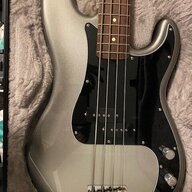
I recently bought a used CV Squier P-Bass - upgraded all the electronics and put a Fender PV63 PU in it and I am all in on this Bass for $550.00 (It came with a HSC as well)!!! The thing sounds amazing and I alternate between it and an AM ProII P bass while gigging!Both absolutely fair points, but it leads to the question of how much that budget instrument really cost you if you add up all the effort and new parts. Lets say I was going to replace the tuners in my HB. I'm not, but fine. A budget set is £30, but are they going to be meaningfully better than the ones already in there? Gotohs are £150+. The same is true for pickups. I can get a pickup for less than £50, but realistically the 'good' aftermarket ones that people buy are in the £100-£200 range. This means the £109 bass can easily end up being £300-£400, nevermind my time and effort. For £400 I can just buy a Sire or a nice Ibanez.
I agree that they still do make some real clunkers, but you've got to look pretty hard on Aliexpress or in lousy store's own brands to find a bass that isn't above the 'usability line' these days. Almost anything you can buy with a recognisable name on the headstock will be fine.
My point was more on the OP topic, assuming a certain bass is a POS. On the contrary, I assume if I see any (cheap) bass on stage, it’s been looked over and any necessary adjustments have been made to achieve a certain level of playability.Both absolutely fair points, but it leads to the question of how much that budget instrument really cost you if you add up all the effort and new parts. Lets say I was going to replace the tuners in my HB. I'm not, but fine. A budget set is £30, but are they going to be meaningfully better than the ones already in there? Gotohs are £150+. The same is true for pickups. I can get a pickup for less than £50, but realistically the 'good' aftermarket ones that people buy are in the £100-£200 range. This means the £109 bass can easily end up being £300-£400, nevermind my time and effort. For £400 I can just buy a Sire or a nice Ibanez.
I agree that they still do make some real clunkers, but you've got to look pretty hard on Aliexpress or in lousy store's own brands to find a bass that isn't above the 'usability line' these days. Almost anything you can buy with a recognisable name on the headstock will be fine.


My '68 Coral Deluxe Bass and two '68 Silvertone 1443 Hornets are all 100% Dano. The Hornets have a different electronic harness but the CDB has the two stacked pots as most Dano's. The CDB was essentially a RI of the early '60s Dano Dane E, and in no way a "cheap POS". Coral bought Danelectro in '67 and tanked in '69.That’s interesting! Did the Coral have that sound built into the electronics somehow? I think member @JIO has a few restored Corals, but I don’t know if they can do that “Hooked On a Feeling” (B.J.Thomas) thing. Were the sitar models made on the usual Dano assembly line? Somehow I thought they were Japanese-made (not a criticism).
I build my own basses, and do setups for a lot of folks in my scene. I can (and have) take a budget bass, and get it to where it'll play very well. I can't make it balance better without changing a bunch of parts, or weigh a lot less in most cases, but a lot of what makes a cheap bass cheap nowadays is they haven't put in the time to tweak things to their utmost. But the basics (done by CNC on any bass nowadays) are usually done quite well. If a top level pro likes the look of a cheap bass, and has a good tech, you can be assured that that bass is well setup, and has been tweaked to where it's a good musical instrument.I was goofing off, admiring Esh basses (of which I am a big fan), and saw a picture of Hiisi, from Lordi. He's also an Esh user.
But he hasn't always used an Esh. Check out his picture.
View attachment 7238848
Is this guy, a professional musician, really rocking a Yamaha TRBX304 on stage? Isn't that the beginner-est of beginner instruments?



 www.basschat.co.uk
I was in a band that opened up for The Dropkick Murphys. I used:I was goofing off, admiring Esh basses (of which I am a big fan), and saw a picture of Hiisi, from Lordi. He's also an Esh user.
But he hasn't always used an Esh. Check out his picture.
View attachment 7238848
Is this guy, a professional musician, really rocking a Yamaha TRBX304 on stage? Isn't that the beginner-est of beginner instruments?

My total including strings was 280 on the Debut.Both absolutely fair points, but it leads to the question of how much that budget instrument really cost you if you add up all the effort and new parts. Lets say I was going to replace the tuners in my HB. I'm not, but fine. A budget set is £30, but are they going to be meaningfully better than the ones already in there? Gotohs are £150+. The same is true for pickups. I can get a pickup for less than £50, but realistically the 'good' aftermarket ones that people buy are in the £100-£200 range. This means the £109 bass can easily end up being £300-£400, nevermind my time and effort. For £400 I can just buy a Sire or a nice Ibanez.
I agree that they still do make some real clunkers, but you've got to look pretty hard on Aliexpress or in lousy store's own brands to find a bass that isn't above the 'usability line' these days. Almost anything you can buy with a recognisable name on the headstock will be fine.
As does Gibson and RICFender still manages to pull it off tho

Thats why I want to slim down to 3..but its so tough deciding which one is the final keeper.If I can't gig with any instrument I own, I do not need it! That is just the way I see them! They are tools to me!

I'd love to offer Bonamassa an obscene amount of money to play a stock Squier onstage for an entire show. Through a Kemper modeler. I bet he wouldn't do it.Victor takes his Foderas, Joe Bonamassa takes his vintage gear just to name two.