• TalkBass has been independent since 1998. Add your voice.
    Create a free account to reply to discussions, view embedded media, and browse with fewer display ads.
    Join freeLog in
    Want zero display ads or expanded classifieds tools? Compare plans.

Questions about this Ebonol Fretless Neck

Hey all,

So I'm looking into unlined fretless necks. And I stumbled onto this:

Invalid Link Removed

I have read the term "ebonol" but only now saw it on an application, a quick look on Wikipedia told me that it "is a paper-based high pressure laminate made from layers of black paper and phenolic resin."

I like the neck, I love that the truss rod adjustment is in the headstock, but I don't know about the 9.5" radius or that it is completely finished in oil based poly.

Does ebonol need a finish on it? Could I just sand the oil finish off of the fingerboard and it still remain in good condition for years to come? I plan on using tapewounds.

Also, how does the tone of ebonol compare with that of ebony?

As for the radius, I have a 12" StewMac sanding block that I'd like to use. Can you sand ebonol, or would that be a big no-no with the layers of black paper?

I'm thinking I may just get an Allparts ebony neck, but they are twice the price and the truss rod adjustment is in the heel, which I've come to dislike.

Thanks,

Matt
 
Bought an Ibanez Ebonol finger board fretless, was not a material i had any pre-conceptions about. Had issues and i had to sand the factory finish. You can do it, ie rework the material. Me, never purchase another Ebonol instrument. Stick with wood, is my advice. Others may have had better experiences of course. At least with wood you have a fighting chance. HTH
 
As little as possible, about 4 mil ( thou' ). Believe it or not it had "fret" rattle for a fretless! There were surface disturbances at the nut end which made the relief almost impossible to set in regard what a fretless is capable of. Well set up here for engineering best practise, ie up to 1200 wet and dry to hand, plus buffing wheel to bring back the polished finish. Too much like hard work for a brand new instrument, bought in the USA and shipped o/s to me, warranty claim was not possible. Seller did not want to know in any case. Think with these things you need to weigh the cost to product quality outcomes. Hard to beat rosewood or ebony for a fretless aftermarket neck. Hope you obtain the desired outcome. Regrads
 
Ebonol is what they're using on the Squier VM fretless. From what I've heard, ebonol is similar or same as material used in bowling balls. My VM fretless is nice. I just wish it had a wider nut, like this one. As I have big hands, I tend to like wider necks at the nut.
 
As I understand it Ebonol basically the same as High pressure laminate (Formica) and is layers of craft paper (brown parcel paper) pre soaked in Phonolic resin then placed in a press and cured under heat and pressure. I have used the 12mm and 16mm for many different applications. It works very well using standard woodworking tools and can be brought to a good finish using only abrasives; it is much stronger then hard wood for fine pieces which need to endure a load. It will also take a very fine tapped thread (M3 being the smallest that I have used successfully). I think of it in terms of a cross between hard wood and aluminium. It is very stable from moisture perspective it does expand and contract with temperature variations. I did lab tests years ago but cant remember the exact figures, somewhere around 1mm per meter per 10 deg C). My 10c.
 
I don't know if I'd necessarily sand the radius down anymore. I was thinking of it it, but you're right Michael, no point in tampering with it.

I've been looking some things up and I don't know if the fingerboard is covered in oil poly. A lot of things I've read say that a lot of finishes don't work on ebonol since it isn't a wood, so it doesn't have pores, and is made with resin, which in a way, isn't that some sort of finish in itself? Does this make sense?

And I'm also now curious about the craftsmanship of Mighty Mite necks. They seem cheaper than a lot of other's. So anyone who's played an MM fretless neck, was it good, was it perfectly levelled from the factory?

Much appreciated,

Matt
 
Be surprised if the Ebonol has a coating over it in a finger board application, though it could be done, have not seen it. Richtea has some experiences with the material in question. Phenolic or SRBP material is used in printed circuit board manufacture, if Ebonol is of the same type i defer to your knowledge over mine. SRBP is very brittle and good for mass production, though in low volume use like a diy, it is not worth the small cost saving over FR4 or fibre glass pcb material. Know the above is not pertinent directly to the topic, yet it may clarify an aspect. What i did notice almost instantly, on this bass, the Ebonol was marked by the round wounds that came on the new bass. Not serious marking, however it was a mark that dulled the lustre of the finish, defeated the concept of the original purpose to purchase for me, a full lustre finger board, did not want the lines actually.

Like many choices in life, the only final property, is if you can use the material for the intended purpose. Have many examples here of 30-40 year old synthetic materials failing ( and some that are like new, having said that ). If the neck you decide upon is a standard pocket fit, and it fails, what is the overall cost to replace. Included in that equation is how much you learned along the way, often a great deal more is gained in knowledge over the actual cost of the project. Knowledge is all at times, why these forums exist. Regards.
 
Thanks again Eight,

I do intend to use flats or tapewounds on it, so I don't think they should chew through it that badly. I've actually been reading a LOT of reviews on them and most people say that they're pretty decent... Some people recommended replacing the nut, but that's not a big deal at all, but I would say that the majority feel that the neck was very straight. Also, oddly enough, the heel seems to fit perfectly in MIA Fenders and Squire's, but needs to be sanded a tad for MIMs. I don't quite get that, but I'll be putting it on an MIA, and if I need to sand it, it apparently doesn't need much.

I have read that people recommend AllParts more, but I can't seem to find one with an adjustment in the headstock... Drives me nuts.

My only question now is if the side-dots are where the fretlines would be or if they are in the middle of the frets?

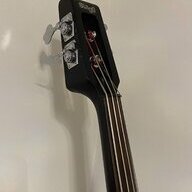
I found the pic that I attached below and it seems like they are where they should be for an unlined fretless (on the fretlines), but I'm not sure, anyone have one of these necks?
 

Attachments

  • P1160317.jpg
    P1160317.jpg
    44.5 KB · Views: 447
Have both here, side dots on the actual pitch position and in the "middle" of two pitches, for fretless, gives you something to think about while your playing, grin. Am a brass nut guy ( here we go...) slowly replacing the nuts on all the basses here that require a metal nut, my prefered material for personal desired sound. Seems your ok with that as well, Matthew 84. All the best with the project.
 
Thanks guys, yeah steel wool apparently brings her right back to a beautiful shine.

And Eight, I don't know about those side dots, the duller one (second from the last) has on odd placement, to me anyway. And at the top of the photo, it looks like there may be two dots side by side... I'm actually very confused about what I see there.