
Hey guys and gals,
So, I've been thinkin'...
I'm working on a fretless neck-through single-cut that I plan to set up with piezo bridge pick-up only.
Current and previous discussions here in the Corner concerning body stiffness in relation to tone have been interesting and educational for me, specifically:
@Bruce Johnson, you rock I guess I'm kind of calling you out for more, but I assume you enjoy participating in these discussions almost as much as I like reading your comments. And of course I would love to hear anyone's thoughts on this matter! I'm not necessarily looking for an answer (which would probably be "g'ahead and find out
  "), more of a discussion or call for ideas...
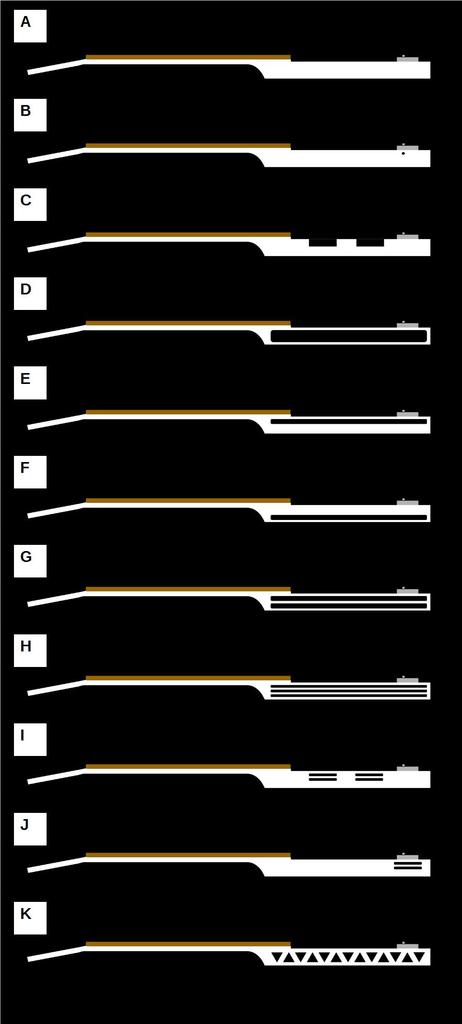
So, in the pic below
A. is what we have in hand (actually, mine's not one piece but a sandwich, but we can get into the effect of wood on the tone later...)
B. is the channel for the piezo wires, that is going in regardless (GraphTech saddles)
C. is the position of conventional magnetic pickup routes
D. balls to the wall hog-out
E-K. etc. etc. Let your imagination run wild!
What d'ya think? More? Less? Under the bridge? Not? More on the bass-side? More on the treble? Something completely different? Ever seen something like this done before? Do I want to err on too soft or too stiff when using piezo's? What's best for metal?
Thanks for reading!
So, I've been thinkin'...
I'm working on a fretless neck-through single-cut that I plan to set up with piezo bridge pick-up only.
Current and previous discussions here in the Corner concerning body stiffness in relation to tone have been interesting and educational for me, specifically:
although this^ was more about bolt-on than neck-through...That really depends on the size of the chambers you are routing. If they are relatively small, you can leave just 1/8". For larger chambers, where the span across is 2" or more, it's safer to leave 1/4". Just to keep someone from caving it in later on.
A simple way to do chambering is to rout a pattern of straight slots, parallel and leaving 1/4" to 3/8" wall between them. Make the slots like 3/8" wide and deep enough to leave 1/8" of the top surface. That's simple to rout and work with.
If you make those slots parallel to the centerline, you are turning the center area of the body into a row of little parallel I-beams. As a rough guideline, think of what percentage of the volume of wood you are removing. You are weakening the body by about half of that percentage. That is, if you are removing 50% of the wood, you are weakening the beam by around 25%. The webs and the top and back surfaces are still carrying the bulk of the load.
If you cut the slots crosswise, perpendicular to the centerline, that weakens the structure much more. That's like cutting big holes in the web of an I-beam. The top and back surfaces are still carrying the bulk of the load, but because they are thin, they could buckle. In that case, removing 50% of the wood may remove 50% of the strength. You could have structural problems. The body could bend and collapse under the load of the strings. Which is not a good thing.
In general, you are trying to weaken the body somewhat. Not drastically. As a starting point, I'd suggest removing 30% to 50% of the wood volume from the center area of the body, leaving some ribs parallel to the centerline.
Making the center area of the body weaker like this allows it to flex more with the strings, adding extra background harmonics. Because the length of this weaker zone is roughly 1/4 to 1/3 of the overall scale length, these added harmonics will tend to be in the mid-range. This is what we call warmth.
The overall purpose of my structural tricks is to make the deep lows and the highs very clear, and then add harmonic warmth in the middle. The truss rod and the rigid neck/body joint make the deep lows clear. Careful mounting of the bridge and the nut make sure the highs are clear. Chambering the body brings in that mid-warmth and keeps the overall instrument from being too cold and sterile sounding.
@Bruce Johnson, you rock
I guess I'm kind of calling you out for more, but I assume you enjoy participating in these discussions almost as much as I like reading your comments. And of course I would love to hear anyone's thoughts on this matter! I'm not necessarily looking for an answer (which would probably be "g'ahead and find out "), more of a discussion or call for ideas...So, in the pic below
A. is what we have in hand (actually, mine's not one piece but a sandwich, but we can get into the effect of wood on the tone later...)
B. is the channel for the piezo wires, that is going in regardless (GraphTech saddles)
C. is the position of conventional magnetic pickup routes
D. balls to the wall hog-out
E-K. etc. etc. Let your imagination run wild!
What d'ya think? More? Less? Under the bridge? Not? More on the bass-side? More on the treble? Something completely different? Ever seen something like this done before? Do I want to err on too soft or too stiff when using piezo's? What's best for metal?
Thanks for reading!
Last edited:



 Just a bit worried about going too far.