• TalkBass has been independent since 1998. Add your voice.
    Create a free account to reply to discussions, view embedded media, and browse with fewer display ads.
    Join freeLog in
    Want zero display ads or expanded classifieds tools? Compare plans.

Remote Extension Cab: Advisability, Issues?

eadg57

Gold Supporting Member
Sep 7, 2005
144
15
SF Bay Area
Howdy,
I am playing in a 19-piece jazz orchestra which rehearses in several locations. (No PA, no monitors.) In each case, someone usually complains that the bass is too loud, or too soft--sometimes on the same tune! Lead trumpet, lead tenor (MD), even the drummer. The rhythm section discussed the possibility of adding an extension cabinet to my combo and placing them 10' to 20' apart, hoping to meet the needs of the rhythm section and the 15 horns.

(I am playing a passive 4 string through a 200w combo. I imagine trying a matching extension cabinet connected with a high quality Neutrik cable.)

Any thoughts or experiences with this kind of situation? Cautions? Alternatives?

Thanks!

 
For the cases where they say you’re too loud, maybe one of the cabs could be a wedge, so it’s potentially louder for you?

I’m kind of considering this myself. My group practices through PA but the mix isn’t great so I bring a combo. Wondering if I should get something like a Hartke kickback, maybe something like that would work here too.
 
Bass should be pretty omnidirectional in a room large enough for a big band. I'm not sure adding another cab that far away would solve the problem and would likely introduce some issues of its own.

Have you noticed any commonalities in regards to their comments? For example, do they think you're too loud when playing on E/A strings down low on the fretboard and too quiet when you play higher or on the D/G?
 
I am playing in a 19-piece jazz orchestra which rehearses in several locations. (No PA, no monitors.) In each case, someone usually complains that the bass is too loud, or too soft--sometimes on the same tune! Lead trumpet, lead tenor (MD), even the drummer. The rhythm section discussed the possibility of adding an extension cabinet to my combo and placing them 10' to 20' apart, hoping to meet the needs of the rhythm section and the 15 horns.
i mean, nobody else is attempting to project their sound from somewhere else on stage, why should you? that's a layer of added sonic weirdness you probably don't need to try and wrestle with as a musician (i.e., not the soundguy)

i'm trying to imagine 19 musicians in one room and somebody doesn't complain about something
 
I'm not sure adding another cab that far away would solve the problem and would likely introduce some issues of its own.
yeah; first thing that pops in my head is that with two bass cabs really far apart, you end up with hot spots and dead spots scattered through the area

the players that happen to be sitting equally distant from both cabs will get hit with the most low end and probably won't like it
 
There is no perfect solution. Anything you do to improve the situation will create a different set of problems.

If the priority is to sound good to the audience, then the musicians need to accept that they won't hear everything perfectly. The volume of the bass should be set fairly close to the optimum level for the audience.

IME, musicians frequently prioritize their own needs over the audience. Adding a remote extension cab functionally the same thing as putting bass through monitors that are in different locations. It can definitely help distribute your sound more evenly across the band. It won't necessarily stop the complaints, as musicians are rarely satisfied. Also spreading out the bass like this often means the level of bass reaching the audience will be excessive.

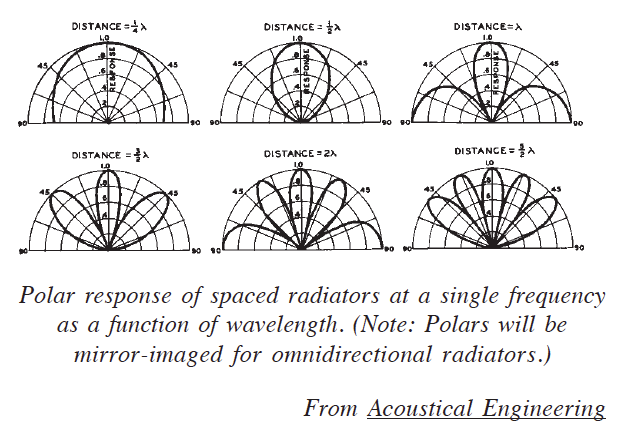
Any time you have sound sources separated by distance, you get comb filtering or lobing. These are basically two ways of explaining the patterns of destructive interference that occurs between non-coincident sound sources. The result can be that the frequency response of the bass is uneven across the audience.

Here is what I mean. The images below show lobing. There is a primary lobe that shoots straight out between the two sound course. There are also nulls and secondary lobes that shoot off at angles. The number and angles of the nulls and secondary lobes vary depending on the spacing between the sound sources and the frequency. The reason frequency is a factor is because wavelength is inversely proportional to frequency. I.E. as the frequency gets lower, the wavelength gets longer. Of course the spacing remain constant.
1775013036974.png

From one of my older posts:

The resultant pattern is based on the ratio between the spacing or distance between the drivers and the wavelength (Lambda)
upload_2022-8-14_21-20-47-png.4782575
.

Lambda
upload_2022-8-14_21-20-47-png.4782575
is just a fancy name for wavelength, and distance is the center to center spacing between drivers.

Take a look at the following patterns and there associated ratios.
Low_Directivity-polars1.png


You should see that Fig 43 is most like the pattern that occurs when Distance = 1 Lambda. Fig 44 is most like the pattern that occurs when Distance = 2 Lambda. The ratio in Figs 43 and 44 are not exactly 1 and 2, but they are close. If you are curious, wavelength of 50hz is about 22.51' and wavelength at 100hz is about 11.25'. Compare to spacing of 26.2'.
 
I’m assuming you are set up near the drumkit? In larger groups I just make sure I match the drum volume. Have your amp pointed at yourself and not the drummer (but nearby). Hopefully the horns are far enough away for you to position your amp in a direction ideal for everyone. The stage plot is probably more important to think about than having a second cabinet.

In a situation with no PA there’s bound to be horn players that complain. This is why I always wanted to learn tuba.
 
  • Like
Reactions: walterw
For the cases where they say you’re too loud, maybe one of the cabs could be a wedge, so it’s potentially louder for you?

I’m kind of considering this myself. My group practices through PA but the mix isn’t great so I bring a combo. Wondering if I should get something like a Hartke kickback, maybe something like that would work here too.
Ah, the good ol' Kickback. This was the available amp back when I played in my university's big band. Good to know that this is still in the running.

It definitely worked for me back in the late 1990s....
 
Concerns about phasing, comb filtering, etc are real but they can also happen in a room with a single sound source.

They also can happen any time a bass is run through FOH PA or stage monitors so adding a remote second cabinet is not that weird from a sound perspective. It is "out of the box" - and Sonic weirdness does happen as a result of bass running through multiple cabinets in a performance situation.

Thoughts:
Any Sonic weirdness would be primarily experience by people equidistant to the two cabinets. People closer to one will primarily experience the direct sound from one cabinet.

One thing to try is move your amp away from any nearby walls and/or get it off the floor to reduce room boundary coupling which tends to emphasize certain bass frequencies over others.

Another potential quick solution would be to reduce the deep bass below 80Hz or so using an EQ or high pass filter. The bass is too loud folks might be satisfied with less rumble and boom, and the bass is not loud enough folks could be assuaged by turning up a little.

Another option would be to get a couple wedges and a simple mixer/amp PA. Now you could run a bass DI to the PA, optionally have a couple solo mics and maybe keyboards, vocals, etc. - your amp is now your personal monitor. Stage mix is no longer your problem. Can always flip the monitors around for mains in a pinch.

If you do try a remote extension cab I'd try a monitor wedge and play around with placement. They will typically have a light bass response so you'd be doing a hybrid of my examples above. Plus you'd be 1/3 of the way to the PA option if you decided to go that way. And you could have the band pay for it :)
 
You stated that your 19 piece group practices with no PA and No Monitors. You are playing an electric bass. You are playing through a small rig. If your rig allows for it, absolutely try the extension cab. This allows you to treat the cabs like side-fills on a stage.
There is no audience to worry about, where lobing and whatnot is concerned (enlightening as that post is!!!) and you’ll increase coverage and dB’s with a second cab. Make sure your 200 watt head can handle the second cab in order to support the dB’s. Also, a low pass filter, mentioned above, isn’t a bad idea, used judiciously.
Try using them like side-fills… basically a mini monitor/pa side-fill set-up for the only electric instrument. Yes.
 
Yes, try a low pass filter. There is a lot of energy in the lowest frequencies, the LPF will reduce that. Also use the amp’s EQ to reduce the bass frequencies, if you can, boost the mids. It isn’t about what sounds good to your ear when you. are setting up the amp, it’s about how it sounds in the mix.
 
  • Like
Reactions: Ric Vice
Seconding work with the drums. If you match them so the kick and bass are even (following dynamics of course) then at least you have a clear reference.

If Joe trumpet says the rhythm section is too loud her or she may be just a crank.
 
  • Haha
Reactions: Wasnex
If Joe trumpet says the rhythm section is too loud her or she may be just a crank.
Or not a crank, but an experienced player with a legitimate complaint? It happens...assuming people are cranks before you Know is...imprudent. (not that crank karens don't exist and should be identified & stifled asap) Horn players need to be able to hear the instruments sound in their head as well as some acoustic wash from the front of the horn some of which may come from playing into the music stand. If the volume is too high, they may overblow and there goes endurance, tone and high range... when I played trumpet in a rock/americana band I had my own tiltable monitor (Ampeg B100 heavy mf) so I didn't have to share PA with vocals and wasn't tempted to overblow. I also had my own preamp/eq and effects.

The position of your amp is adjustable, and we don't know of a 2nd cab is possible given outputs and impedance. I'd advocate for a cheap 2nd combo, like a Rumble 100 or Ampeg 1/10 (which is tiltable) that way you can cut the low bass freq and accent mids (that people can hear at volume) You'll also need a line splitter, there are lots of effects with 2 high imp outputs (like stereo chorus, you don't have to turn it On.)
 
  • Like
Reactions: Chris Wilke
. I'd advocate for a cheap 2nd combo, like a Rumble 100 or Ampeg 1/10 (which is tiltable) that way you can cut the low bass freq and accent mids (that people can hear at volume) You'll also need a line splitter, there are lots of effects with 2 high imp outputs (like stereo chorus, you don't have to turn it On.)

+1 to a second combo. +2 if it tilts. +3 if it was a Powered monitor of some sort. Put someone else in charge of running it. They can place it, EQ it and adjust volume for those around them.

If you went with an extension, even if it works great, someone is 100% going to ask you to turn the bass down "over there", which also means turning the bass down where you are too. A second combo would give them local control.
...And someone else to blame. A blame spreader! 🤣
 
The tricky part is that the OP has stated that some players say the bass is too loud and others have said it's not loud enough.

A group effort to set up stage positioning is in order. IEMs may be the perfect solution, but I realize this isn't likely to happen
He didn’t say where the amp is placed though.

It sounds like he needs to set up right next to the drum kit and match that volume, so wherever the horns hear the kick from, the bass should be right there with it.