• TalkBass has been independent since 1998. Add your voice.
    Create a free account to reply to discussions, view embedded media, and browse with fewer display ads.
    Join freeLog in
    Want zero display ads or expanded classifieds tools? Compare plans.

Removing/lessening deep scratches from Rickenbacker 4003...?

facetsquared

Supporting Member
Aug 8, 2022
563
1,732
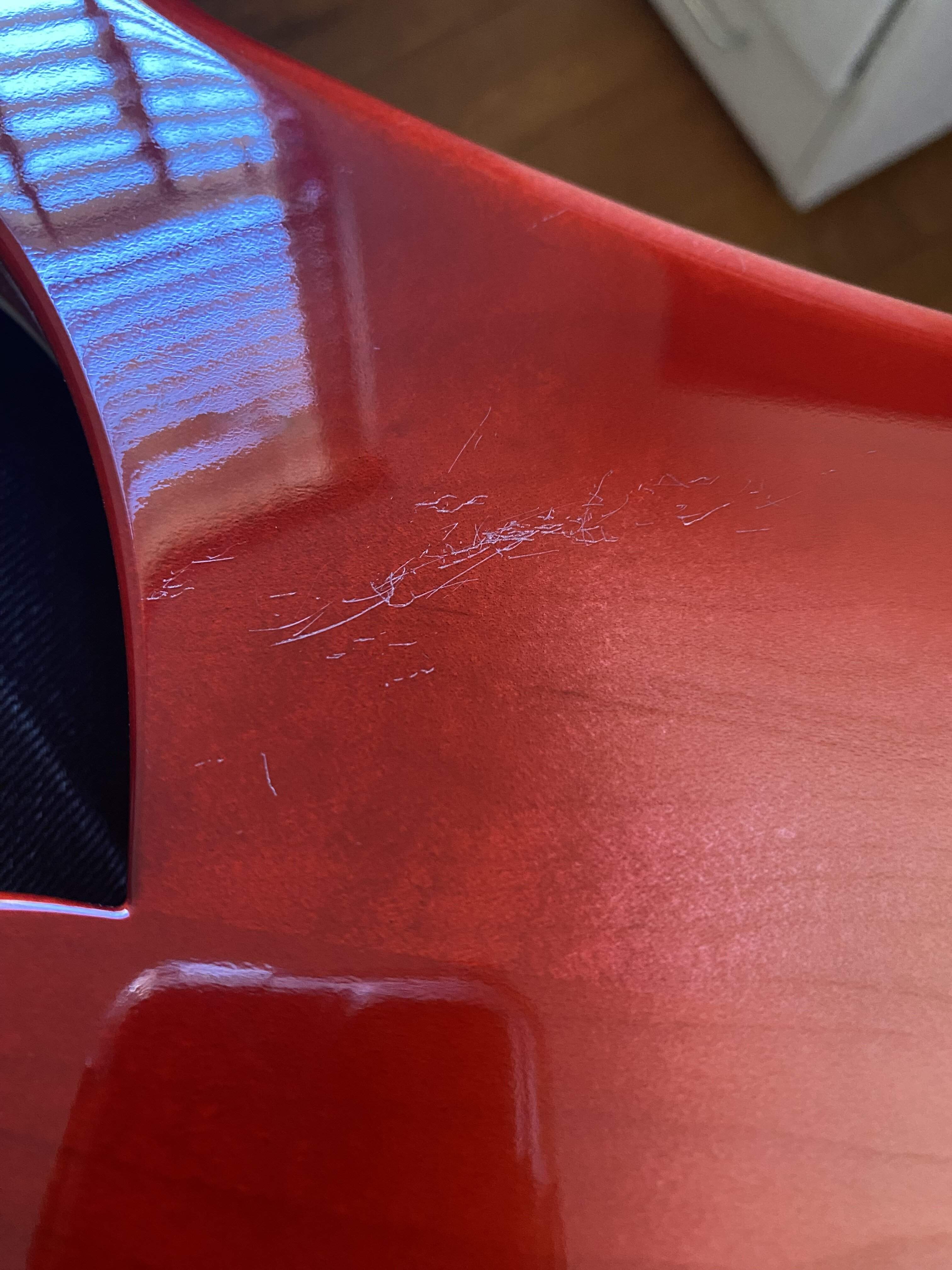
Hi all. I have a Rickenbacker 4003 (year 2002) that is in very good condition apart from some pretty nasty rash on the back. From what I remember, it was caused years ago by a zipper on a jacket that I carelessly wore.

The cluster of scratches have an almost grey/blue cast to them, and are a real eyesore. I wonder if anyone here has any suggestions of how to remove/lessen scratches like this? I'm not sure if there are any no-nos when it comes to using compounds on Rickenbacker finishes. Grateful for any advice - thank you, all.

IMG-2983.jpg
 

Attachments

  • IMG-2983.jpg
    IMG-2983.jpg
    744.9 KB · Views: 64
I use Micromesh abrasives lubricated with soap and water.

The trick is to do a test someplace inconspicuous before you attempt to sand someplace that will be seen. You're less likely to cause damage if you start with an abrasive grit that is much finer than necessary, examining the damaged area frequently with an inspection light held at a low angle to the work. Once you've established an appropriate starting grit, work your way through progressively finer grits until the job looks and feels right.

If you start with a grit that's too coarse, it's easy to inflict visible scratches that are worse than the condition you are trying to correct, or to sand through the finish entirely.

Good luck! :)
 
Well... you might want to post this question on the Rick Owner's Forum here. Lots of knowledgeable folks there. Personally? Other than attacking them with a really good auto cleaner/polish? I'd say the best thing would be - just suck it up and live with it. Rickenbacker finishes - especially since they went to the UV-cured, reduction lacquer finish - are thin, thin, thin. And quite brittle. I have 3 Ricks - a '73 4001; an '01 4003; and an '87 330 guitar. The 4001's old pre-reduction lacquer Jetglo finish is beat to Hell, but - none is missing - except for a couple of spots where most basses get dinged, and lose their finish - and there are no cracks/scratches. Lots of snail-trail marks on it - like someone put a ball bearing under a steel plate; pressed down hard; and rolled it all over the body - front and rear. But, they didn't crack the finish. The 4003? It's a COY model (Desert Gold, that year); being a rare color - and probably the only left handed anything in that color - it doesn't get played very often. It was pristine when I got it, and I try very hard to keep it that way... As for the 330? It's Fireglo finish is brittle as thin glass; look at it cross-eyed, and another piece flakes off... If it were mine? If it really, really bothered me, I'd try one of the auto scratch fillers (I've found the Nu Finish one works pretty well), and then a good coat of premium car wax. And, I wouldn't wear a jacket like that while playing...;)
 
  • Like
Reactions: facetsquared
Thanks for the replies so far, everyone. At the moment, it's a toss-up between using an auto polish like Meguiar's ScratchX 2.0, or leaving things well alone. The fact that the scratches are so conspicuous already is what gives me pause - I wonder whether polish would even make a difference. The rash is smooth to the touch, but is certainly more severe than usual hairline scratches.
 
Well... you might want to post this question on the Rick Owner's Forum here. Lots of knowledgeable folks there. Personally? Other than attacking them with a really good auto cleaner/polish? I'd say the best thing would be - just suck it up and live with it. Rickenbacker finishes - especially since they went to the UV-cured, reduction lacquer finish - are thin, thin, thin. And quite brittle.
IIRC, the OP's bass should still be conversion varnish, pre-UV cured finish.
 
Thanks for the replies so far, everyone. At the moment, it's a toss-up between using an auto polish like Meguiar's ScratchX 2.0, or leaving things well alone. The fact that the scratches are so conspicuous already is what gives me pause - I wonder whether polish would even make a difference. The rash is smooth to the touch, but is certainly more severe than usual hairline scratches.

Meguiar's Scratch X 2.0 is good stuff.
 
  • Like
Reactions: facetsquared
IIRC, the OP's bass should still be conversion varnish, pre-UV cured finish.
In a 2010 post on the Rick Forum, Jingle Jangle said that Ricks from 1959 to mid-2010 used the polyurethane conversion finish; the UV-cured polyester finish started in the last half of that year. And continues to the present. So... you are right, and I stand corrected. Although, that doesn't much help the atrocious quality of my 330 guitar's finish... Still, it does make the OP's problem easier to deal with. So, for his sake? Glad I was wrong...:rolleyes:
 
  • Like
Reactions: Jeff Scott
If I could ever figure out how to post pictures on this laptop - and from there to TB, I'd be happy to accommodate you - and, everybody else who tells me "Pics or it doesn't exist"... I could quote an old post - assuming I can find it - with a picture of all 3 of my Ricks together, but it wouldn't show the patches of missing finish. That's mostly on the back of the body, and around the tuner posts on the back of the headstock. And the heel of the neck, where the original owner punch-stamped his social security number... Believe me; I wish it was in brand new condition; especially since it's from the last year that 330's were fully chambered. And that it wasn't currently in pieces, while I try to find somebody around here I trust to re-finish it...:cool:
 
In the manual that came with my 2022 4003 it says here:
"...Polish using any non-abrasive pure carnauba based auto wax if the finish becomes stained or dull. Inexpensive Turtle Wax T-123 mixed 50/50 with water works better than most available specialty guitar polishes.
Wipe in a circular motion at the speed which is slow enough to see small water bubbles form but fast enough to remove the polish completely before drying."

Good luck, and let us know how/what you used to fix it!!
 
  • Like
Reactions: facetsquared
I use Micromesh abrasives lubricated with soap and water.

The trick is to do a test someplace inconspicuous before you attempt to sand someplace that will be seen. You're less likely to cause damage if you start with an abrasive grit that is much finer than necessary, examining the damaged area frequently with an inspection light held at a low angle to the work. Once you've established an appropriate starting grit, work your way through progressively finer grits until the job looks and feels right.

If you start with a grit that's too coarse, it's easy to inflict visible scratches that are worse than the condition you are trying to correct, or to sand through the finish entirely.

Good luck! :)

I'd pick one isolated area and trial the MicroMesh as described or with a dab of 3M Finesse-It machine polish. Check your progress frequently. Depending on the depth & severity of the blem, you could very well end up with a nice shiny spot with a scratch dead-center.

Riis
 
  • Like
Reactions: Jazzdogg
Mr. JH himself recommends Zymol, the original in the light blue bottle. The owner of the company designed it for his music instruments as well as automotive and other applications. I had a friend who gave my Gibson J-45 some pick rash and this took care of it:
Zymol.jpg
 
  • Like
Reactions: facetsquared