I was given a CCB as a repair project and would like to solicit suggestions.
First off, I have low expectations, as this is clearly a low quality item (There are no markings of origin anywhere). But I do consider myself to be pretty handy and welcome the learning experience. FWIW, I used to play DB in high school but haven't had one of my own, so this could be a transition to something nicer.
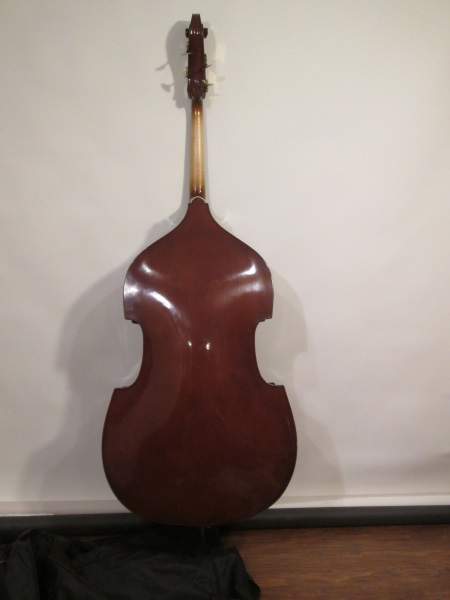
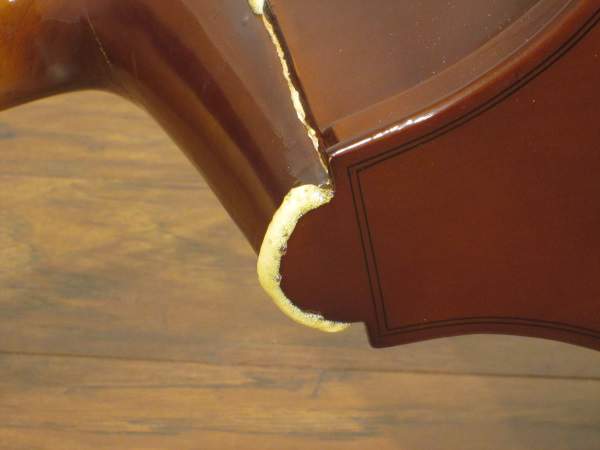
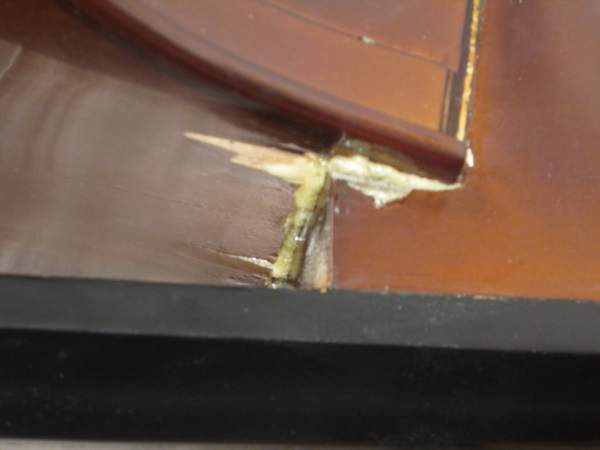
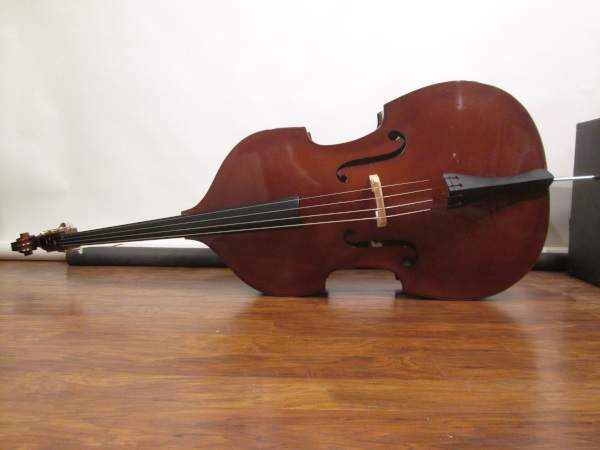
This bass suffered a broken neck joint and the original owner gave up on it. A friend grabbed it and glued the neck but never reassembled it. I saw it sitting in the garage where it had been for a year and got the bass, bridge, tailpiece, and strings separately. There is a tailpiece in place, fwiw.
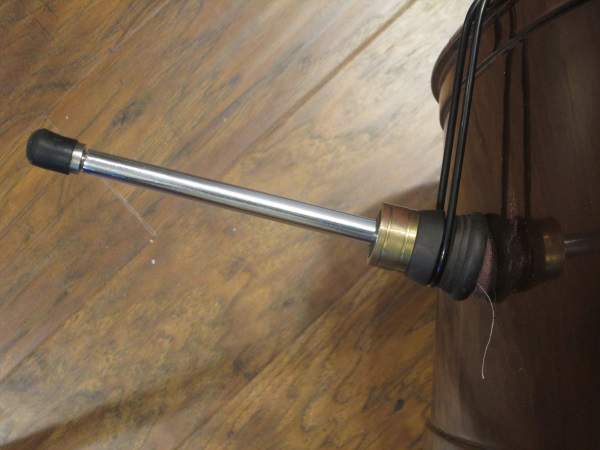
I did a dry fit and found a few significant issues (the strings are not under full tension at the moment). Other than the neck joint 'repair', the endpin plug does not seat in the hole in the bottom. The hole is about 1/8" larger in diameter, and someone tried unsuccessfully to shim it with rolled up sandpaper. (The sandpaper has chinese writing, so I wonder if it shipped that way.) The result is that the end pin shifts forward when string tension is applied and makes a horrible creaking noise. This seems to me to be the most urgent issue and I'd like to fix this first. I'm not sure the best way of approaching this, but I thought it might make sense to glue a plug into the hole with hardwood and re-drill the hole to the proper dimensions.
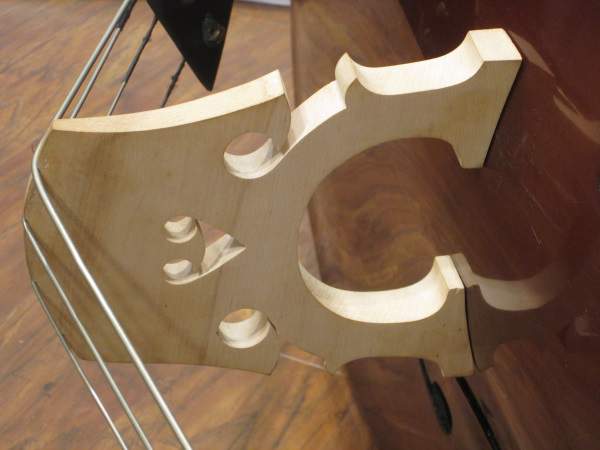
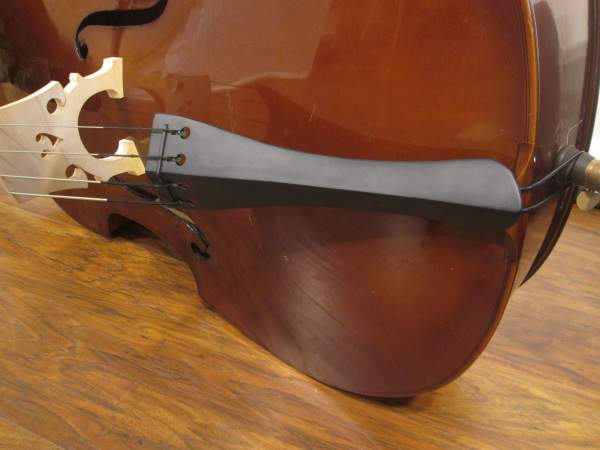
Also the bridge was never fit to the front of the bass. Kind of close, but not a proper fit. I think I can tackle this, although if the bass turns out to be playable, a proper adjustable bridge would be a better solution.
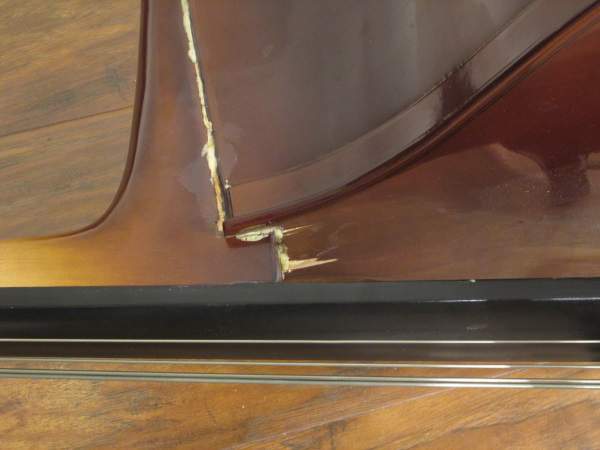
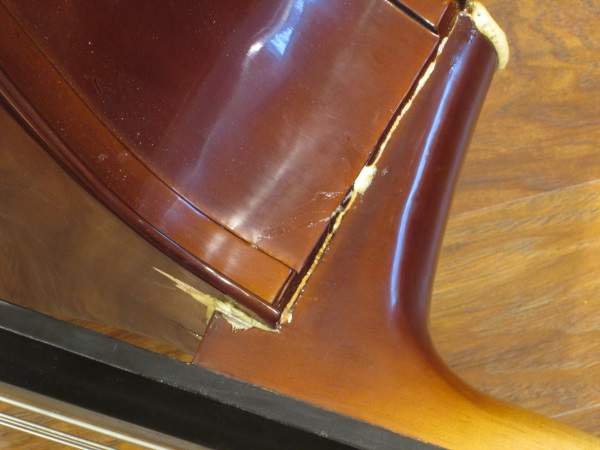
The neck joint appeared to have separated cleanly, and I see minimal wood damage due to that happening. However, it was glued with gorilla glue, and wasn't set fully. I actually think the gap will work in my favor because it will allow me to reach in and work some glue out and hopefully remove the neck in one piece. I don't look forward to doing it, but I think it will be possible to disassemble the joint and use chisels to get the glue out, then set it properly with hide glue.
I got a mirror and looked inside and while the quality is low, the seams all seem to be holding and there isn't any major cracking of the plywood. The soundpost is about 5/8" diameter and looks like it was carved with a pocket knife. The ends are adjusted to the curve of the body, however.
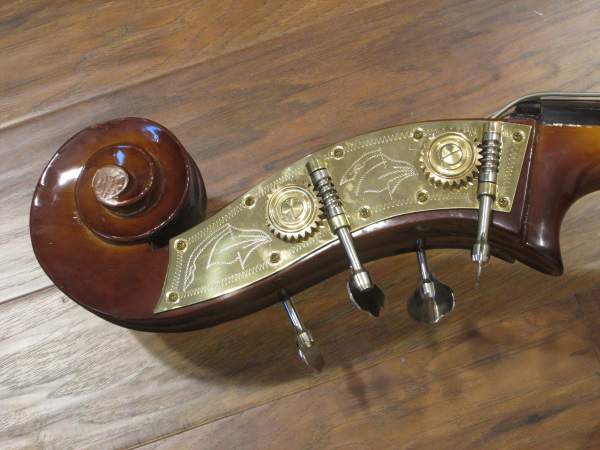
There's a bit of finish damage between the neck and fingerboard on one side, but the fingerboard doesn't appear to have separated from the neck at that point. The nut looks like it was cut with a screwdriver or other dull instrument. I haven't measured the fingerboard, but it looks fairly straight and doesn't have any obvious damage.
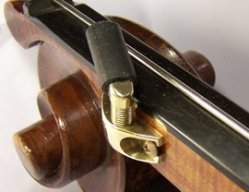
The tailpiece is metal. I am certain that I could fabricate a replacement in my workshop, depending on everything else.
Thanks for your input. My main hope is to get experience that I can carry forward. I don't think that I'll turn this into a great instrument, but if I can get it playable and learn something, I'll be happy.
First off, I have low expectations, as this is clearly a low quality item (There are no markings of origin anywhere). But I do consider myself to be pretty handy and welcome the learning experience. FWIW, I used to play DB in high school but haven't had one of my own, so this could be a transition to something nicer.
This bass suffered a broken neck joint and the original owner gave up on it. A friend grabbed it and glued the neck but never reassembled it. I saw it sitting in the garage where it had been for a year and got the bass, bridge, tailpiece, and strings separately. There is a tailpiece in place, fwiw.
I did a dry fit and found a few significant issues (the strings are not under full tension at the moment). Other than the neck joint 'repair', the endpin plug does not seat in the hole in the bottom. The hole is about 1/8" larger in diameter, and someone tried unsuccessfully to shim it with rolled up sandpaper. (The sandpaper has chinese writing, so I wonder if it shipped that way.) The result is that the end pin shifts forward when string tension is applied and makes a horrible creaking noise. This seems to me to be the most urgent issue and I'd like to fix this first. I'm not sure the best way of approaching this, but I thought it might make sense to glue a plug into the hole with hardwood and re-drill the hole to the proper dimensions.
Also the bridge was never fit to the front of the bass. Kind of close, but not a proper fit. I think I can tackle this, although if the bass turns out to be playable, a proper adjustable bridge would be a better solution.
The neck joint appeared to have separated cleanly, and I see minimal wood damage due to that happening. However, it was glued with gorilla glue, and wasn't set fully. I actually think the gap will work in my favor because it will allow me to reach in and work some glue out and hopefully remove the neck in one piece. I don't look forward to doing it, but I think it will be possible to disassemble the joint and use chisels to get the glue out, then set it properly with hide glue.
I got a mirror and looked inside and while the quality is low, the seams all seem to be holding and there isn't any major cracking of the plywood. The soundpost is about 5/8" diameter and looks like it was carved with a pocket knife. The ends are adjusted to the curve of the body, however.
There's a bit of finish damage between the neck and fingerboard on one side, but the fingerboard doesn't appear to have separated from the neck at that point. The nut looks like it was cut with a screwdriver or other dull instrument. I haven't measured the fingerboard, but it looks fairly straight and doesn't have any obvious damage.
The tailpiece is metal. I am certain that I could fabricate a replacement in my workshop, depending on everything else.
Thanks for your input. My main hope is to get experience that I can carry forward. I don't think that I'll turn this into a great instrument, but if I can get it playable and learn something, I'll be happy.