• TalkBass has been independent since 1998. Add your voice.
    Create a free account to reply to discussions, view embedded media, and browse with fewer display ads.
    Join freeLog in
    Want zero display ads or expanded classifieds tools? Compare plans.

Repairing a German Warwick

Here's a Warwick Streamer LX-5 with some damage.
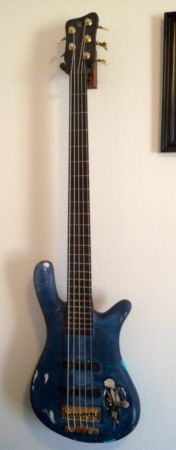
339ssa8.jpg

It's kinda hard to see, but it has a hole where the controls are.
Any tips on the repair? Like what to use and such?
I don't have a lot of experience with wood projects, other than wood shop in high school, haha.
 
Here's a Warwick Streamer LX-5 with some damage.
339ssa8.jpg

It's kinda hard to see, but it has a hole where the controls are.
Any tips on the repair? Like what to use and such?
I don't have a lot of experience with wood projects, other than wood shop in high school, haha.

I would rout out the entire cavity, and fill the rout with a solid block of wood, then glue it in place.

Rerout the cavity and paint it a solid color. Its repairable, but I think its days with a transparent finish are numbered.
 
Isn't that a fairly expensive instrument? I'm not up on the Warwick lines, so I don't know for sure, but if you're talking about an instrument worth a few thousand dollars and you don't have the woodworking experience to repair it properly, you should really consider having it professionally repaired.

The cheapest/fastest repair is probably installing a cover on top of the control cavity and having the controls mounted to that (like a J bass or other instrument with top mounted controls). After that you get into filling the cavity in some manner, such as how Hopkins described, or cutting part of the body off to replace it with as close to a matching piece of wood as you can find, both of which will require refinishing the body.
 
You could clean up the edges of the cavity from the front, cut a new piece out of thin wood to cover it, finish it to match, bevel the edges and attach it like a pickguard with gold screws. Then you can drill it for the pots and hook everything back up. I can't see what type of wood that is, but if it's flamed or birdseye or whatever, you could probably find something that would look good with it.
 
I think your best bet is to design a "control plate" that fits the bass and cut it from pickguard stock. Getting a grain and color match that doesn't look like a patch job is going to be a pretty tall order.
 
I think your best bet is to design a "control plate" that fits the bass and cut it from pickguard stock. Getting a grain and color match that doesn't look like a patch job is going to be a pretty tall order.

That's what I was thinking of doing. It would make it look ugly, but not as bad as it does now I'm sure.

Wasn't this for sale in the classifieds for super cheap a month or two ago?

It's quite possible. I haven't bought the bass yet. I plan on it if the guys goes through with the deal. He had previously been unsure he wanted to sell it.
 
Besides cutting 2x4s, I don't know much about woodworking, lol!

Anyway, might it be possible to cut out and replace the damage and cover the entire front with a really thin veneer to conceal the repair?

I know the Streamer is pretty curvy, but my Schecter Studio has a really thin veneer of bubinga on the flat part of the body top.
 
I'm pretty sure I saw this for sale awhile back. If fixed properly it could be done in a way that would barely be noticeable.

Definitely. As for the scuffs on it, I think it adds character to the bass. It got damaged in a tornado supposedly and had the neck replaced. He replaced it with a left handed neck if anyone noticed.

Honestly, I don't like having to make sure I don't scratch or scuff my instrument all the time.
 
Definitely. As for the scuffs on it, I think it adds character to the bass. It got damaged in a tornado supposedly and had the neck replaced. He replaced it with a left handed neck if anyone noticed.

Honestly, I don't like having to make sure I don't scratch or scuff my instrument all the time.

I thought those basses had asymetrical neck pockets.